

Noncompete agreements in Southern California often create confusion and conflict between employers and employees. California courts apply strict standards that make many restrictive covenants unenforceable, but disputes still arise regularly.
We at Raul Garcia Law Firm help clients navigate noncompete litigation strategies that protect their business interests while understanding the unique legal landscape of Orange County. This guide walks you through what you need to know about these agreements and how to defend your position effectively.
What Makes Noncompete Agreements Unenforceable in Orange County
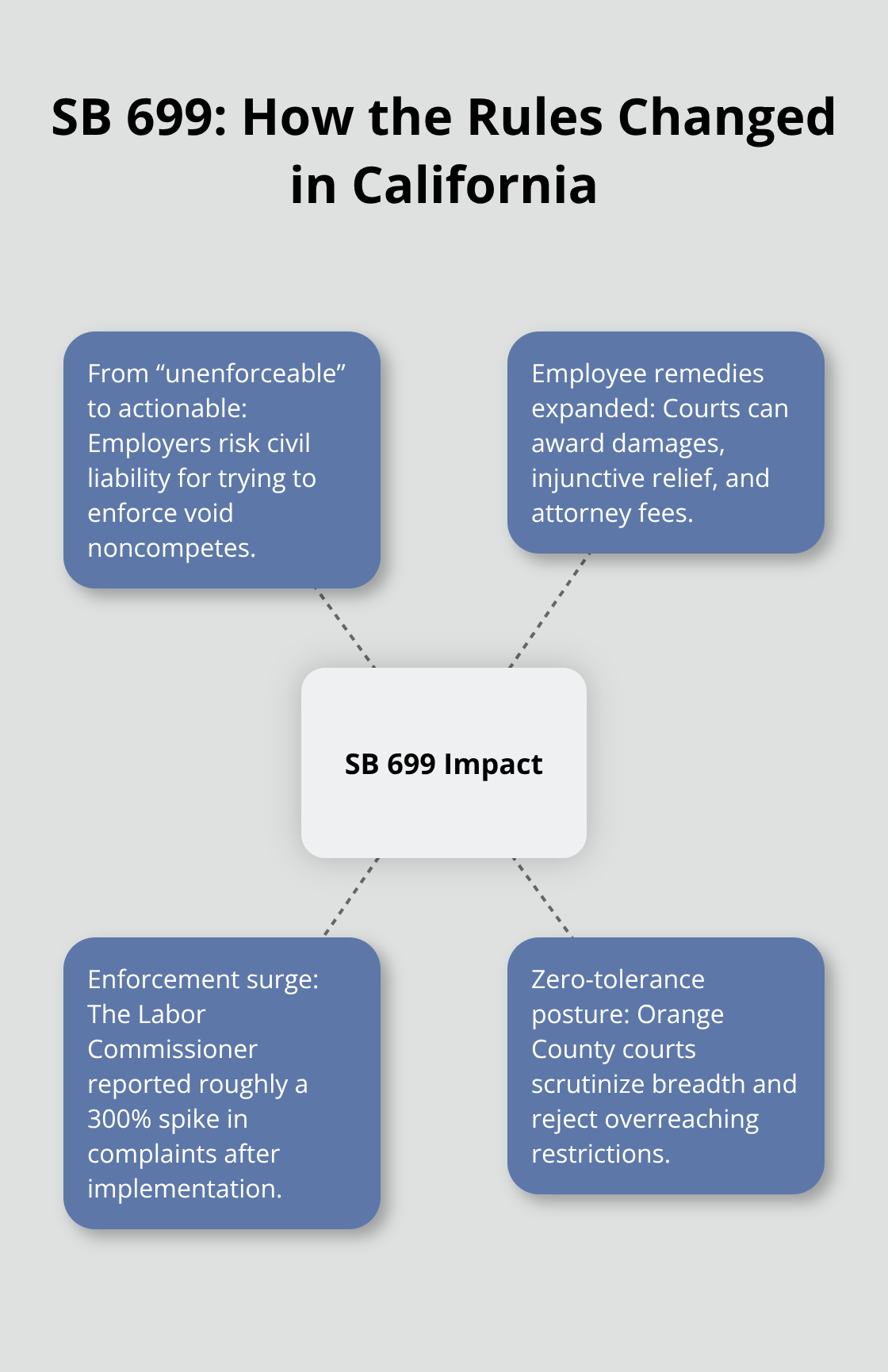
California Business and Professions Code Section 16600 has invalidated nearly all noncompete agreements since 1872, but this prohibition became dramatically more restrictive on January 1, 2024, when Senate Bill 699 took effect. SB 699 transformed noncompetes from merely unenforceable to actionable violations-employees can now sue for damages, injunctive relief, and attorney fees if an employer attempts to enforce one. The California Labor Commissioner reported a roughly 300 percent spike in worker complaints about illegal noncompetes following SB 699’s implementation, signaling heightened enforcement activity across Orange County and the state. Orange County courts apply this statute with zero tolerance for breadth.
The Extraterritorial Reach of California’s Noncompete Ban
A noncompete is void regardless of where or when the contract was signed and regardless of whether employment occurred outside California. This extraterritorial reach means that even remote workers or employees who relocated from out-of-state receive protection under California law if they have any connection to the state. The statute explicitly prohibits enforcement “regardless of whether the contract was signed and the employment was maintained outside of California,” making it nearly impossible for employers to circumvent the ban through choice-of-law provisions or jurisdictional tricks.
What Orange County Courts Actually Protect
Orange County courts distinguish sharply between what employers cannot do and what they can do. Noncompetes are dead, but trade secret protection under the Uniform Trade Secrets Act remains viable and enforceable. Courts will grant injunctions and award damages for actual misappropriation of proprietary information-the key word is actual. Generic confidentiality language that lists trade secrets without specificity fails regularly; Orange County judges demand precision.
Why Customer Non-Solicitation Agreements Fail in Orange County
Customer non-solicitation agreements fare poorly in Orange County courts following the Edwards v. Arthur Andersen LLP decision from the California Supreme Court, which declared such provisions void as backdoor restraints on competition. However, narrowly tailored protections tied to the sale of a business, dissolution of a partnership, or protection of genuine trade secrets survive scrutiny. Garden-leave arrangements-where employers continue paying employees during notice periods while limiting active work-gain traction as a practical tool that Orange County courts view favorably because they do not restrain future employment.
Drafting Agreements That Survive Orange County Scrutiny
Employment agreements that specify what information employees cannot take (customer lists, pricing data, proprietary systems) perform better than agreements that specify where employees cannot work. This distinction matters enormously in litigation. Orange County courts will enforce robust confidentiality obligations focused on identifiable trade secrets, but they will strike down vague restrictions designed to prevent competition generally. The difference between a provision that survives and one that fails often comes down to whether the language targets specific business assets or attempts to control where someone works.
Understanding these distinctions shapes how you position your case when disputes arise. Whether you defend against a noncompete claim or seek to protect legitimate business interests, the strategic approaches you adopt early in the process determine your leverage in negotiation and your strength at trial.
How to Build a Winning Position Before Trial in Orange County
Act Fast: The First 30 Days Matter
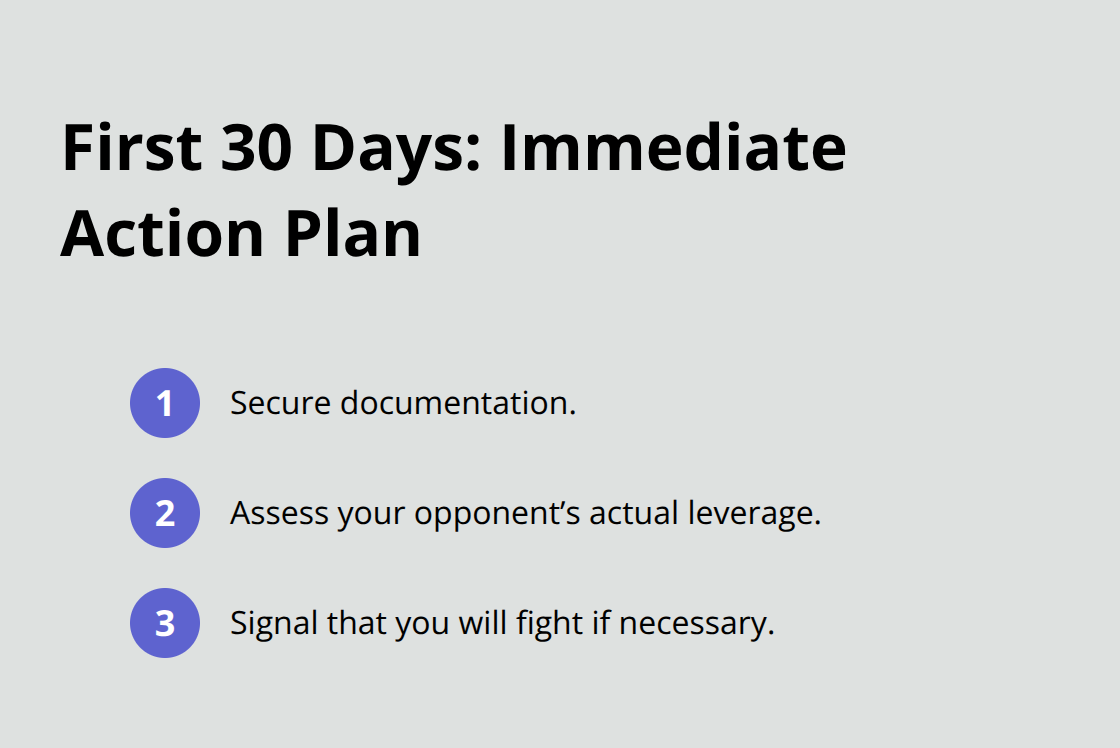
The moment an employer enforces or threatens to enforce a noncompete against you, your response determines whether you settle on favorable terms or face expensive litigation. Clients who ignore the threat or immediately capitulate make critical mistakes in the first 30 days. The winning approach requires immediate action on three fronts: securing documentation, understanding your opponent’s actual leverage, and signaling that you will fight if necessary.
Start by collecting every communication from your former employer about the noncompete, including the employment agreement itself, any email referencing the restriction, offer letters, and separation documents. Many employers in Orange County send cease-and-desist letters without solid legal footing, relying on intimidation rather than enforceability. Pull your employment file and identify what your employer claims you cannot do versus what California law actually prohibits.
Identify What Your Employer Actually Claims
If the restriction bars you from working in your field generally, it violates Section 16600 regardless of how narrowly the employer phrases it. If it restricts customer solicitation, Edwards v. Arthur Andersen LLP already decided that provision is void. Photograph or save digital copies of client lists, pricing information, and proprietary systems you developed or accessed during employment. This documentation serves two purposes: it proves what information was actually confidential and it demonstrates what you can legitimately use or reference without misappropriation.
Orange County courts require specificity about trade secrets, not generic assertions that something was confidential. The distinction between what you created versus what you merely accessed during employment becomes critical when litigation begins. Courts will examine whether you had authorized access to information and whether that information qualifies as a genuine trade secret under the Uniform Trade Secrets Act.
Send a Strategic Response Letter
Retain counsel immediately and send a response letter that rejects the noncompete as unenforceable under California law while affirming your commitment to protecting legitimate trade secrets and confidential information. This signals strength without being reckless. Many employers back down at this stage because they know SB 699 exposes them to damages and attorney fees if they pursue a void restriction.
Simultaneously, document your new employment or business activities in writing to show you are not misusing proprietary information. If you solicit clients, do so using information available in public sources like LinkedIn, industry directories, or prior relationships where the client initiated contact. Orange County employers sometimes overreach by claiming that any client contact constitutes breach, but courts distinguish between lawful competition and actual misappropriation.
Assess Your Opponent’s Real Leverage
Prepare a detailed timeline showing your role at the former employer, what you created or contributed to, and what you did not have access to. This timeline becomes invaluable if settlement negotiations stall and litigation begins. Finally, assess whether your former employer has realistic damages or whether they are bluffing about losses. If they cannot prove actual harm from your competition, their leverage collapses.
Most noncompete disputes settle within 60 to 90 days once both sides understand the legal reality in California and the cost of litigation. Your position strengthens dramatically when you demonstrate that you understand California law, that you have documented your conduct, and that you will not accept an unenforceable restriction. The next phase of strategy involves positioning your case for either settlement or trial, depending on what your opponent reveals during early negotiations.
Dismantling Weak Noncompete Claims in Orange County
Orange County employers frequently overreach when drafting noncompete restrictions, creating vulnerabilities you can exploit during litigation. The most common mistake is writing restrictions so broad that they fail immediately under California law. A noncompete that bars you from working in your entire industry, or even in a defined geographic region, violates Section 16600 regardless of how the employer phrases the language. Courts in Orange County have consistently rejected restrictions framed as protecting legitimate business interests when the language actually prevents you from lawful competition. Your defense strategy starts with identifying exactly where the restriction fails under California law, then weaponizing that failure during settlement negotiations.
Identifying Overbroad Restrictions in Orange County
If an employer’s noncompete bars you from working for any competitor within 50 miles for two years, that restriction is dead on arrival. Orange County judges will not save overbroad provisions through narrowing, despite what employers hope. The statute simply does not allow it. Document this vulnerability in your response letter immediately, because most employers capitulate once they understand their restriction cannot be salvaged through judicial modification.
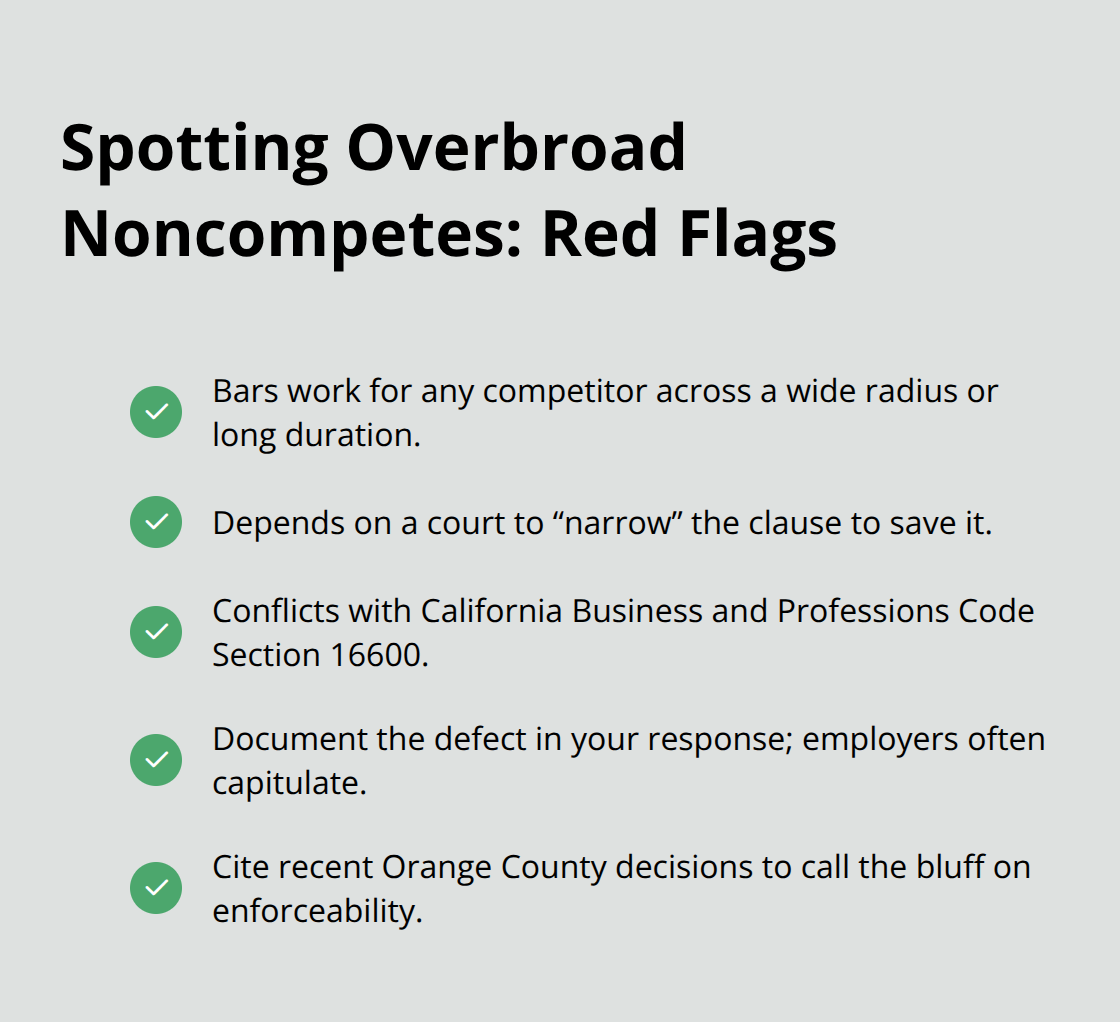
The California Labor Commissioner reported a 300 percent spike in complaints about illegal noncompetes after SB 699 took effect, and Orange County courts are processing these cases with speed and decisive rulings against employers. Your opponent likely knows their restriction is vulnerable but will bluff about enforceability to pressure settlement. Call that bluff by demonstrating specific violations of Section 16600 with citations to recent Orange County decisions.
How Orange County Courts Define Legitimate Business Interests
Employers argue they need noncompetes to protect legitimate business interests like trade secrets, client relationships, or confidential information. Orange County courts accept this reasoning only when the restriction actually targets identifiable assets rather than blanket competition bans. If your former employer claims they need to protect client relationships but drafted a noncompete preventing you from working in your field generally, the restriction fails because it goes far beyond what is necessary to protect those relationships. Courts distinguish between a narrowly tailored confidentiality agreement covering specific client lists and pricing data versus a broad prohibition on competition. The Uniform Trade Secrets Act provides the framework Orange County judges use when evaluating whether an employer genuinely needed protection.
If the information your former employer claims is confidential was not actually secret, not kept under reasonable security measures, or was known in the industry generally, no legitimate business interest exists. Gather evidence showing that what your employer called confidential information was actually common knowledge or publicly available. LinkedIn profiles, industry publications, and competitor websites often contain the same information your employer restricts. This evidence destroys the employer’s claim that a legitimate business interest justified the noncompete. Additionally, if you never actually had access to the confidential information the employer claims the noncompete protects, the restriction cannot apply to you. Your employment file, access logs, and role description become critical weapons here. If you worked in sales and never touched product development files, an employer cannot claim you need a noncompete to protect engineering trade secrets. Orange County courts view such overreach as pretextual restraint on competition, not legitimate protection of business assets.
Why California’s Public Policy Defeats Employer Arguments
California’s policy favoring employee mobility and competition runs deeper than most business owners understand. The state deliberately chose in 1872 to ban noncompetes, not because the restriction was technically unenforceable in narrow circumstances, but because California wanted workers to move freely and start competing businesses. SB 699 hardened this policy by making noncompete enforcement a civil violation exposing employers to damages and attorney fees. Orange County courts apply this public policy aggressively, treating noncompetes as suspect restrictions that must fail unless an extremely narrow exception applies.
The sale-of-business exception exists only when you actually sold your ownership interest in a company and agreed not to compete as part of that sale transaction. Partnership dissolution exceptions apply only in limited circumstances where a departing partner receives compensation for leaving. These exceptions do not apply to ordinary employment relationships. When an employer argues that the public policy against restraints should yield to their business needs, Orange County judges reject that argument categorically. Your defense should emphasize that California’s policy is not a default rule subject to override by contract language-it is a mandatory protection that employers cannot negotiate around.
If your former employer included language attempting to waive California’s public policy or choose another state’s law to govern the noncompete, that waiver is void and unenforceable. Courts will not honor choice-of-law provisions designed to circumvent Section 16600. The FTC struck down its nationwide noncompete rule in August 2024, recognizing that broad employment restraints harm worker mobility and economic competition. Orange County courts have embraced this reasoning for decades. Position your defense around this strong public policy rather than narrow technical arguments about whether the restriction might protect some legitimate interest. The law favors you fundamentally, and that advantage becomes your foundation for settlement or trial.
Final Thoughts on Orange County Noncompete Litigation Strategies
California law fundamentally favors your mobility and competition, and noncompete litigation strategies in Orange County succeed when you recognize this advantage. The 300 percent spike in worker complaints about illegal noncompetes following SB 699 shows that employers continue testing boundaries they should not cross, yet most disputes settle once both sides understand the legal reality and the cost of litigation. Your position strengthens dramatically when you act within the first 30 days by securing documentation, understanding your opponent’s actual leverage, and signaling that you will defend your right to work.
If you face a noncompete threat, demand specificity about what information qualifies as a genuine trade secret under the Uniform Trade Secrets Act, because generic assertions fail in Orange County courts. Employers who shift from blanket noncompetes to narrowly tailored confidentiality agreements and robust trade secret protections position themselves far better for litigation and settlement. The California Labor Commissioner and Orange County judges process these cases with speed and decisive rulings, making bluffing about enforceability a losing strategy.
The strategic decisions you make early determine your leverage in negotiation and your strength at trial. We at Raul Garcia Law Firm represent businesses, owners, and professionals in complex commercial disputes, and we can help you develop a noncompete litigation strategy that protects your interests under California law. Contact us to discuss your specific situation today.