

Your business depends on staying ahead of competitors. When employees leave or partners breach agreements, restrictive covenant litigation becomes your shield against unfair competition and lost revenue.
At Raul Garcia Law Firm, we help Orange County businesses enforce these agreements and recover what’s rightfully theirs. This guide walks you through enforceability standards, litigation strategies, and how to draft covenants that actually hold up in court.
What Are Restrictive Covenants and Why They Matter in Orange County
Restrictive covenants are contractual promises that limit what someone can do after an employment relationship or business transaction ends. In Orange County, these agreements typically fall into five categories: non-compete clauses that prevent former employees from working for rivals, non-solicitation provisions that block recruitment of staff or customer poaching, confidentiality agreements that protect trade secrets and business information, customer non-solicitation restrictions that safeguard client relationships, and employee non-recruitment clauses that prevent talent raids.
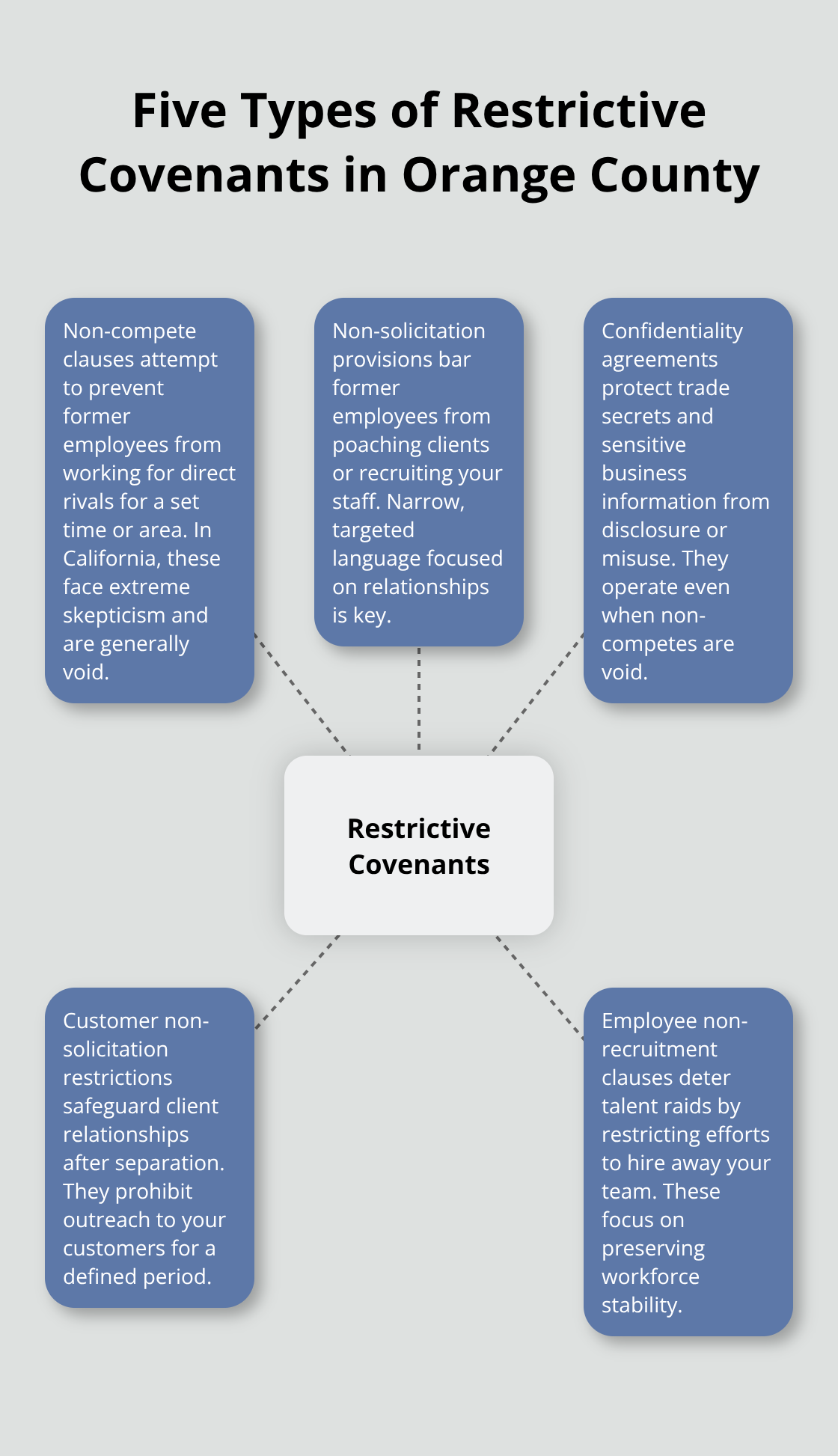
California law treats non-competes with extreme skepticism under Business and Professions Code Section 16600, which has voided such agreements since 1872. However, non-solicitation agreements, confidentiality provisions, and trade secret protections remain enforceable when properly drafted. The distinction matters enormously because a poorly worded agreement that tries to function as a non-compete will fail entirely, leaving your business exposed. Courts in Orange County examine whether restrictions protect legitimate business interests like customer relationships, confidential information, or trade secrets before deciding whether to enforce them.
Why Violations Cost More Than You Think in Orange County
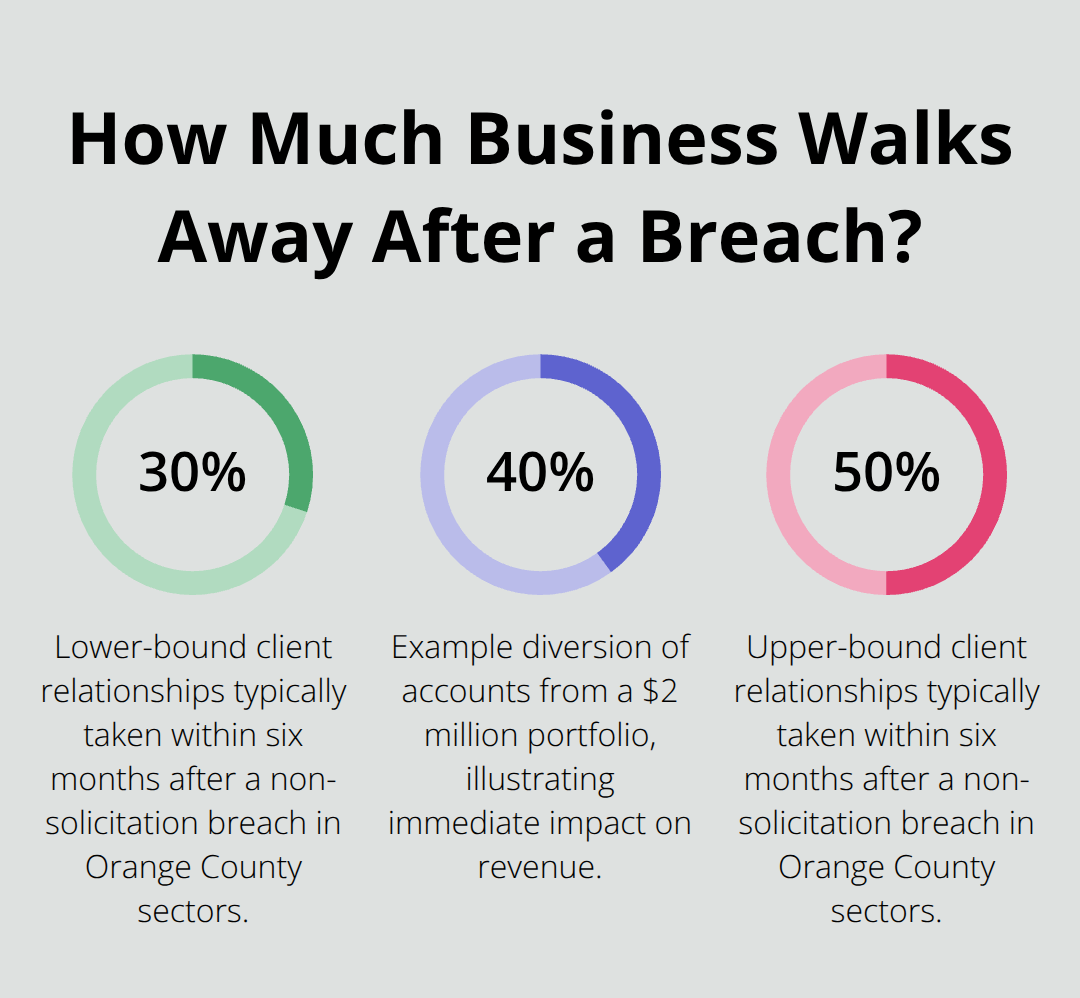
When someone breaches a restrictive covenant, the financial damage extends far beyond direct lost revenue. The American Management Association found that companies experiencing trade secret theft lose an average of 2.7 years of competitive advantage in their market segment. In Orange County’s competitive tech and professional services sectors, departing employees who violate non-solicitation clauses typically take 30 to 50 percent of their client relationships with them within the first six months. These losses compound quickly: if a mid-level manager with a $2 million client portfolio leaves and diverts just 40 percent of accounts, that represents $800,000 in immediate revenue loss plus the cost of rebuilding those relationships.
Beyond revenue, covenant breaches damage internal morale because remaining staff see that departing employees face no consequences for stealing clients or trade secrets. The cost of litigation to stop the violation-typically $50,000 to $150,000 in attorney fees and court costs for preliminary injunction fights alone-often seems high until you calculate what inaction costs. Orange County businesses that wait too long to act allow competitors to establish customer relationships that become nearly impossible to recover through litigation later.
When Disputes Actually Happen in Orange County
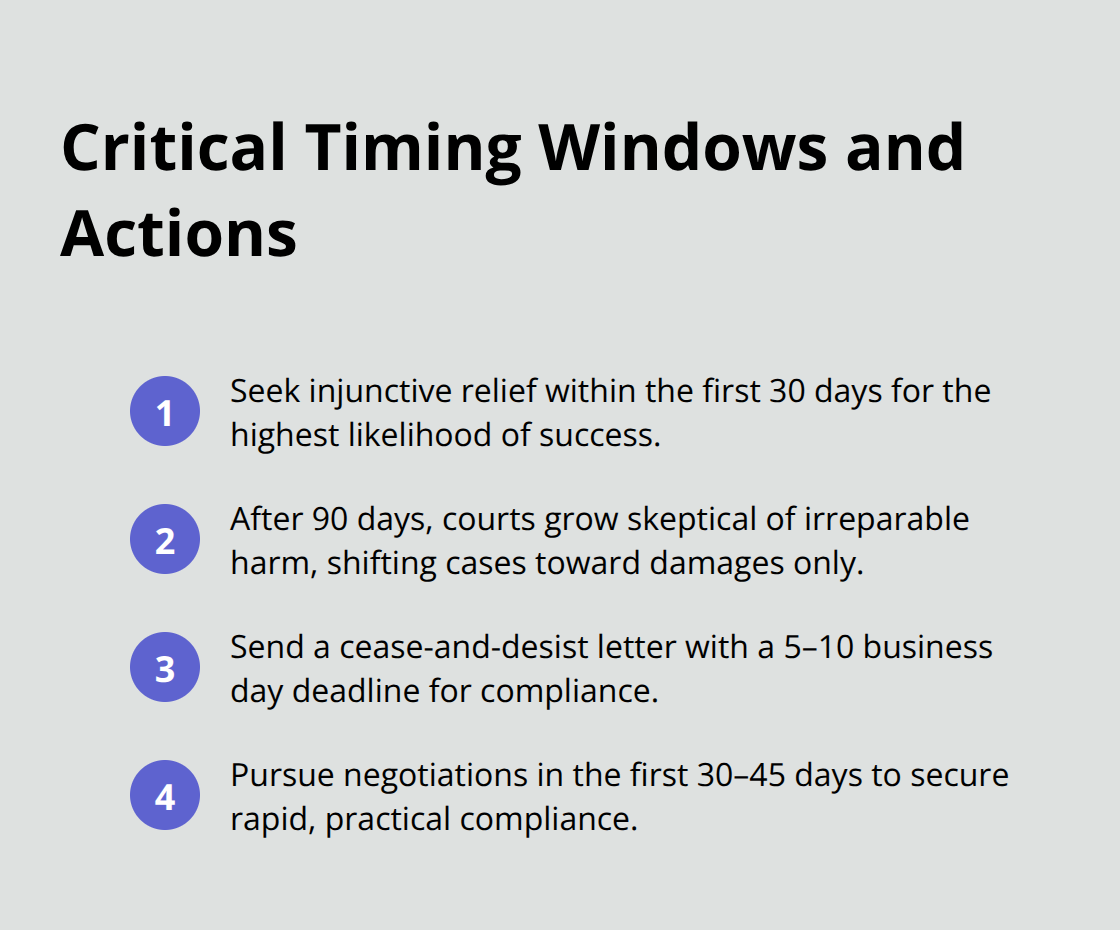
Restrictive covenant disputes in Orange County arise most frequently in three scenarios. First, a key employee leaves to start a competing business or join a direct rival, immediately contacting former clients or recruiting team members. Second, a business acquisition includes non-compete obligations that the new owner either ignores or interprets too narrowly. Third, departing contractors or consultants misuse confidential processes, pricing data, or customer lists they accessed during their engagement. Real estate and commercial transactions generate their own covenant disputes when property owners restrict land use or when buyers attempt to circumvent seller-financed transaction terms. The timing of these disputes matters critically: the first 30 days after a breach occurs are when injunctive relief is most effective and most likely to succeed. After 90 days, courts become skeptical that irreparable harm still exists, making damages the only remaining remedy. This narrow enforcement window means that immediate legal action separates businesses that recover from those that lose millions.
Understanding what restrictive covenants protect and how quickly violations can damage your bottom line sets the stage for the next critical question: which agreements actually hold up in court under California law?
Enforceability Standards and Legal Framework in Orange County
California’s approach to restrictive covenants is ruthless toward non-competes and permissive toward everything else. Business and Professions Code Section 16600, enacted in 1872, voids any agreement that restricts someone from engaging in a lawful profession, trade, or business. This means a traditional non-compete clause that prevents an employee from working for competitors within a certain geographic area or time period will fail completely in Orange County courts, regardless of how reasonable it sounds. SB 699, which took effect January 1, 2024, reinforced this by explicitly prohibiting non-compete enforcement even if the contract was signed outside California or the work occurred outside California. The statute gives employees a private right of action to sue employers who attempt to enforce these agreements and recover attorney fees. If your agreement contains language that restricts someone from competing after employment ends, it will not survive a California court challenge.
Non-Solicitation Agreements Remain Enforceable in Orange County
The law distinguishes sharply between non-competes and non-solicitation agreements. A non-solicitation clause that prevents an employee from recruiting your staff or soliciting your customers remains enforceable when it is narrowly tailored to protect legitimate business interests. Courts in Orange County analyze whether the restriction reasonably protects customer relationships, trade secrets, confidential information, or substantial relationships with prospective or existing clients. The difference between an unenforceable non-compete and an enforceable non-solicitation often comes down to precise language: instead of saying someone cannot work for competitors, say they cannot solicit your clients or employees for a defined period.
Trade Secret Protection Operates Independently in Orange County
Trade secret protection operates independently from restrictive covenants and provides stronger legal footing in Orange County litigation. California’s Uniform Trade Secrets Act defines a trade secret as information that derives independent economic value from not being generally known and is kept secret with reasonable efforts. The federal Defend Trade Secrets Act broadens this to include patterns, plans, designs, prototypes, techniques, and source code, creating parallel protections for misappropriation cases that involve interstate commerce. Courts assess trade secret status by examining whether the information is known in the industry, the cost and effort to develop it, how easily competitors could duplicate it, the actual secrecy measures in place, and the competitive value to others. A customer list qualifies as a trade secret only if it contains non-public information like pricing arrangements, contact preferences, or purchasing patterns that a competitor could not easily compile. Generic customer names alone do not receive trade secret protection.
The Four-Part Test Courts Apply in Orange County
When evaluating enforceability, Orange County courts apply a four-part test. They examine the scope and duration of the restriction, its geographic reach, the employee’s access to confidential information, and whether the restriction protects a legitimate business interest. A restriction that lasts two years across all of California protecting customer relationships after a salesperson departs will survive scrutiny far more readily than a five-year statewide non-compete. Courts also consider the employee’s role; restrictions on executives and high-level employees receive more favorable treatment than those on junior staff.
The Blue Pencil Rule Salvages Overbroad Agreements in Orange County
If an agreement is overbroad but contains enforceable core provisions, Orange County courts apply the Blue Pencil Rule, which allows them to modify the agreement rather than void it entirely. This means a court can narrow an overly broad geographic area or shorten an excessive time period to salvage the restriction. A court can also rewrite language that functions as a disguised non-compete into a legitimate non-solicitation provision. Restrictive covenants that survive California scrutiny are those that specifically identify what they protect, limit their scope to legitimate business interests, and avoid any language that functions as a non-compete in disguise.
Understanding which agreements hold up in court sets the foundation for the next critical step: building a litigation strategy that actually stops the violation and recovers your losses before competitors establish permanent footholds in your market.
Litigation Strategies for Protecting Your Competitive Interests in Orange County
The moment you suspect a restrictive covenant violation, most Orange County business owners wait too long before acting. This hesitation costs millions. Courts measure irreparable harm by whether the violation is ongoing and whether money damages can adequately compensate you later. After 90 days of inaction, judges become skeptical that harm still qualifies as irreparable, shifting your case from potential emergency injunctive relief to a damages-only claim that takes years to resolve.
Document the Violation Immediately in Orange County
The first action you need is documentation that proves the violation occurred and that it causes real competitive injury. Start by preserving all communications: emails showing the departing employee soliciting clients, text messages discussing customer transfers, LinkedIn activity indicating recruitment of your staff, or evidence they downloaded files before leaving. If a former employee joined a competitor, document which specific clients they contacted within 30 days of departure and track revenue losses from those accounts.
One Orange County software company discovered a departing engineer downloaded their entire proprietary codebase two hours before resignation; that timestamped evidence became the foundation for an emergency injunction that stopped the competitor from using the technology. Without that documentation, the case would have been circumstantial and weak. Create a detailed loss calculation showing which clients left, when they left, what revenue they represented, and the margin you lost. The Society for Human Resource Management reports that replacing lost client relationships costs 50 to 200 percent of the annual value of that relationship, accounting for sales effort, relationship rebuilding, and competitive disadvantage. Courts take this seriously when you present it with specifics rather than estimates.
Send a Cease-and-Desist Letter Before Filing Suit in Orange County
Before filing suit, most violations stop through a cease-and-desist letter that makes the violation explicit and demands immediate compliance. A well-crafted demand letter from an attorney carries weight that internal communications do not. The letter should identify the specific covenant provision being violated, describe the conduct in detail with dates and client names, quantify the damage to your business, and demand cessation within a defined period (typically five to ten business days). Many violations stop here because the violating party realizes they cannot win in court and the cost of defense exceeds any benefit from continuing.
If the violation continues after your demand letter, you have established bad faith and strengthened your position for emergency relief.
Negotiate Settlement Terms in Orange County
When negotiations occur, focus on what the other party actually cares about: their ability to work, their reputation, their legal costs. A former employee earning $120,000 annually will reconsider client poaching if they face $100,000 in legal defense costs and potential damages liability. Settlement discussions often succeed when you offer a path forward that allows them to work elsewhere while respecting your legitimate business interests. Offer a shorter restriction period in exchange for immediate compliance, or agree to release them from certain covenant obligations if they return confidential materials and cease solicitation. These negotiations typically happen in the first 30 to 45 days after discovery and before formal litigation begins.
Pursue Discovery and Evidence Collection in Orange County
If settlement fails, you move to discovery and evidence collection, where you obtain the violating party’s communications, client lists, financial records, and device activity through formal legal process. This is where you prove the violation definitively rather than rely on circumstantial evidence. Courts grant discovery requests that target specific information about client contacts, revenue transfers, and competitive harm. The violating party’s own emails and records often provide the strongest proof of intentional breach. Device forensics can establish when files were downloaded or when communications occurred, creating an irrefutable timeline of misconduct.
Final Thoughts on Protecting Your Competitive Edge in Orange County
The strongest defense against restrictive covenant violations starts long before disputes arise. You need to draft clear agreements that California courts will actually enforce, which requires precision: define exactly what information qualifies as confidential, specify which customer relationships you protect, set reasonable time limits tied to legitimate business interests, and avoid any language that functions as a disguised non-compete. Non-solicitation provisions work better than non-competes because they target specific harms rather than blanket restrictions on employment, and you should include detailed confidentiality obligations that survive employment termination, require return or destruction of materials upon departure, and establish clear consequences for breach.
Preventative measures inside your business matter equally because they deter violations and create evidence if violations occur anyway. You should conduct exit interviews that remind departing employees of their obligations and collect all company materials before they leave, implement role-based access controls so employees only see information necessary for their jobs, and monitor suspicious activity like unusual file downloads or after-hours access before someone resigns. Courts in Orange County examine whether your protective measures were reasonable when deciding whether information qualifies as a trade secret, so document your safeguards through access restrictions, password protections, role-based permissions, and confidentiality policies that employees acknowledge in writing.
When violations happen, the 30-day window after discovery determines whether you recover through injunctive relief or settle for damages years later. You must act immediately by documenting the breach, sending a cease-and-desist letter, and consulting counsel about emergency relief options, since most violations stop through negotiation once the violating party understands the legal and financial consequences. Contact Raul Garcia Law Firm to review your agreements, respond to violations, or defend against claims in restrictive covenant litigation before disputes escalate into costly litigation.