

Orange County’s business landscape moves fast, and contract disputes can derail even solid companies. Whether you’re dealing with real estate disagreements, partnership conflicts, or vendor issues, understanding your options matters.
We at Raul Garcia Law Firm help Orange County businesses navigate these disputes with clear strategies tailored to local courts and market conditions. The right approach early on can save you time, money, and relationships.
How Orange County’s Court System Shapes Your Contract Dispute Strategy
The Four-Part Test and Damages Framework
California contract law applies a four-part test across all disputes: a valid contract existed, you performed your obligations, the other party failed to perform, and that failure caused you measurable harm. Civil Code § 3300 and § 3301 govern damages, requiring them to be clearly tied to the breach and reasonably foreseeable. This framework applies uniformly across California, but where your case lands matters enormously for timeline and cost.
Orange County’s Four Distinct Court Venues
Orange County has four distinct court venues, and filing in the wrong one adds months and thousands in legal fees. Complex business cases with multiple parties or damages exceeding $25,000 go to the Civil Complex Center in Santa Ana under California Rules of Court Rule 3.400, where judges manage discovery tightly and expect sophisticated motion practice. Non-complex cases file at the Central Justice Center in Santa Ana, while limited-jurisdiction matters under $35,000 scatter across North Justice in Fullerton, Harbor Justice in Newport Beach, or West Justice in Westminster.
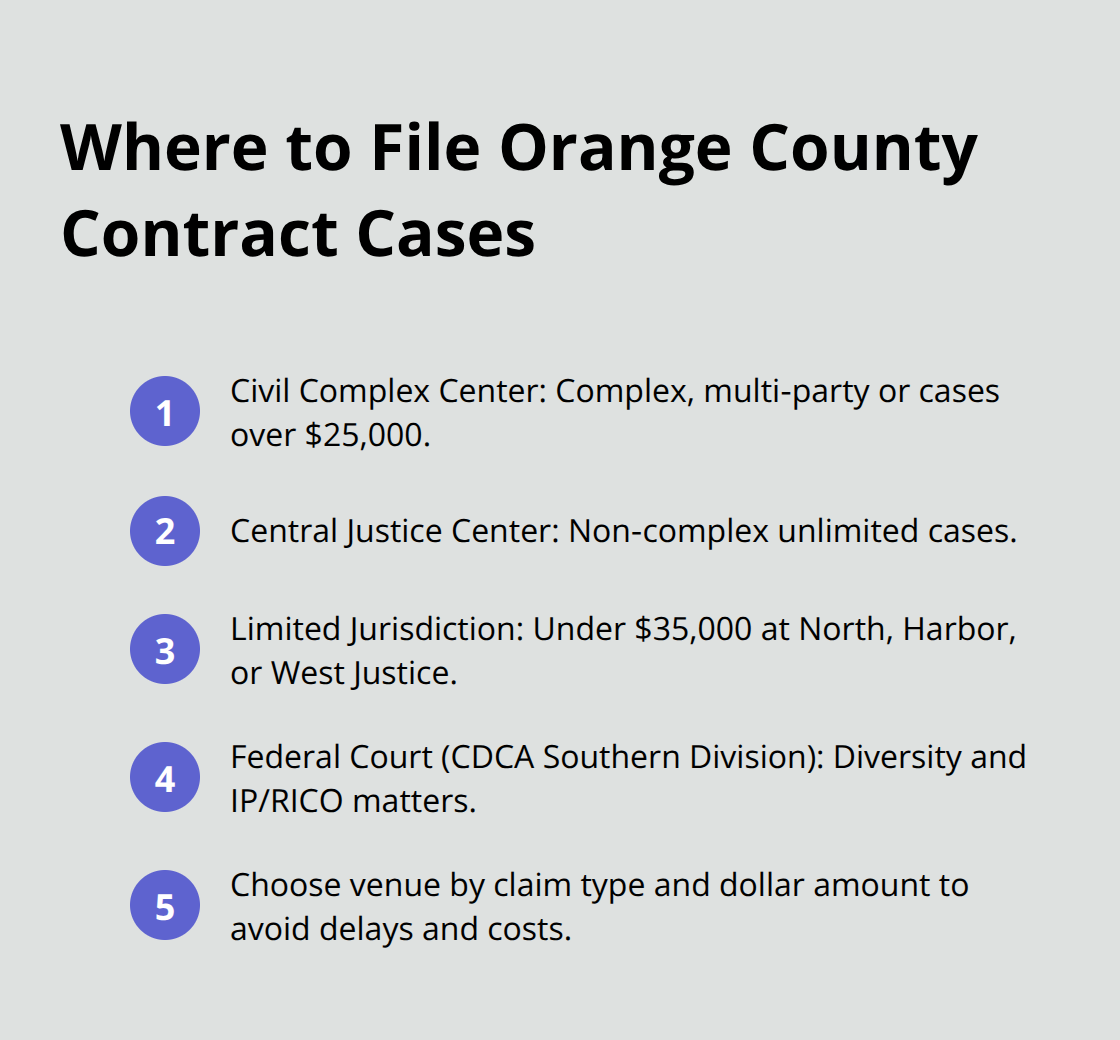
Federal diversity cases involving Orange County businesses land in the Central District of California, Southern Division, where trademark, copyright, and RICO claims originate. This venue fragmentation means your contract dispute strategy depends partly on the dollar amount and claim type before you even hire counsel.
Industry-Specific Dispute Patterns Across Orange County
Orange County’s business clusters generate predictable dispute patterns that shape how you should structure preventive contracts and early resolution tactics. The Irvine and Newport Beach tech and medical-device sector produces IP and non-compete disputes; Costa Mesa retail and hospitality creates payment and service-performance conflicts; Huntington Beach and Long Beach manufacturing and logistics centers spawn equipment-lease and operational-support claims; and South Orange County family-owned businesses face shareholder and succession disagreements. A $50,000 vendor non-payment issue demands different tactics than a $5 million partnership dissolution, and local counsel familiar with Orange County judges and opposing counsel networks identifies settlement opportunities faster than outside firms.
Building Your Pre-Litigation Strategy
Early demand letters, preservation of emails and invoices, and strategic choice between negotiation, mediation, arbitration, or litigation all hinge on understanding which court would handle your case and what outcomes others in your industry have achieved. The specific performance remedy applies when compelling performance is essential and damages alone won’t suffice. Arbitration clauses often provide faster, binding outcomes with limited appeals compared to court litigation. Your contract’s language-including attorney-fee clauses, arbitration provisions, and venue terms-shapes the entire path to resolution and influences leverage before you file suit.
Three Dispute Patterns That Define Orange County Contract Problems
Real Estate Disputes and Performance Gaps
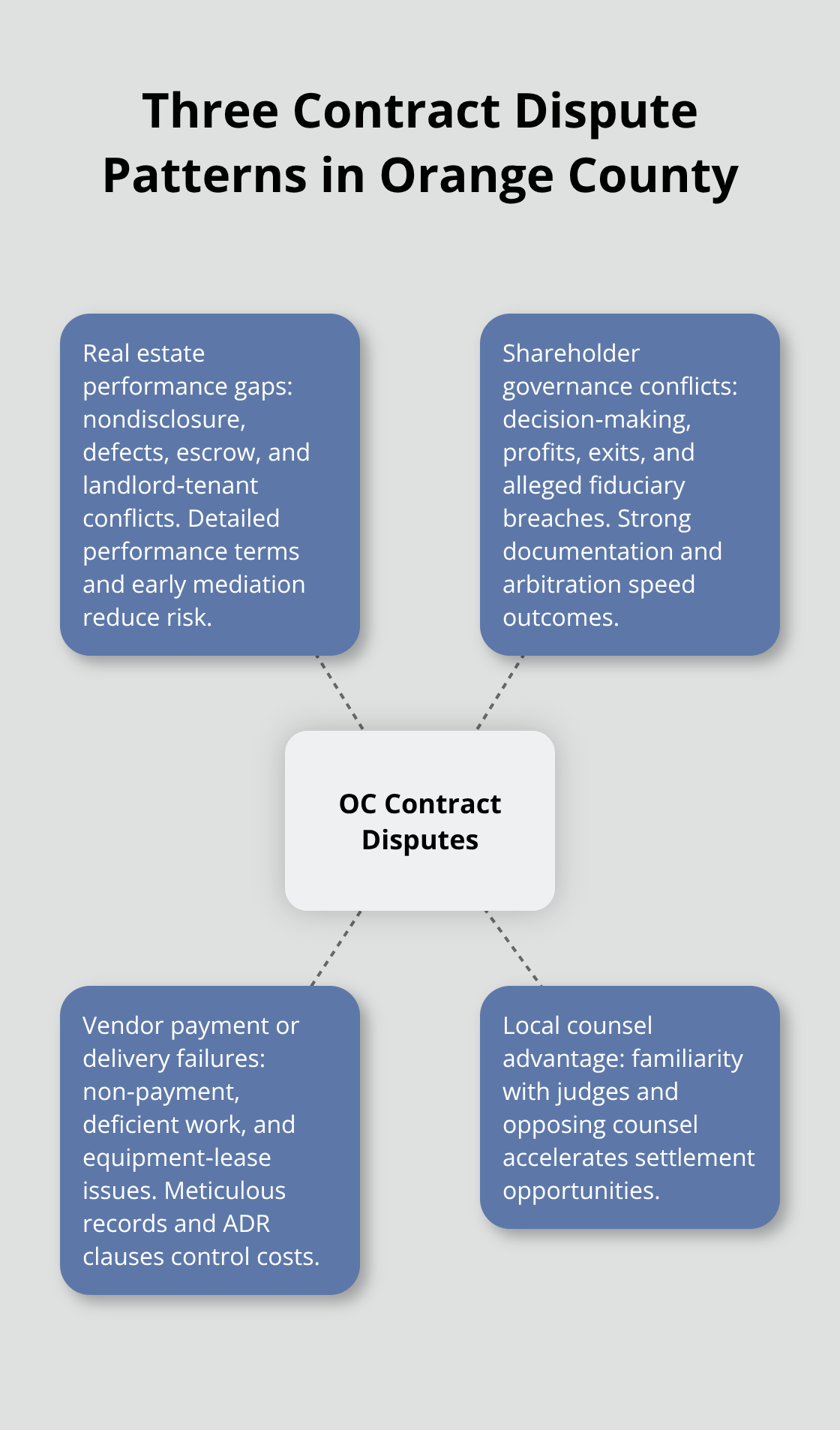
Real estate disputes in Orange County rarely involve simple disagreements over property lines or lease terms. Most stem from nondisclosure, property defects discovered mid-project, escrow complications, or landlord-tenant conflicts that escalate because the original contract left performance standards vague. A commercial tenant discovering undisclosed environmental contamination or a landlord facing tenant non-payment often cannot resolve the issue through negotiation alone because neither party wants to admit fault or renegotiate from a weakened position. Detailed lease language that specifies inspection rights, remediation responsibilities, and dispute timelines before occupancy begins prevents these conflicts. When disputes do arise, Orange County’s real estate-heavy market means judges see hundreds of similar cases annually, making precedent predictable but also making early mediation far cheaper than discovery. A property owner facing a $200,000 tenant default should send a preservation notice immediately, document all communications, and consider mediation within 30 days rather than waiting for litigation to clarify obligations that should have been explicit from day one.
Partnership and Shareholder Conflicts in Growing Companies
Partnership and shareholder conflicts in Orange County family-owned businesses and tech startups follow a consistent pattern: growth strains expose unstated assumptions about decision-making, profit distribution, or exit strategy, and disagreements over who breached first compound the damage. One shareholder claims the other misappropriated company assets or excluded them from management decisions; the other responds that the first breached their fiduciary duty by competing with the company or failing to fund agreed capital calls. These disputes often involve overlapping claims of breach, negligence, and fraud, with damages tied to lost revenue or diminished equity value that can reach millions. The strategic advantage goes to the shareholder who documented board meetings, capital contributions, and management decisions in writing from the start. Arbitration clauses in operating agreements or shareholder agreements typically resolve these disputes faster than court litigation because arbitrators can address governance and valuation issues without jury proceedings.
Vendor and Supplier Breaches Across Orange County Industries
Vendor and supplier breaches represent the highest volume of Orange County contract disputes, ranging from non-payment disputes with returned checks escalating into breach claims, to service contractors delivering deficient work and disputing corrective costs. Equipment leases involving operational-support arrangements frequently spawn breach, negligence, and fraud allegations when equipment fails, downtime accrues, and both parties blame the other for inadequate maintenance or installation. Meticulous invoicing, delivery records, and communications showing what was promised versus what was delivered form the practical defense. Orange County vendors should build dispute-resolution clauses into every supply agreement, specifying whether mediation or binding arbitration applies, because the regional cost of court litigation easily exceeds settlement value on disputes under $250,000. Early demand letters that clearly cite contract language and quantify damages often prompt settlement before counsel fees mount, and experienced Orange County counsel familiar with local vendor disputes can identify settlement windows that outside firms miss entirely.
These three patterns-real estate performance gaps, shareholder governance conflicts, and vendor payment or delivery failures-shape how Orange County businesses should structure contracts and respond when disputes emerge. Understanding which pattern matches your situation determines whether negotiation, mediation, or litigation offers the fastest path forward.
How to Resolve Orange County Contract Disputes Faster
Send a Demand Letter That Moves the Needle
Negotiation works best when both parties want to preserve the business relationship and move forward quickly. The moment you identify a breach, send a demand letter that cites specific contract language, quantifies your damages, and sets a clear response deadline. Demand letters resolve many contract disputes before filing suit and save significant legal costs, with roughly 40 percent of disputes settling within 30 days. Your letter should avoid accusations and focus on facts: what was promised, what wasn’t delivered, and what you’re owed. Include documentation-invoices, delivery records, emails showing performance gaps-so the other party understands your position is solid. If the other side responds with a counterclaim or disagreement about contract interpretation, you’ve obtained valuable information about their defense before litigation costs spike.
Choose Mediation or Arbitration When Direct Talks Stall
Mediation and binding arbitration represent the practical middle ground when negotiation stalls. Orange County courts frequently require or encourage ADR before trial, and more than 90 percent of civil cases resolve without litigation once mediation begins. Arbitration works especially well for partnership disputes, shareholder conflicts, and vendor disagreements because arbitrators address technical or industry-specific issues faster than juries and without the formality of court rules.
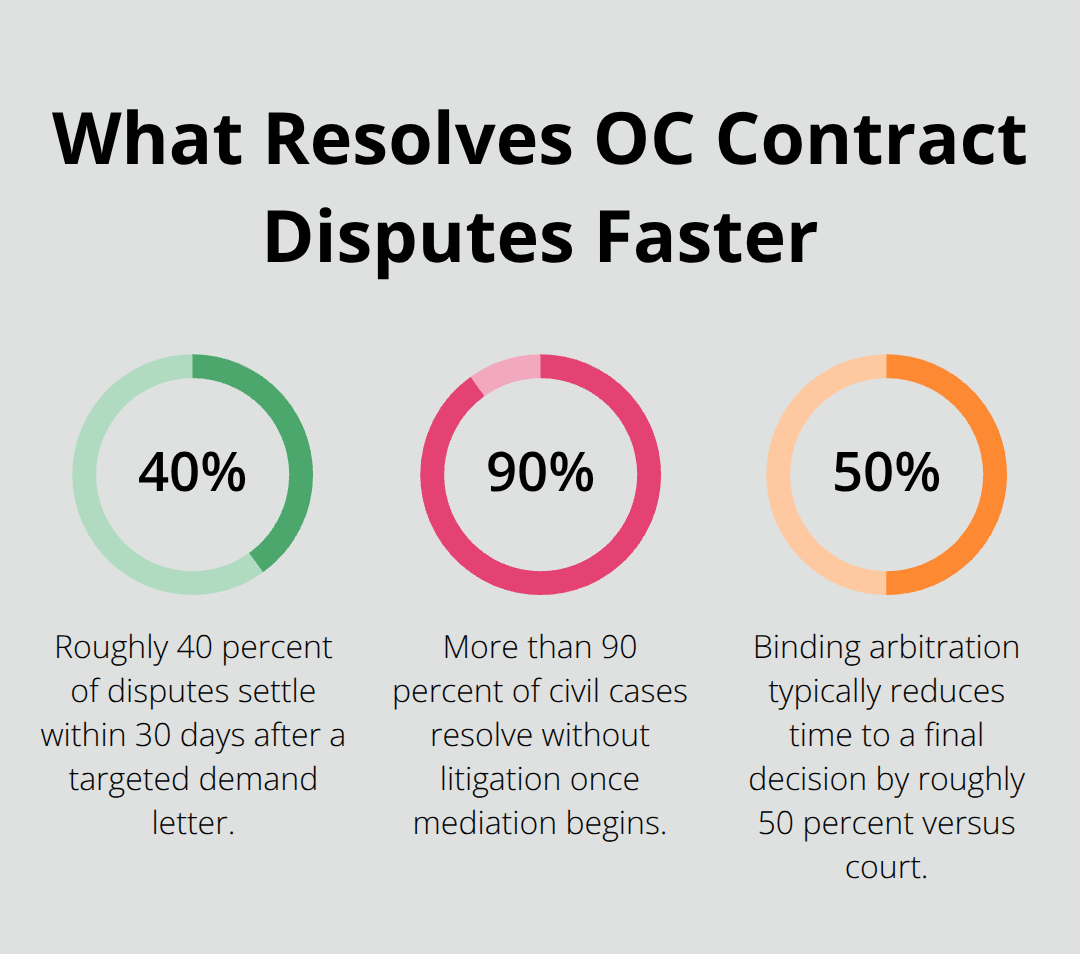
Your contract’s arbitration clause matters enormously: if it exists, arbitration is typically mandatory and binding, limiting appeals and reducing timeline to final decision by roughly 50 percent compared to court litigation. If your contract is silent on dispute resolution, you retain the choice between court litigation and voluntary arbitration, and experienced Orange County counsel can advise whether arbitration or court better serves your specific claim and damages amount.
Understand the Cost Difference Between Settlement and Litigation
Most Orange County business disputes under $250,000 settle faster through direct negotiation or a single mediation session than through discovery and motion practice, which typically run 18 to 24 months. The cost difference is stark: settlement negotiations resolve disputes faster than litigation, costing between $5,000 and $25,000 total compared to litigation’s $75,000+ in attorney fees alone before trial. This financial reality shapes strategy at every stage-early settlement often protects your bottom line far better than winning a judgment after months of expensive discovery.
Navigate Complex Cases in Orange County’s Court System
Litigation in Orange County’s Civil Complex Center in Santa Ana involves sophisticated motion practice and tight case management for disputes exceeding $25,000 or involving multiple parties. Federal court in the Central District of California, Southern Division, applies similar procedures but handles trademark, copyright, and RICO claims that state court cannot address. Courtroom representation requires an attorney with direct access to decision-makers and familiarity with local judges’ procedural preferences. An Orange County boutique litigation practice that combines strategic negotiation, ADR representation, and aggressive courtroom advocacy can resolve disputes at the stage that best protects your financial interests and minimizes operational disruption.
Final Thoughts
Orange County contract disputes follow predictable patterns, but outcomes depend entirely on how quickly you act and which resolution path you choose. The businesses that protect themselves best start with clear contracts that specify performance standards, payment terms, and dispute-resolution procedures before problems emerge. When disputes do arise, the first 30 days matter most: send a demand letter, preserve all communications and records, and assess whether negotiation, mediation, arbitration, or litigation serves your financial interests.
The cost difference between early settlement and protracted litigation is enormous. Most Orange County contract disputes under $250,000 resolve through direct negotiation or mediation for $5,000 to $25,000 in total legal costs, while court litigation routinely exceeds $75,000 in attorney fees alone before trial. If your contract includes an arbitration clause, binding arbitration typically resolves disputes 50 percent faster than court proceedings without limiting your remedies. If your contract is silent on dispute resolution, you retain flexibility to choose the forum that best protects your position.
Early legal intervention separates businesses that minimize damage from those that watch disputes spiral into operational crises. An experienced Orange County attorney can review your contract, identify ambiguities and risk areas, assess your claims and defenses, and position you for settlement or litigation before counsel fees mount. Contact Raul Garcia Law Firm to discuss your Orange County contract dispute and determine the fastest path to resolution.