

Landlord disputes in Orange County can drain your time, money, and patience. From unpaid rent to property damage, tenant conflicts threaten your investment and bottom line.
We at Raul Garcia Law Firm help property owners navigate Southern California landlord litigation with strategies that protect both your rights and revenues. This guide covers the disputes you’ll face, your legal options, and how to approach them strategically.
Common Landlord-Tenant Disputes in Orange County
Unpaid Rent and the Cost of Delay
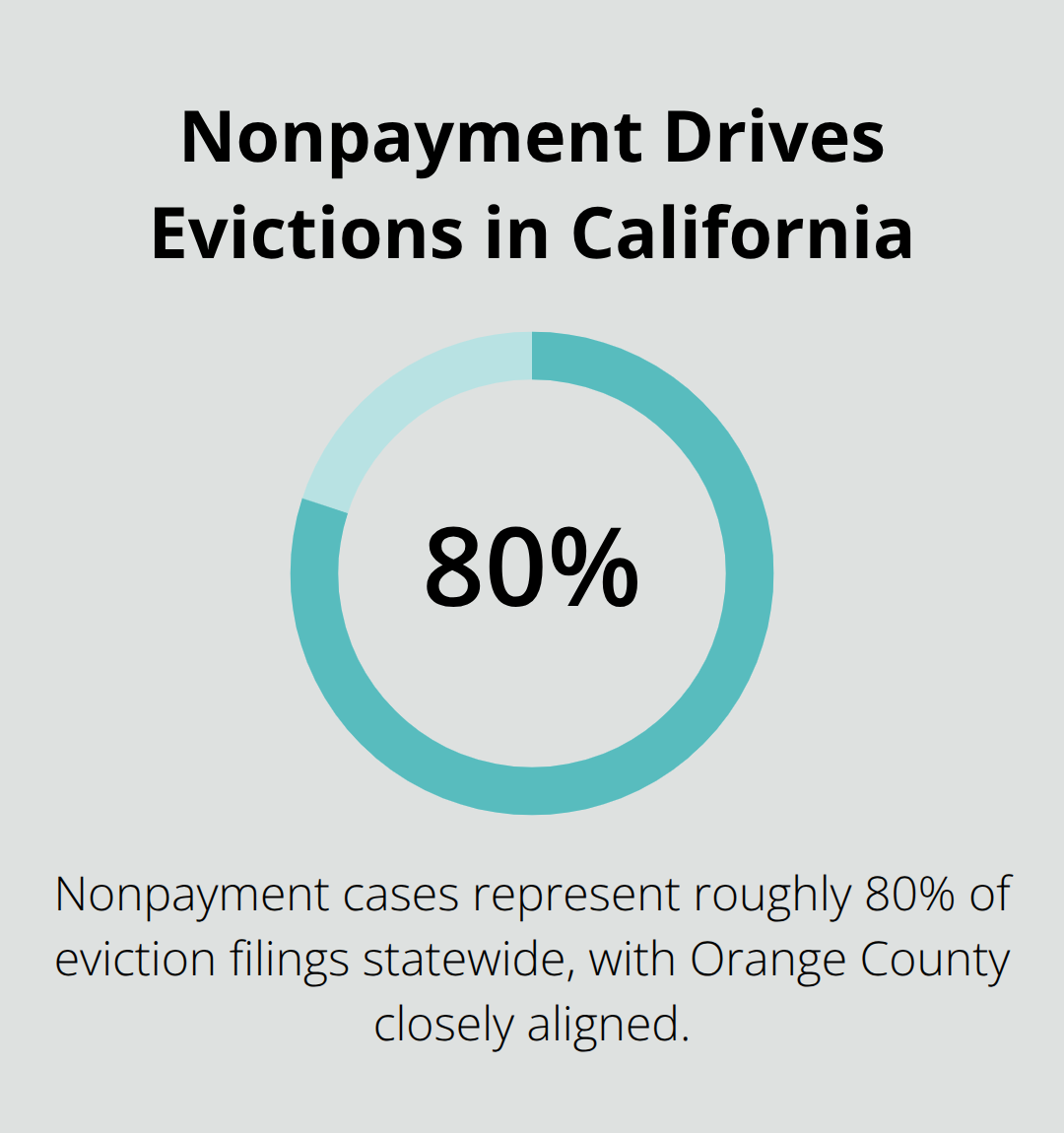
Unpaid rent remains the leading cause of landlord litigation in Orange County, and the numbers are stark. According to California court data, nonpayment cases account for roughly 80% of all eviction filings statewide, with Orange County tracking closely to that pattern. When a tenant stops paying, you face immediate cash flow damage plus mounting legal costs.
A standard unlawful detainer case in Orange County Superior Court runs 30 to 90 days minimum, even in uncontested situations. During that period, you receive no rent while covering mortgage, property taxes, insurance, and maintenance. If the tenant remains in the unit, those costs compound monthly.
Many landlords waste time with informal demands before filing the unlawful detainer, which delays the process that actually starts the clock. File the unlawful detainer immediately once rent becomes 5 or more days late, rather than negotiating endlessly. Speed matters because every week of delay costs you real money and increases the risk the tenant will strip the unit or cause additional damage before leaving. The 3-day notice to pay or quit serves as your first formal step, but only the court filing creates enforceable pressure.
Property Damage Beyond Normal Wear
Property damage disputes stem from disagreement over what constitutes normal wear versus tenant-caused harm. California law is clear: landlords cannot deduct for natural discoloration, carpet matting in high-traffic areas, or aging components from regular use. However, broken windows, holes in walls beyond nail holes, damaged appliances from misuse, and stained or torn flooring count as deductible damage. The problem is proving causation and timing.
AB 2801, effective July 1, 2025, requires landlords to photograph units before move-in, immediately after move-out, and after any repairs, with photos attached to itemized deduction statements. This law eliminates the he-said-she-said dynamic that previously plagued damage claims. Your move-in photos must show the unit’s actual condition on the day the tenant takes possession, not days later.
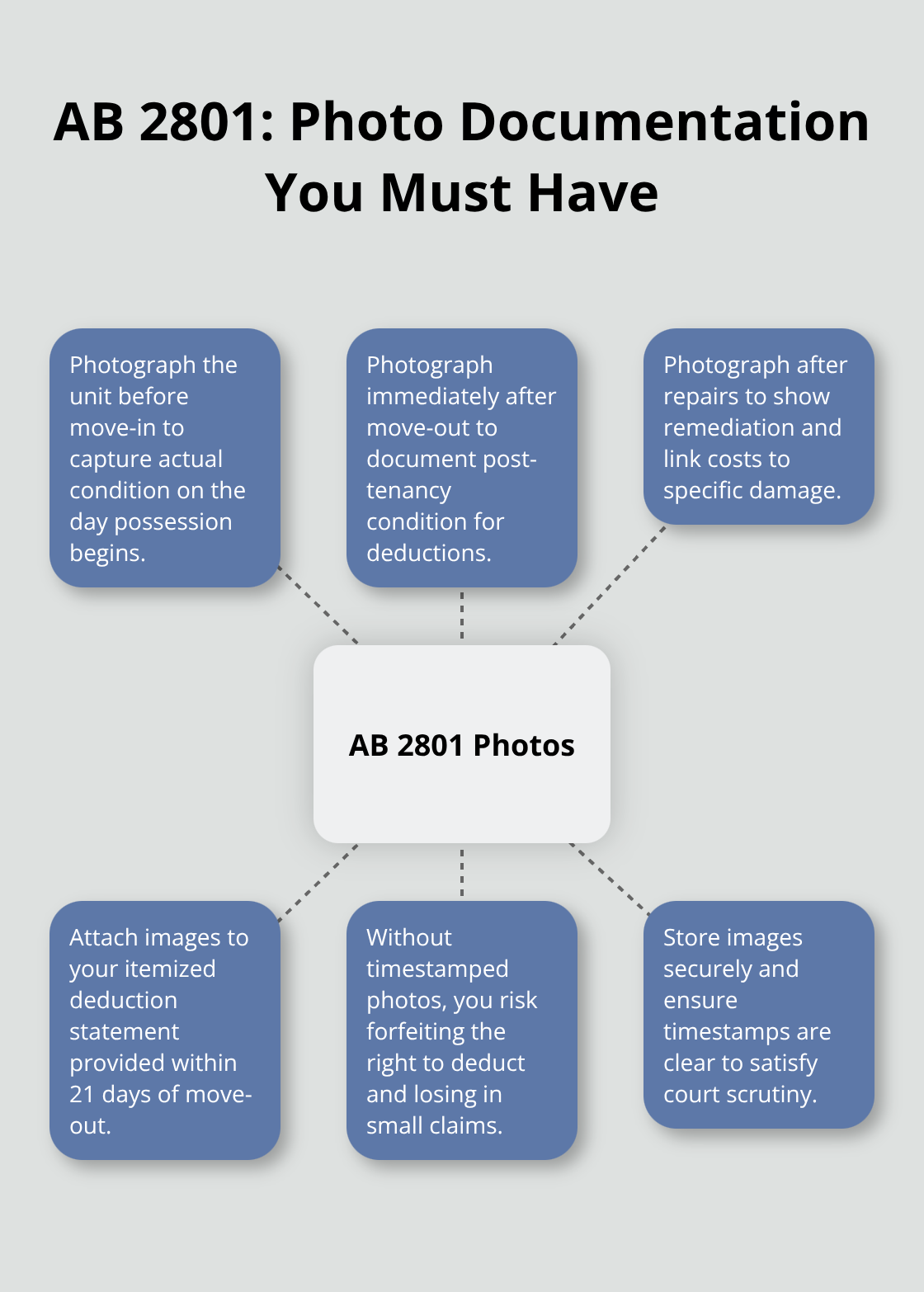
Many landlords skip this step or use poor-quality images, then lose in small claims when tenants contest deductions. Take timestamped photos from multiple angles, store them securely, and provide copies to departing tenants within 21 days alongside your itemized accounting. Damage disputes that reach court often result in partial recovery because judges doubt landlord documentation.
Lease Violations and Unauthorized Occupancy
Unauthorized occupancy and lease violations create ongoing headaches because they compound over time. A tenant who sublets without permission or allows unauthorized household members to move in violates the lease, but landlords often tolerate the situation until it becomes unbearable. Proving when the violation started becomes difficult once months pass. The smarter approach is to document the first sign of unauthorized occupancy with dated photos, witness statements from neighbors or maintenance staff, and a written notice citing the specific lease violation. Give the tenant 3 to 5 days to cure the violation in writing. If they refuse or ignore the notice, you have grounds for a 3-day notice to cure or quit, which leads to eviction.
Many landlords hesitate because they fear tenant retaliation claims, but California law protects you if the violation genuinely occurred. Retaliation protections under California Civil Code Section 1942.5 do not shield tenants who breach material lease terms. The key is documenting the violation before issuing any notice and keeping records of all communication. Subletting disputes often involve tenants claiming they need to rent out a room to cover costs, but your lease controls occupancy regardless of the tenant’s financial situation. Enforce the lease consistently or you risk losing leverage in future disputes and setting a precedent that weakens your position with other tenants.
These disputes demand different strategies depending on their nature, which is why understanding your legal options and local rules becomes essential to protecting your investment.
Legal Tools Orange County Landlords Can Deploy
Just Cause Eviction Requirements Under AB 1482
California Civil Code Section 1946.2, known as the Tenant Protection Act of 2019 or AB 1482, governs your eviction options in Orange County. After a tenant occupies a unit for 12 months, you can only evict for just cause-either an at-fault reason like nonpayment of rent, material lease violation, criminal activity, or nuisance, or a no-fault reason such as owner move-in or substantial remodel. The at-fault path moves faster and more directly when you have solid evidence. For nonpayment, you issue a 3-day notice to pay or quit. If the tenant ignores it, you file an unlawful detainer in Orange County Superior Court. The court process typically takes 30 to 90 days, but filing immediately matters because every delay extends your loss. For lease violations like unauthorized occupancy, document the violation first with photos and witness statements, then issue a 3-day notice to cure or quit. If the tenant refuses to cure, the unlawful detainer becomes your enforcement tool.
No-Fault Evictions and Relocation Costs
No-fault evictions require you to provide relocation assistance equal to one month’s rent or waive one month’s rent to help the tenant move. This adds cost but remains faster than pursuing at-fault grounds when evidence is weak. Orange County courts take documentation seriously, so tenants who contest your eviction will scrutinize your notice compliance and proof of service. A defective notice or improper service can delay the case by weeks or force you to restart the process entirely.
Security Deposit Deductions and AB 2801 Requirements
Damages recovery beyond eviction depends on what you can prove. Security deposit deductions for unpaid rent, cleaning, or damage beyond normal wear and tear form your primary recovery tool, but California Civil Code limits deposits to one or two months of rent depending on whether the unit is furnished. AB 2801, effective July 1, 2025, requires timestamped photographs before move-in, immediately after move-out, and after repairs, with images attached to your itemized deduction statement. Without these photos, you forfeit the right to deduct, so implement this process now even for current tenants. Orange County landlords who fail to photograph units lose deduction disputes in small claims court regularly because judges demand visual proof of damage timing and causation.
Small Claims and Superior Court Damage Actions
For damages exceeding the deposit, small claims court in Orange County allows recovery up to $10,000 per plaintiff, which covers many property damage disputes. Rent judgment is separate from deposit deductions, so unpaid rent claims proceed in court even after you recover the deposit. If a tenant owes $8,000 in back rent, you file for that in Superior Court as a regular civil action, not just an eviction. Many landlords overlook this step and walk away from recoverable money. Collection presents another challenge-judgment does not guarantee payment-but a judgment creates a lien on the tenant’s property and allows enforcement through wage garnishment or bank levies if the tenant later acquires assets. Filing the judgment makes sense even if immediate collection seems unlikely, because tenants often acquire property later and you retain collection rights for ten years.
Documentation Standards That Survive Court Scrutiny
Orange County Superior Court judges expect landlords to present clear, contemporaneous records of all tenant interactions, lease violations, and damage. Tenants routinely challenge notices on technical grounds, so your service of process must comply exactly with California Civil Code Section 1010 et seq. Photographs, maintenance logs, rent payment records, and written communications all strengthen your position. The stronger your documentation, the faster the court resolves the dispute in your favor and the less likely a tenant appeals the judgment. This foundation of evidence determines whether you recover your losses or absorb them as business costs.
When to Fight and When to Settle
Calculate the True Cost of Litigation
Most Orange County landlords overestimate their litigation options and underestimate the true cost of court action. A Superior Court eviction case runs 30 to 90 days minimum and consumes 15 to 25 hours of your time reviewing documents, preparing testimony, and coordinating with counsel. If the tenant contests the eviction or raises a habitability counterclaim, the timeline extends to 120 days or longer.
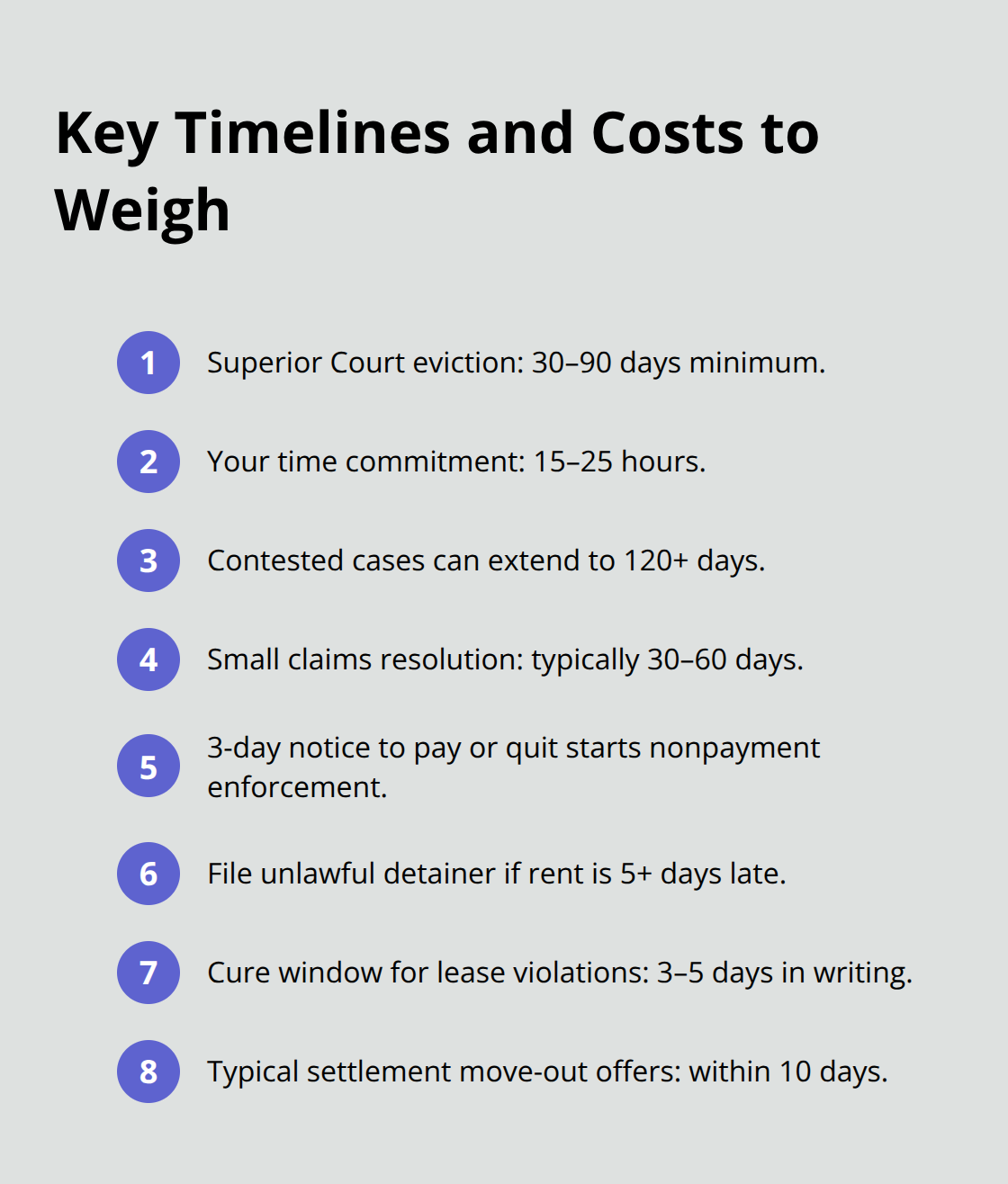
Your carrying costs during this period-mortgage, property taxes, insurance, utilities-often exceed what you’ll recover from the judgment. Small claims court offers faster resolution, typically 30 to 60 days, but caps recovery at $10,000 per plaintiff, which excludes major damage claims. Before filing anything, calculate the actual cost of litigation against the amount you expect to recover. If you owe $6,000 in back rent and the tenant has no assets, spending $3,000 in attorney fees and court costs plus your time to chase a judgment that may never collect makes no financial sense.
Conversely, if a tenant owes $15,000 in unpaid rent and has verifiable income or property, the judgment creates a lien worth pursuing for years. Orange County Superior Court judges award prevailing landlord attorney fees in unlawful detainer cases under California Civil Code Section 1950.7, but only if your lease includes an attorney fee clause and you win. Many landlords assume they’ll recover fees automatically and underestimate the risk of an adverse ruling that leaves them holding the full cost.
Evaluate Settlement Against Full Litigation
Settlement often makes sense when the tenant offers to vacate within 10 days and pay partial back rent, even if the amount falls short of your full claim. A signed settlement agreement guarantees payment on a schedule you control, whereas a judgment requires collection efforts that drain additional resources. If your tenant proposes settlement, evaluate it against the cost and timeline of full litigation, not against the theoretical amount you deserve.
Prepare Before You Negotiate
Early assessment means reviewing the lease, documenting every violation or payment failure with dates and amounts, and consulting experienced counsel before you issue any notice. A strong lease with clear payment terms, explicit unauthorized occupancy prohibitions, and attorney fee language strengthens your position and often encourages settlement. Tenants facing a well-documented case with experienced counsel backing the landlord frequently agree to vacate and negotiate payment rather than risk an adverse judgment.
Weak documentation-missing move-in photos, unclear payment records, vague lease language-forces you into expensive litigation with uncertain outcomes. If your lease lacks an attorney fee clause, add one to all new tenancy agreements immediately to improve your cost recovery in future disputes.
Set Firm Deadlines and File Strategically
Negotiation should happen only after you’ve prepared for court: gather evidence, serve proper notice, and have counsel ready to file the unlawful detainer within days if negotiation fails. Tenants perceive weakness when landlords delay filing after serving notice, so your threat to litigate must be credible. Set a firm deadline for settlement-typically 5 to 7 days after the 3-day notice expires-and file the unlawful detainer on day 4 if the tenant ignores your demand. This approach signals seriousness and often produces a settlement within 48 hours.
Experienced local counsel familiar with Orange County Superior Court judges, court procedures, and tenant defense tactics accelerates resolution and reduces your risk of procedural errors that extend the case or allow appeals.
Final Thoughts
Orange County landlord disputes follow predictable patterns, and your response determines whether you protect your investment or absorb unnecessary losses. Documentation wins cases-move-in photographs, timestamped maintenance records, written lease violations, and proof of service create the foundation that survives court scrutiny. AB 2801 now mandates photo documentation for security deposit deductions, but judges award judgments to landlords who present organized, contemporaneous evidence throughout every dispute.
Your lease controls the relationship and strengthens your position in Southern California landlord litigation. A lease that clearly prohibits unauthorized occupancy, specifies payment terms, includes an attorney fee clause, and defines normal wear and tear protects your rights from day one. Weak lease language forces you to prove intent and causation in court, which costs time and money that you could avoid with stronger contract language.
Early legal assessment prevents costly mistakes before you issue any notice or file any court action. Consult experienced counsel who understands Orange County Superior Court procedures and local tenant defense tactics, since a defective notice or improper service can delay your case by weeks. We at Raul Garcia Law Firm help Orange County property owners develop litigation strategies that protect both rights and revenues-contact us for a strategic assessment of your situation and next steps.