

Trade secrets are the lifeblood of competitive advantage in Orange County businesses. When employees leave or partners betray your confidence, the damage can be swift and irreversible.
We at Raul Garcia Law Firm help businesses protect what matters most through nondisclosure enforcement actions. This guide walks you through the legal framework, common violations, and proven strategies to defend your proprietary information.
What Orange County Courts Recognize as Trade Secrets
The Four-Part Legal Test
California Uniform Trade Secrets Act defines a trade secret as information-a formula, pattern, compilation, program, device, method, technique, or process-that derives independent economic value from not being generally known and remains subject to reasonable efforts to maintain its secrecy. Orange County courts apply this four-part test rigorously. First, the information must exist and be identifiable. Second, it must generate economic value precisely because competitors and the public do not know it. Third, it cannot be widely known or readily available through reverse engineering or independent discovery. Fourth, you must demonstrate reasonable protective measures. Courts will not protect information you treat casually.
What Qualifies for Protection
Customer lists with pricing data, manufacturing processes, software algorithms, marketing strategies with specific metrics, and unpatented technical designs all qualify as protectable trade secrets in Orange County litigation. Production formulas and internal market analyses consistently receive protection when accompanied by documented confidentiality protocols. Client lists that include pricing and volume data are explicitly protected under California law. A manufacturing company protecting a proprietary calibration process must show it restricted access to essential personnel, marked documents confidential, and required written agreements with employees and contractors. Without these measures, Orange County judges will find your protection efforts inadequate and deny enforcement.
Trade Secrets Versus Confidential Information
The distinction between a trade secret and ordinary confidential business information matters significantly. Confidential information might include general business plans, employee salary structures, or internal communications that deserve protection but lack the economic value requirement. Trade secrets command stronger legal remedies because they create competitive advantage. Information loses trade secret status once it becomes generally known, even if disclosure occurs through your own negligence.
Demonstrating Reasonable Protective Measures
Courts examine whether you implemented access controls, encryption, confidentiality notices, and non-disclosure agreements. The value threshold is practical, not theoretical. A customer list with purchasing patterns and contact information for specialized industrial buyers in Southern California has protectable value. A generic list of publicly available names does not. You must show that you restricted who could view sensitive materials, marked them confidential, and required written commitments from anyone with access (employees, contractors, vendors).
Moving Forward with Enforcement
Violations of nondisclosure agreements occur when employees, partners, or vendors breach these protective measures. Understanding what qualifies for protection under Orange County law sets the foundation for recognizing when violations happen and what enforcement options become available to you.
Common Violations of Nondisclosure Agreements in Orange County
How Violations Occur
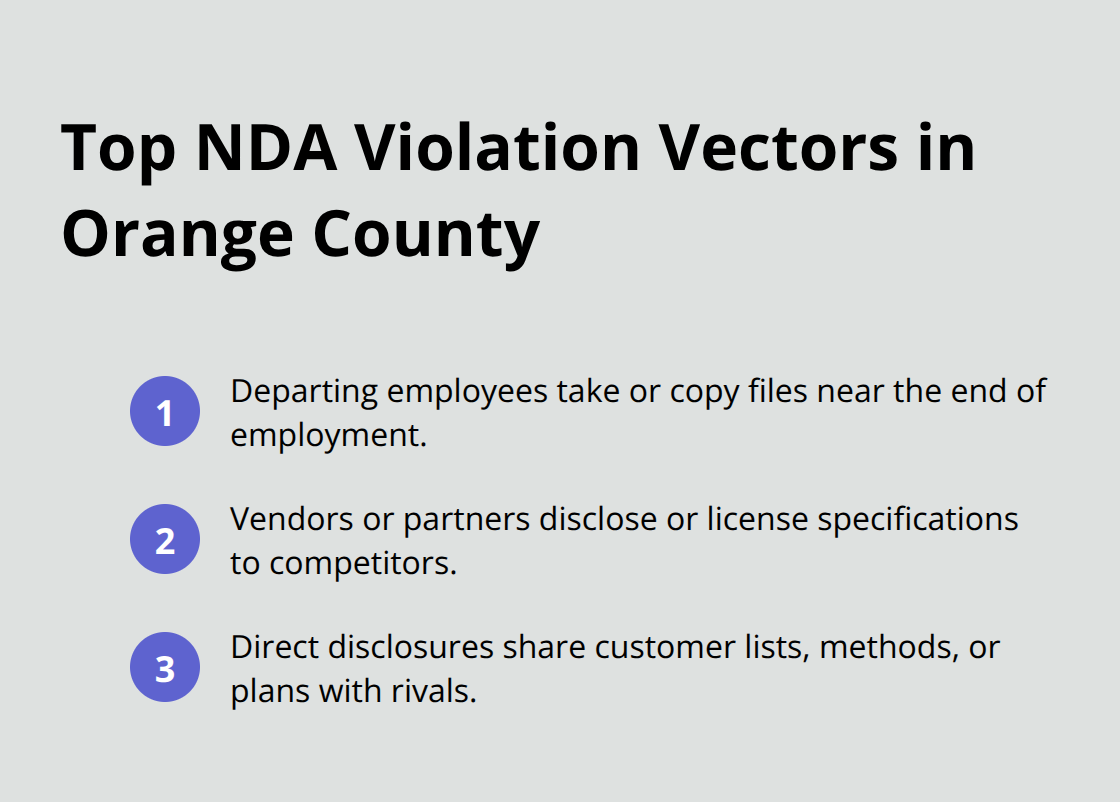
Violations of nondisclosure agreements in Orange County follow predictable patterns, and most stem from inadequate documentation when the violation occurs. When an employee departs with customer files or a vendor shares your manufacturing specifications with a competitor, the damage spreads fast-but your response depends entirely on what you documented beforehand. The California Uniform Trade Secrets Act requires you to prove the information qualified for protection and that the defendant obtained it through improper means. Improper means include theft, misrepresentation, breach of a confidentiality duty, or espionage. If you cannot produce signed NDAs, access logs showing who viewed sensitive files, or communications marking information confidential, Orange County courts will question whether you took reasonable protective measures. This directly determines whether you can obtain an injunction to stop ongoing misuse or recover damages.
Departing Employees as Your Highest Risk
Departing employees represent your highest violation risk. Approximately 40 percent of trade secret litigation involves former employees who take proprietary information to new employers or start competing ventures. The violation often occurs during the final weeks of employment when an employee downloads files, forwards emails to personal accounts, or photographs documents. Many Orange County businesses discover the breach months later when the former employee’s new company launches a competing product with identical features or approaches your shared customers with identical pricing structures. The timing of discovery matters because courts measure damages from the date you learned of the misappropriation, not from when it occurred.
Vendor and Partner Breaches
Vendors and business partners create a different exposure-they may disclose your information to competitors as part of their own business development or sell access to your trade secrets as a revenue stream. One Orange County manufacturer discovered a contract manufacturer had licensed its proprietary calibration process to three competing firms, generating revenue while undermining the manufacturer’s market position. These breaches often remain hidden until a competitor suddenly matches your technical capabilities or pricing strategy with suspicious precision.
Direct Unauthorized Disclosure
Direct unauthorized disclosure to competitors happens less frequently but carries severe consequences. An employee or partner contacts your competitor directly, shares your customer list with pricing tiers, describes your production methodology, or provides copies of your strategic plans.
Orange County courts treat this as willful misappropriation and award enhanced damages-up to three times actual damages-when the defendant acted with malice or reckless disregard. The key distinction is intent. A vendor who accidentally forwards a confidential email to the wrong recipient faces lower liability than one who knowingly sold your specifications to a competitor.
Building Your Enforcement Foundation
Your enforcement strategy hinges on proving what information was taken, when, by whom, and how it was used. Without this documentation (access logs, signed agreements, confidentiality notices), even obvious violations become difficult to stop or remedy through litigation. The violations you identify now determine which enforcement tools become available to you next.
How to Stop Trade Secret Misuse in Orange County
Act Fast to Preserve Your Competitive Position
When a former employee or business partner misuses your confidential information, speed determines whether you recover your advantage or watch it evaporate into market competition. Orange County courts provide immediate tools to halt ongoing damage, but only if you move decisively and have documented your protective measures beforehand. The California Uniform Trade Secrets Act grants courts authority to issue temporary restraining orders within hours of filing, freezing the defendant’s ability to use or disclose your information while litigation proceeds. One Orange County software company obtained a preliminary injunction within 72 hours after discovering a departing engineer had copied proprietary algorithms to a competitor’s server, preventing the competitor from deploying the code for six months while the case resolved. That injunction preserved roughly 2.4 million dollars in projected revenue the company would have lost had the competitor launched their product on schedule.
The speed of your response matters enormously-courts view delay as evidence that you did not truly believe your information faced imminent harm, which weakens your injunction request. You must file immediately upon discovering misuse, provide detailed evidence of what information was taken, demonstrate how the defendant obtained it improperly, and show likelihood of irreparable harm if the court does not intervene. Irreparable harm means damages you cannot recover through money alone; once a trade secret enters the market, no dollar amount fully restores your competitive position.
Obtain Injunctive Relief Through Orange County Courts
Orange County judges understand the reality of trade secret harm and grant preliminary injunctions in clear-cut misappropriation cases at rates exceeding 65 percent when the evidence shows reasonable protective measures existed beforehand. You must establish that you took reasonable steps to protect the information, that the defendant obtained it through improper means, and that irreparable injury will result without court intervention. Courts will not delay-they issue temporary restraining orders that take effect immediately, often before the defendant receives notice of the lawsuit. This immediate freeze prevents further disclosure or use while you prepare for full litigation.
Leverage Discovery to Expose Misappropriation
Litigation itself serves multiple functions beyond obtaining an injunction. Through discovery, you compel the defendant to produce emails, file access logs, device records, and communications revealing exactly how they obtained your information and what they did with it. One Orange County manufacturer uncovered through discovery that a departing operations manager had forwarded 847 confidential documents to a personal email account, then forwarded 312 of those documents to a competitor within 48 hours of starting employment there-evidence that supported an award of 1.8 million dollars in actual damages plus an additional 1.8 million in enhanced damages for willful misappropriation. Settlement negotiations accelerate dramatically once defendants face discovery obligations and understand the scope of evidence against them.
Negotiate from a Position of Strength
Many cases resolve before trial when defendants realize courts will likely award damages, attorney fees, and ongoing injunctions preventing future use. You should pursue settlement discussions only after establishing a strong litigation posture through aggressive early motion practice and discovery requests. Settling from weakness invites inadequate compensation and incomplete protection. Settlement from strength-demonstrated through successful preliminary injunction motions, compelling discovery responses, and clear liability evidence-yields agreements that include monetary recovery, return of confidential materials, permanent injunctions, and non-disparagement provisions preventing the defendant from claiming your information was independently developed or publicly available.
Consider Alternative Dispute Resolution Carefully
Alternative dispute resolution through mediation can compress timelines and reduce costs, but mediators cannot compel defendants to return stolen information or cease ongoing misuse as effectively as court orders. Arbitration clauses in your NDAs can limit defendants’ ability to litigate in public courts, though arbitration restricts your ability to obtain injunctive relief quickly since arbitrators typically cannot issue emergency orders with the speed Orange County courts provide. The enforcement path you choose determines whether you regain control of your competitive position or watch competitors benefit from years of your research and investment.
Final Thoughts on Orange County Trade Secret Protection
Trade secret protection in Orange County requires action before violations occur, not after. The businesses that successfully defend their competitive advantage implement documented protective measures, respond swiftly when breaches happen, and pursue aggressive nondisclosure enforcement actions. Courts will not grant injunctions or award damages if you treated confidential information casually, failed to mark documents, or neglected to require written agreements from employees and vendors-the four-part legal test under California law demands proof at every stage, and that proof comes from the systems you establish today.
Violations happen constantly in Orange County’s competitive marketplace as departing employees download files, vendors license your specifications to competitors, and partners share your customer lists with rivals. Most businesses discover breaches months after they occur, by which time competitors have already launched products or captured customers, so your response speed determines whether you obtain preliminary injunctions that freeze ongoing misuse or watch your competitive position erode. Courts understand this reality and grant emergency relief rapidly when evidence shows reasonable protective measures existed beforehand (access controls, signed NDAs, confidentiality markings, and thorough exit procedures all strengthen your position).
Proactive legal safeguards transform your position from reactive to commanding, and when violations occur, contact Raul Garcia Law Firm immediately. We represent Orange County businesses in complex trade secret disputes, combining practical business insight with aggressive enforcement strategies to stop misuse and recover damages. Your competitive advantage depends on acting decisively.