

California employers often assume noncompete agreements protect their business interests. The reality is starkly different-most noncompetes violate state law and won’t hold up in court.
We at Raul Garcia Law Firm help Orange County businesses understand what actually works. This guide breaks down noncompete agreement enforceability under California law and shows you which restrictions courts will actually enforce.
What California Law Actually Says About Noncompetes in Orange County
Section 16600 Voids Noncompetes Without Exception
California Business and Professions Code Section 16600 is unambiguous: it voids any contract that restrains someone from engaging in a lawful profession, trade, or business. This isn’t a gray area. The California Supreme Court’s 2008 Edwards v. Arthur Andersen decision confirmed that even narrowly tailored noncompetes fail to survive scrutiny unless they fall into specific statutory exceptions. Those exceptions are razor-thin. A noncompete might be enforceable only when you sell your entire business or dissolve a partnership, and even then, the restrictions must tie directly to that transaction and remain reasonable in scope. Most Orange County employers rely on noncompetes thinking they protect client relationships or prevent competition. They don’t.
Why California Prioritizes Employee Mobility Over Employer Control
California’s policy is clear: employee mobility trumps employer control. The state enacted these laws to foster innovation, entrepreneurship, and fair labor practices. The California Labor Commissioner’s Office reported a 300% spike in worker complaints about illegal noncompetes, signaling that employers continue to enforce agreements with no legal standing. This trend reflects a fundamental shift in how courts and regulators view restrictive covenants in employment relationships.
Senate Bill 699 Creates Private Liability for Enforcement Attempts
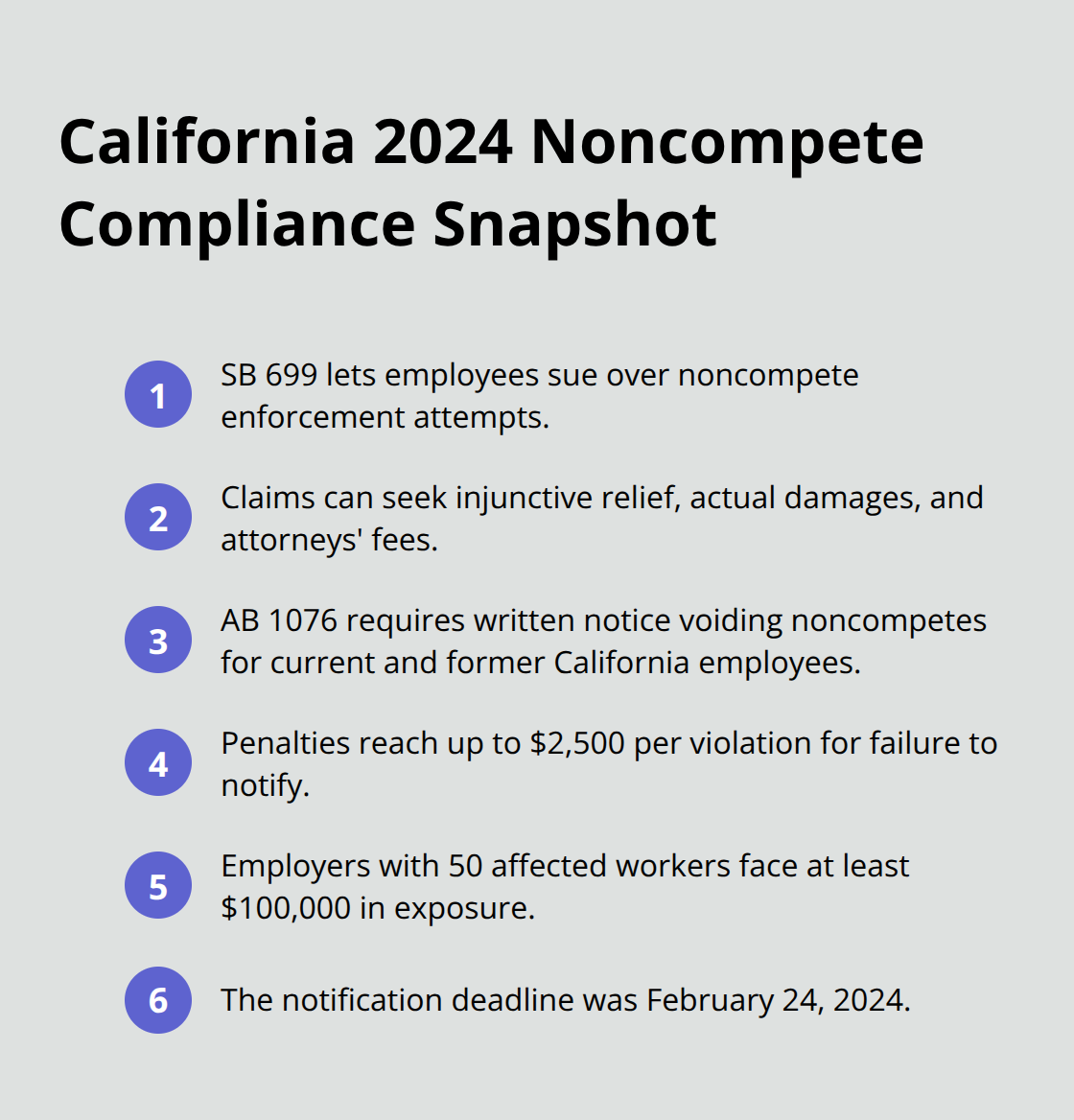
Senate Bill 699, effective January 1, 2024, added Civil Code Section 16600.5, which gives employees a private right of action against employers who attempt to enforce noncompetes. An employee can now sue for injunctive relief, actual damages, and attorneys’ fees if you threaten or enforce an unenforceable agreement. This provision fundamentally changed the risk calculus for Orange County businesses.
Assembly Bill 1076 Imposes Notification Requirements and Penalties
Assembly Bill 1076, also effective January 1, 2024, requires employers to notify all current and former California employees who signed noncompetes that those agreements are void. Failure to provide written notice triggers penalties of up to $2,500 per violation. If you employed even 50 people who signed noncompetes, the exposure reaches $100,000 minimum. The notification deadline passed on February 24, 2024, meaning many Orange County employers already face liability for non-compliance.
Statewide Application Regardless of Contract Origin
These laws apply regardless of where the employment contract was signed or where the employee worked. If you hired a remote worker in another state but they later moved to California, SB 699 applies. The legislative intent is unmistakable: California wants to eliminate noncompetes entirely and shift employer protection to trade secret laws and confidentiality agreements instead. Understanding which alternative restrictions actually hold up in court becomes essential for protecting your business moving forward.
Why Noncompetes Fail in Orange County Courts
Overbroad Restrictions Collapse Under Scrutiny
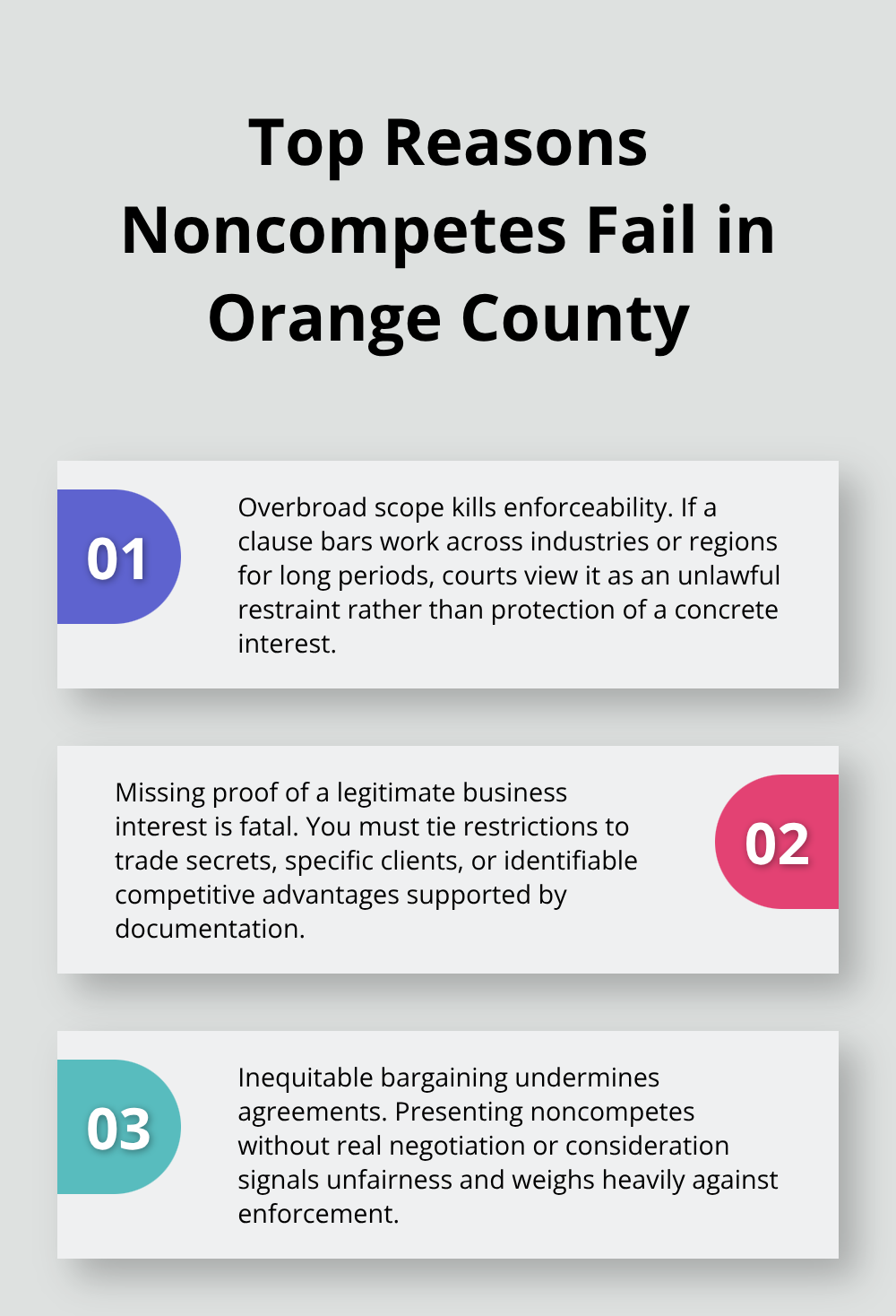
Courts reject noncompetes in Orange County because they’re fundamentally overbroad. A restriction that prevents an employee from working in your industry for two years across a three-state region extends far beyond protecting any legitimate business interest. California courts apply a strict test: the restriction must be narrowly tailored to protect something concrete-trade secrets, confidential client lists, or goodwill tied directly to a business sale. Most Orange County employers fail this test immediately.
They draft noncompetes that blanket entire industries or geographic areas without documenting what specific information or relationships actually need protection. The Edwards v. Arthur Andersen decision makes clear that courts won’t rewrite overbroad agreements to make them reasonable. If your noncompete is too broad on time, geography, or scope, it dies completely. California applies no judicial blue-pencil doctrine that salvages half-written restrictions.
Missing Documentation of Legitimate Business Interests
The second major failure point is the absence of a legitimate business interest tied to the specific restriction. California courts demand concrete proof that you need to protect something real. A vague claim that you want to prevent competition fails to meet this standard. You must show that the employee had access to trade secrets, worked directly with specific clients you’re naming, or possessed information that gives you a competitive advantage.
Without this documentation, the noncompete collapses entirely. Orange County employers often assume that signing an agreement creates automatic enforceability. It doesn’t. Courts require you to identify what you’re actually protecting before you can restrict an employee’s future work. This distinction separates enforceable confidentiality agreements from unenforceable noncompetes.
Inequitable Bargaining Power Undermines Enforceability
Inequitable bargaining also sinks agreements in Orange County litigation. If you presented a noncompete to an employee on day one of employment without negotiation, without consideration beyond continued employment, or without explaining its terms, courts view it as an unfair imposition. Employees with significant bargaining power-executives, technical specialists-have stronger arguments against enforcement than lower-level staff.
The power imbalance matters legally in California. Courts scrutinize whether both parties had genuine opportunity to negotiate terms or consult counsel. If an employee signed under duress or without meaningful choice, enforceability becomes questionable even if the restriction itself were reasonable. This reality means that protecting your business requires a fundamentally different approach than relying on restrictive covenants.
What Actually Works Instead of Noncompetes in Orange County
Non-Solicitation Agreements Protect Specific Client Relationships
Non-solicitation agreements targeting specific clients or customers remain enforceable in California when drafted narrowly and tied to legitimate business interests. Unlike noncompetes that ban all competitive work, a non-solicitation prevents the employee from soliciting only those clients the employee actually worked with or had access to during employment. The California Supreme Court’s Edwards v. Arthur Andersen decision rejected broad non-solicitation clauses, but courts recognize that protecting specific client relationships from active solicitation is permissible when you document which clients the employee served.
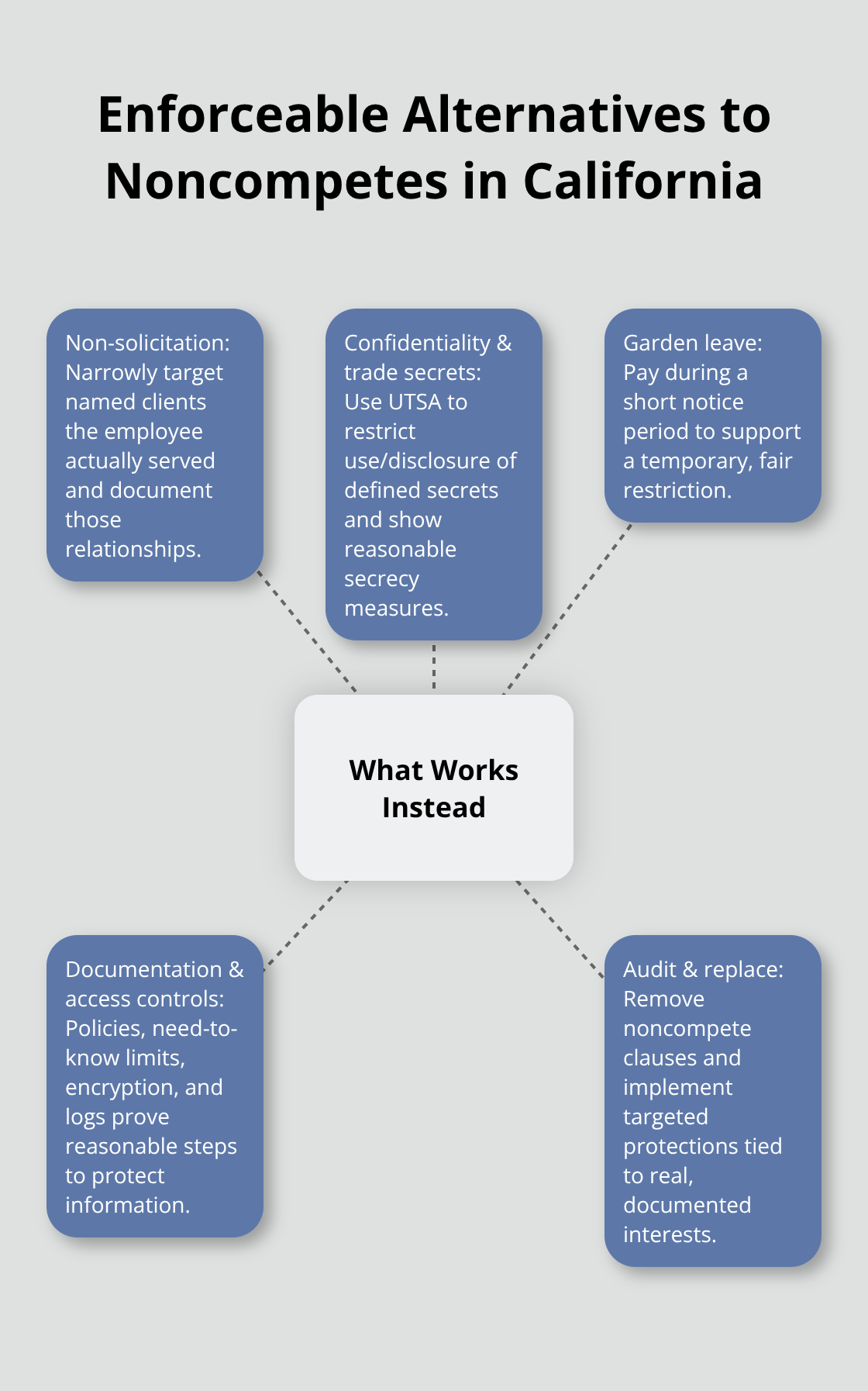
Orange County businesses should identify named clients or customer segments in the agreement rather than claiming protection over entire industries. This specificity makes the difference between an enforceable restriction and a void restraint. You need written records showing which accounts the employee managed, which projects they touched, and which relationships they developed. Without this documentation, even a narrowly drafted non-solicitation fails because you haven’t proven a legitimate business interest worth protecting.
Confidentiality Agreements Form the Backbone of Enforceable Restrictions
Confidentiality agreements and trade secret protections form the actual backbone of enforceable restrictions in California. The Uniform Trade Secrets Act, codified in California Civil Code Section 3426, allows you to restrict use and disclosure of information that qualifies as a trade secret-meaning it derives economic value from not being generally known and you take reasonable steps to maintain secrecy. This is where Orange County employers should direct their energy instead of chasing noncompetes.
Draft robust confidentiality agreements that identify specific trade secrets, establish access controls, require signed acknowledgments, and document security measures. Courts enforce these agreements because they protect something concrete rather than simply blocking competition. The specificity of what you’re protecting matters far more than the breadth of the restriction.
Garden Leave Provisions Offer Temporary, Paid Restrictions
Garden leave provisions-paying an employee during a notice period when they cannot work-hold up better than noncompetes because the consideration is clear and the restriction is temporary. If you pay an employee three months’ salary during a restricted period, enforceability improves dramatically compared to an unpaid noncompete restriction. The payment demonstrates fair dealing and reduces the inequitable bargaining concerns that sink other restrictions.
This approach works because courts see it as a fair exchange rather than a one-sided employer control mechanism. The employee receives compensation for the restriction, which addresses the fundamental fairness objection California courts raise against traditional noncompetes. The temporary nature also satisfies the reasonableness requirement that courts demand.
Documentation and Access Controls Strengthen Your Position
You must document which employees access which trade secrets and maintain records of your security measures. Create written policies that identify confidential information, restrict access to specific personnel, require return of materials upon termination, and establish consequences for unauthorized disclosure. Courts examine whether you actually treated information as secret-not just whether you claimed it was secret in an agreement.
Implement access controls that limit who can view sensitive information, use encryption for digital files, and maintain visitor logs for physical locations containing trade secrets. These concrete steps demonstrate that you took reasonable measures to maintain secrecy, which is a legal requirement under the Uniform Trade Secrets Act. Without evidence of actual security practices, courts dismiss trade secret claims even when the information itself qualifies as proprietary.
Audit Your Current Agreements and Replace Noncompete Language
Strip noncompete language from your current agreements and replace it with specific confidentiality obligations tied to documented trade secrets, named client lists with written evidence of employee involvement, and clearly stated consideration for any restriction on future work. This shift from broad restrictions to targeted protections aligns your agreements with what California courts actually enforce.
Review employment contracts, offer letters, and separation agreements for noncompete clauses that violate state law. Identify which employees had access to trade secrets or managed specific client relationships, then draft agreements that protect those concrete interests rather than attempting to block all competition. This targeted approach reduces legal risk while actually protecting what matters to your business.
Protecting Your Orange County Business Moving Forward
The shift from noncompetes to enforceable alternatives demands concrete action, not assumptions about what courts will accept. Courts in Orange County support restrictive covenants only when you document what you actually protect and tie restrictions directly to legitimate business interests. Start by identifying which employees access trade secrets, which clients they serve, and what information gives your business a competitive edge-this documentation forms the foundation for confidentiality agreements that courts will enforce.
Your employment agreements must specify which information qualifies as confidential, require employees to acknowledge receipt of trade secret policies, and establish clear procedures for handling proprietary materials. Include provisions that require return of all documents and digital files upon termination, and implement access controls that limit who can view sensitive information. These concrete steps satisfy California’s requirement that you take reasonable measures to maintain secrecy, which directly impacts noncompete agreement enforceability in disputes.
For client relationships, name the specific accounts or customer segments an employee managed rather than claiming protection over entire industries. Written records showing which projects the employee touched and which relationships they developed transform a vague non-solicitation into an enforceable restriction. Audit your current agreements immediately and strip out noncompete language that violates state law, then contact us to review your agreements and build a protection strategy aligned with California law.