
Boardroom disputes can paralyze a company from the inside, pitting shareholders against directors and threatening the stability of your governance structure. When conflicts over strategy, asset management, or board composition escalate, the stakes become financial and reputational.
We at Raul Garcia Law Firm understand that boardroom dispute litigation demands immediate, decisive action. This guide walks you through what these disputes look like, why they happen, and how we defend your governance interests when internal conflict threatens your business.
What Boardroom Disputes Actually Look Like in Orange County
Shareholder-Director Conflicts and Fiduciary Breaches
A boardroom dispute is not a single conflict-it is a collision of competing interests over who controls the company, how decisions get made, and who benefits from those decisions. Shareholder-director conflicts emerge when those who own the company disagree fundamentally with those who run it. A director may push a strategic pivot that threatens minority shareholders’ interests, or a majority shareholder may demand board actions that violate fiduciary duties owed to the minority.
Breach of fiduciary duty claims arise when directors or officers act in their own interest rather than the company’s, divert corporate opportunities to themselves, or fail to disclose conflicts before voting. These violations strike at the core of governance legitimacy. When a director votes on a related-party transaction without recusal, or when a majority shareholder freezes out a minority owner by cutting dividends and compensation, litigation becomes unavoidable.
Deadlock, Control Struggles, and Governance Breakdown
Deadlock and control issues occur when the board cannot function because factions cannot agree, or when one party tries to remove directors to seize control. In Orange County, where closely held businesses and family enterprises dominate the commercial landscape, these disputes often stem from informal governance structures that work fine until they do not. The Delaware General Corporation Law shapes how courts analyze these claims, focusing heavily on whether directors followed proper process, disclosed conflicts, and made informed decisions.
The Operational Damage of Prolonged Conflict
The real harm in boardroom disputes is operational paralysis. Board meetings turn adversarial, decision-making stalls, and strategic opportunities slip away while factions fight. Companies lose months or years to depositions, document production, and courtroom battles when they should be growing. A 2019 Business Roundtable statement emphasized that boards must create value for all stakeholders, yet governance conflicts pull boards away from that mission entirely.
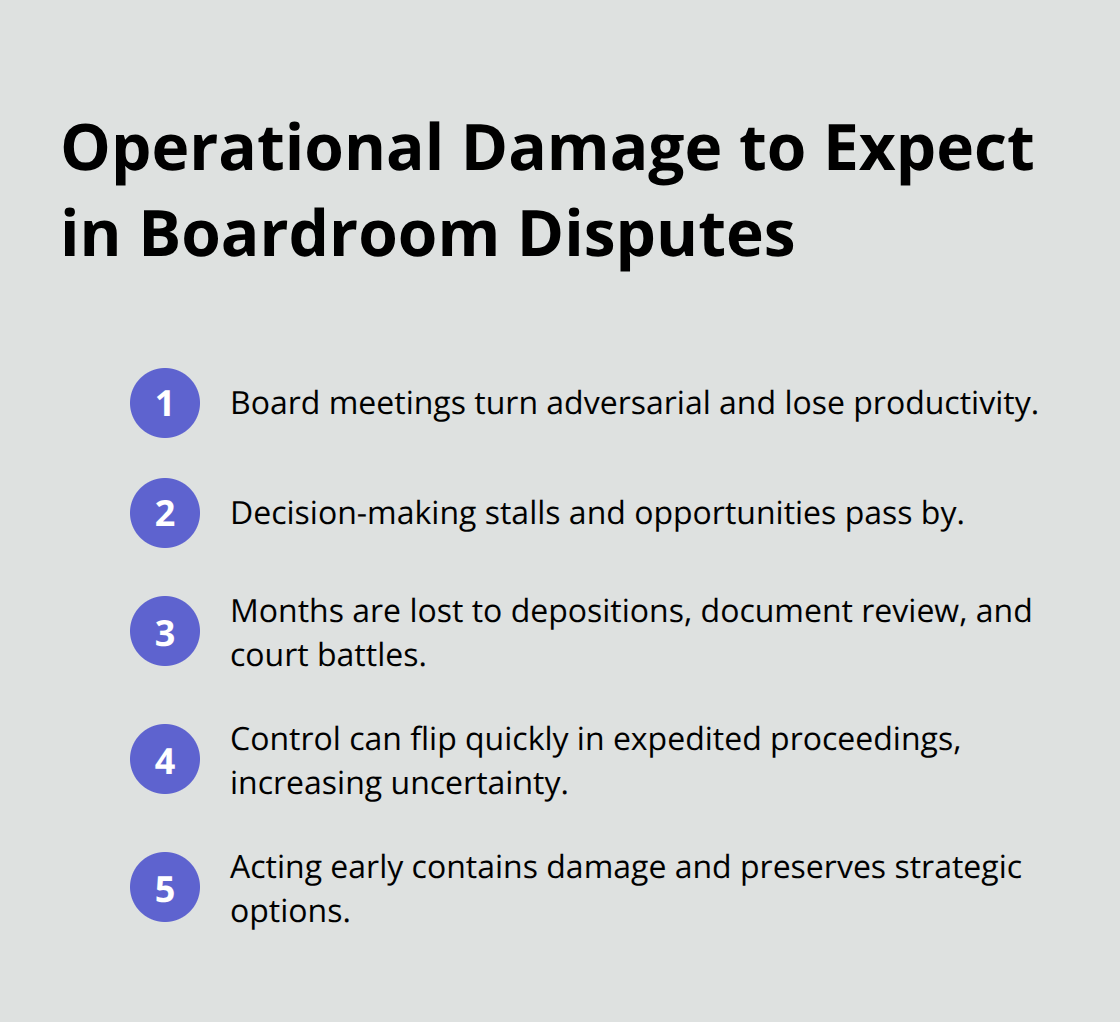
Control disputes frequently play out through proxy fights or removal votes, and Section 225 of the Delaware General Corporation Law empowers courts to determine rightful directors in fast proceedings-meaning control can flip suddenly. The sooner you identify a boardroom conflict and act, the sooner you can contain the damage and move toward resolution. Waiting signals weakness and gives opposing factions time to entrench themselves, remove allies from the board, or lock up votes through shareholder agreements you did not know existed. Understanding these dynamics positions you to move into the specific causes that trigger boardroom disputes in the first place.
Common Causes of Boardroom Disputes in Orange County
Strategic Disagreements That Harden Into Conflict
Strategic disagreements in Orange County businesses rarely stay confined to boardroom discussion. When founders or majority shareholders push the company in a direction that minority owners view as reckless or self-serving, conflict hardens fast. A director may champion an acquisition that diverts cash from dividends, or a controlling shareholder may demand the company enter a market that conflicts with a co-owner’s competing business. These tensions explode when one faction realizes the other has the votes to steamroll through decisions without consensus.
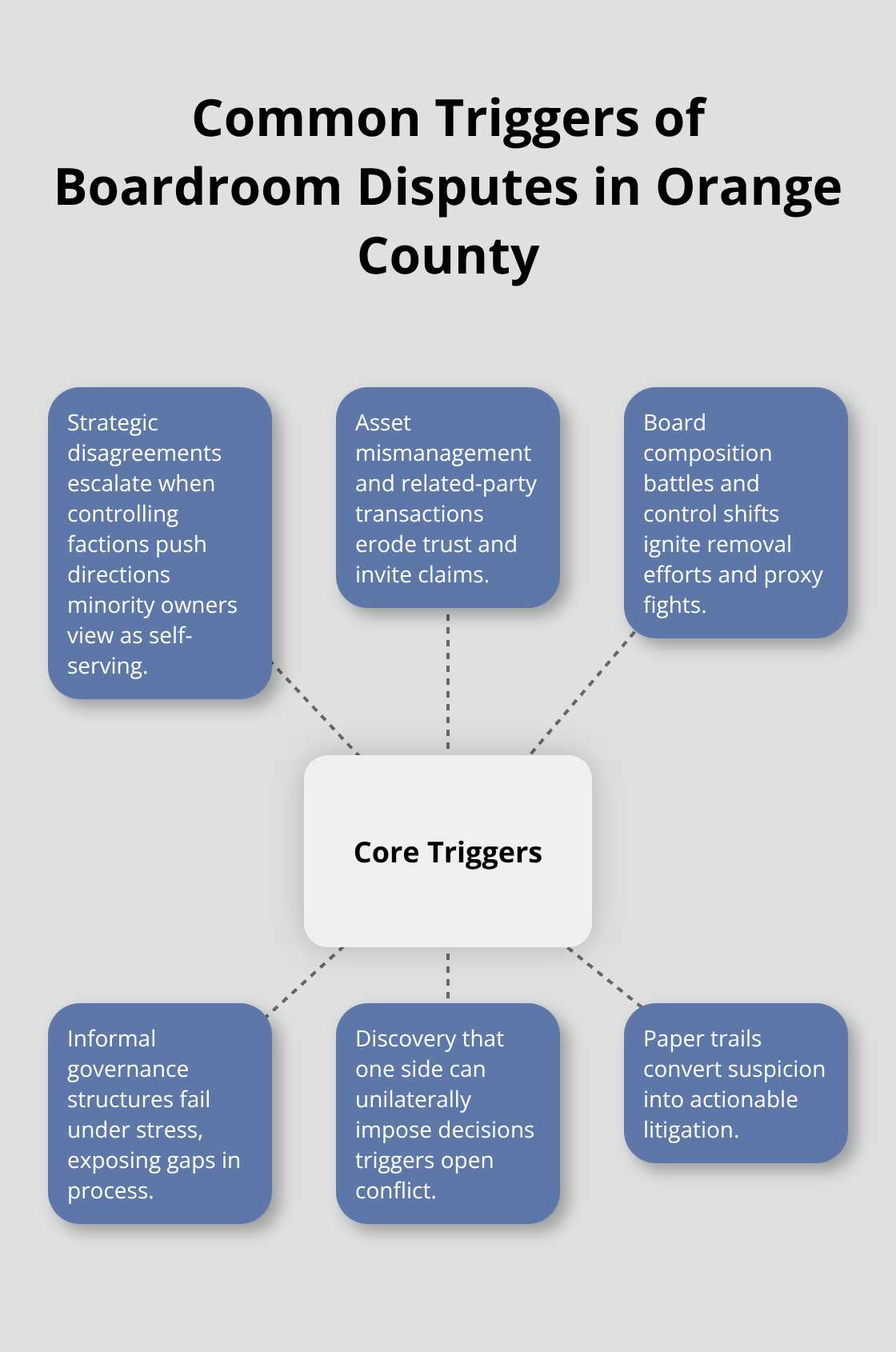
In closely held companies, informal governance structures amplify these problems. Handshake agreements about company direction evaporate when circumstances change, and no written governance documents exist to mediate the dispute. The real trigger is not disagreement itself but the discovery that one party can unilaterally impose its will on the others.
Asset Mismanagement and Related-Party Transactions
Asset mismanagement claims follow naturally from strategy conflicts. When a director or officer diverts company funds to related entities, takes excessive compensation without board approval, or loans company money to themselves at favorable rates, minority owners lose trust immediately. The 2019 Business Roundtable statement emphasized that boards must act in the company’s interest, yet many Orange County business owners operate without independent oversight or formal approval processes for related-party transactions.
A shareholder notices company cash flowing to a director’s consulting firm, or discovers that a majority owner granted themselves a seven-figure bonus while cutting everyone else’s compensation. These discoveries fuel derivative claims and direct shareholder litigation because the damage is tangible and documented. The paper trail becomes evidence that transforms suspicion into actionable claims.
Board Composition Battles and Control Shifts
Board composition disputes ignite when one faction attempts to remove or replace directors to consolidate control. A majority shareholder demands the removal of a minority-appointed director, or a faction of board members votes to replace the CEO without following proper procedures. Section 225 of the Delaware General Corporation Law allows courts to determine rightful directors in expedited proceedings, which means control can shift overnight through a successful removal vote or proxy fight.
Orange County business owners often underestimate how quickly board seats can flip. A shareholder agreement that grants removal rights without cause creates vulnerability-once one side moves to remove an opponent’s director, the other side must respond immediately or lose their voice entirely. The operational damage compounds when removal efforts paralyze decision-making. Board meetings become battlegrounds, committees refuse to function across factional lines, and management teams receive contradictory directives from competing board factions.
The Cascade of Operational Damage
Companies in this state cannot execute acquisitions, refinance debt, or make capital investments because no one trusts the decision-making process anymore. The longer removal battles drag on, the more damage accumulates. Key executives leave because they see instability ahead, clients sense weakness, and lenders grow concerned about governance breakdown. Acting decisively to either defend your board seat or remove an adversary prevents months of operational paralysis and positions you to move toward resolution before irreversible harm occurs.
Defending Your Position When Boardroom Conflict Erupts in Orange County
The moment a boardroom dispute surfaces, most business owners make a critical mistake: they assume negotiation will solve it. That assumption costs them months of lost time and thousands in unnecessary legal fees. We at Raul Garcia Law Firm have seen countless Orange County companies wait too long to assess their actual leverage, which means they enter settlement talks from a position of weakness. The first step is always a rigorous, honest evaluation of your governance claims and your opponent’s vulnerabilities, followed immediately by a clear-eyed decision about whether negotiation or litigation gives you the better outcome. This assessment must happen within days, not weeks, because boardroom disputes move fast and control can shift through a single shareholder vote or board removal action.
Map Your Legal Position First
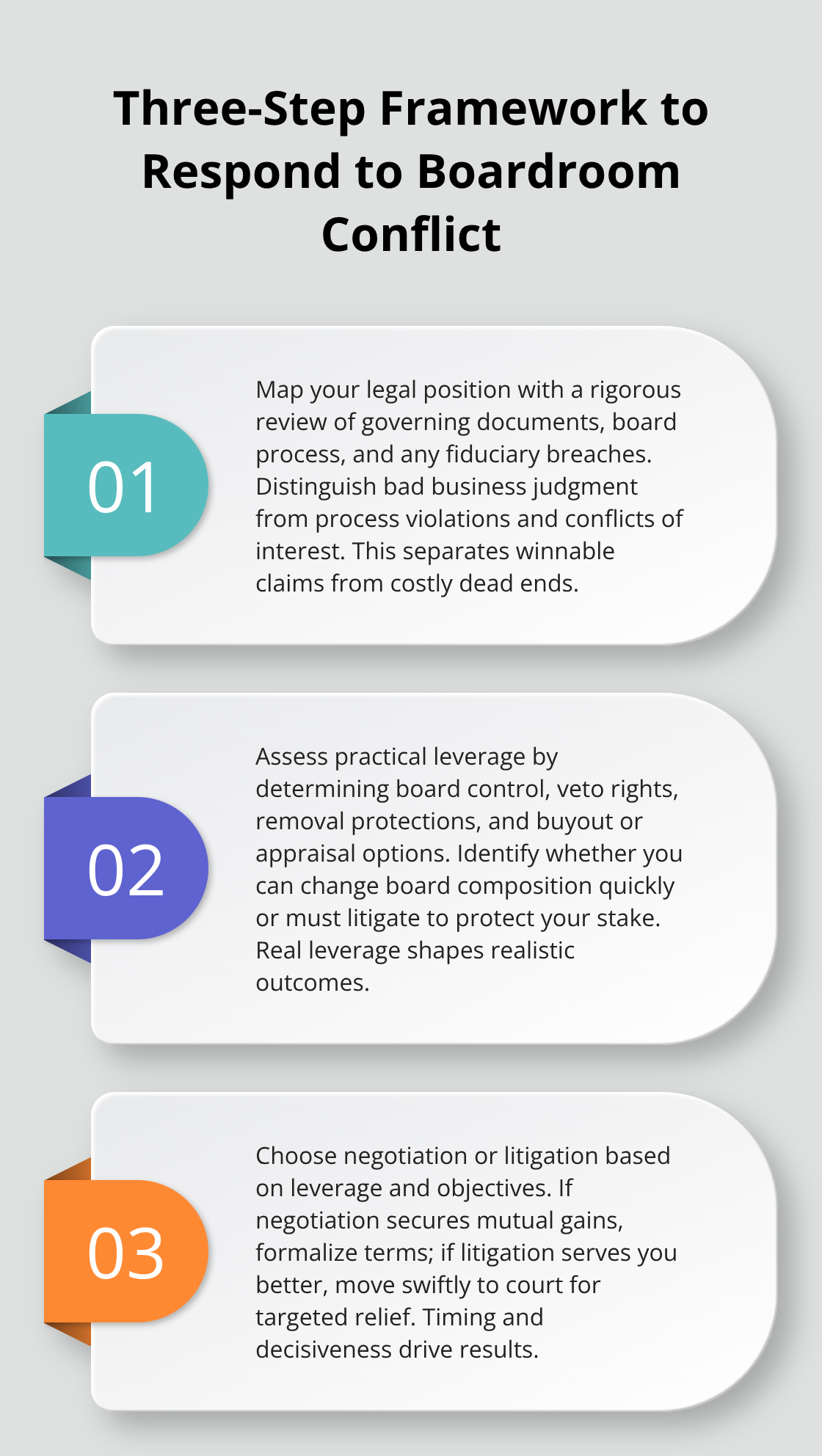
Your initial assessment should focus on three concrete questions: Do the governing documents support your position, or do they contain ambiguities your opponent can exploit? What is the actual decision-making process that led to the contested action, and can you document that process with board minutes, emails, or witness testimony? Can you identify a breach of fiduciary duty that a court would recognize, or are you arguing over business judgment where courts will defer to the board’s decision?
The Delaware General Corporation Law and California Corporations Code both protect director decisions made in good faith, on an informed basis, and in the company’s best interests through the business judgment rule. If your opponent can show they followed proper process and disclosed conflicts, courts will not second-guess the outcome. If your claim rests on the idea that the board made a bad business decision, you will lose. If your claim rests on the idea that the board violated process, failed to disclose a conflict, or acted in self-interest rather than the company’s interest, you have a case worth fighting.
This distinction separates winnable claims from expensive losing battles. Many Orange County business owners confuse disagreement with fiduciary breach, and that confusion leads them to spend six figures on litigation they cannot win.
Assess Your Practical Leverage
Once you understand your legal position, you must assess your practical leverage. Do you control the board, or does your opponent? If you are a minority shareholder, can you block major decisions through a supermajority requirement in the operating agreement, or do you have no formal veto rights? Can you force a buyout under the governing documents, or will you need to litigate for an appraisal of your shares?
If you control the board, can you remove an opposing director through a removal vote, or does the shareholder agreement grant removal protection to that director? These questions determine whether you have real negotiating leverage or whether litigation is your only path forward. A controlling shareholder with the ability to remove opposing directors from the board sits in a far stronger position than a minority owner with no formal governance rights.
We see many minority owners enter negotiations convinced they have stronger claims than they actually do, which leads them to reject reasonable settlement offers and pursue litigation that depletes their resources. Conversely, controlling shareholders sometimes overestimate their legal position and fail to recognize that minority owners have legitimate fiduciary duty claims that will survive a motion to dismiss and reach a jury. The assessment phase eliminates these illusions.
Choose Your Path: Negotiation or Litigation
Once you have mapped your legal and practical position, the path forward becomes clearer. If negotiation makes sense because both sides have genuine leverage and a path to mutual benefit exists, you structure settlement discussions to protect your interests and lock in gains through a formal agreement. If litigation is your better option because your opponent’s legal position is weak or because negotiation would signal weakness and invite further demands, you move immediately to court with a clear strategic objective.
Many Orange County business owners fear litigation will destroy working relationships, but in boardroom disputes, the relationship is already destroyed. Litigation simply formalizes what has already happened. The question is whether you litigate from a position of strength or from a position of desperation after months of failed negotiation.
Companies that negotiate for six months accomplish nothing and then litigate from a weakened position because they have depleted cash reserves and lost management focus. Conversely, companies that move to court immediately can secure a favorable preliminary injunction within weeks and then negotiate from a position of strength with an opponent who suddenly becomes willing to talk. Timing and decisiveness matter far more than most business owners realize.
Final Thoughts
Boardroom dispute litigation in Orange County moves faster than most business owners anticipate, and control can shift through a single shareholder vote or removal action before you recognize what happened. Your first move must be a clear-eyed assessment of your legal position and practical leverage within days, not weeks. Do your governing documents support your claims, can you document the decision-making process that triggered the dispute, and do you have a genuine fiduciary duty claim or merely a disagreement about business judgment?
Once you understand your position, you must decide whether negotiation or litigation serves your interests better. Many Orange County business owners assume negotiation is always preferable, but that assumption often costs them months of wasted time and thousands in legal fees. If your opponent has weak legal claims and you control the board, litigation from a position of strength may force them to accept a reasonable settlement within weeks.
The operational damage from prolonged boardroom conflict compounds daily as key executives leave, clients sense instability, and strategic opportunities disappear while factions fight. Companies that move decisively to defend their position or remove an adversary contain this damage and position themselves for resolution before irreversible harm occurs. Contact us now to map your position and move forward with confidence.