

Boardroom disputes can paralyze a company’s operations and drain resources faster than most business leaders anticipate. When shareholders clash with directors, or control battles erupt, the stakes become existential for your organization.
Corporate governance litigation in California requires specialized knowledge of state statutes, local court procedures, and the judges who preside over these complex cases. We at Raul Garcia Law Firm have guided Orange County businesses through these conflicts with precision and strategic clarity.
What Disputes Actually Drain Orange County Boardrooms
Shareholder Derivative Claims and Fiduciary Breaches
Shareholder derivative claims represent one of the most destructive governance battles because they target the board’s fundamental duty to act in the corporation’s best interest. When a shareholder sues on behalf of the company against directors or officers, the litigation exposes internal decision-making to external scrutiny and fractures trust at the highest levels. Breach of fiduciary duty claims allege that directors prioritized personal gain over shareholder welfare, engaged in self-dealing on contracts, or misappropriated corporate assets. These cases demand forensic analysis of board minutes, email communications, and transaction timing to establish intent and motive.
Director and Officer Liability Disputes
Director and officer liability disputes often center on whether individual managers acted within their authority or violated their legal obligations. Orange County businesses frequently face claims that officers exceeded their scope of authority or that directors failed to oversee management adequately. These disputes expose personal liability for individual board members and officers, creating pressure to settle even weak claims to avoid personal financial exposure.
Control Disputes and Ownership Deadlocks
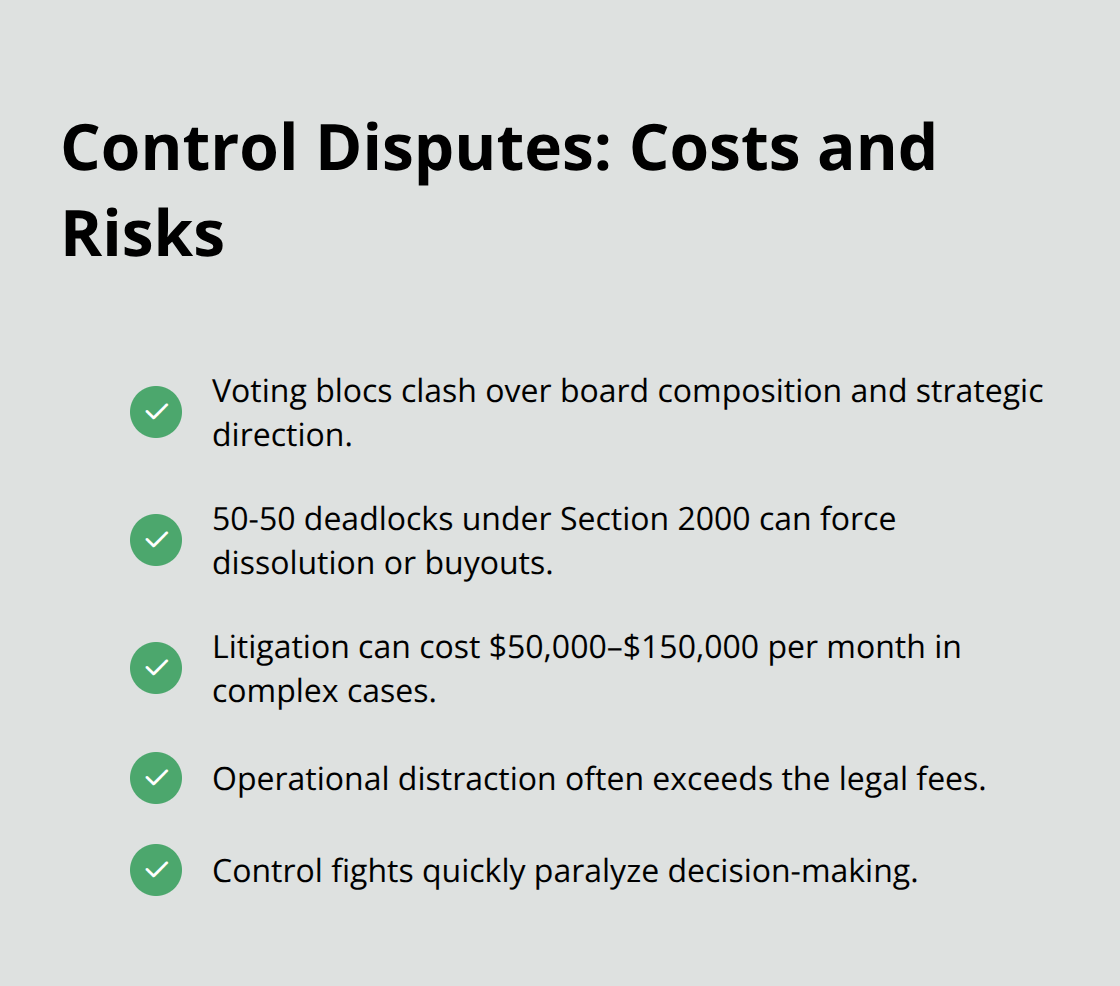
Control disputes emerge when voting blocs clash over board composition, merger decisions, or fundamental business direction. Deadlocks in 50-50 ownership structures under California Corporations Code Section 2000 can paralyze operations entirely, forcing dissolution or expensive buyout negotiations. The financial damage escalates quickly: litigation costs mount at $50,000 to $150,000 per month in complex governance cases, and the operational distraction often costs more than the legal fees themselves.
Why Governance Breakdowns Trigger Cascading Conflicts
The real risk lies in what these disputes reveal about governance breakdowns. A forced CEO removal signals deeper conflicts between legacy leadership and new investors, exactly like the Ben & Jerry’s dispute with Unilever in 2025, where governance protections proved inadequate to prevent leadership disruption. Courts in California interpret governance agreements strictly, and ambiguities in board authority or veto rights are resolved against the party claiming broader power. Your governance documents must define independent director authority with surgical precision, specify which decisions require supermajority votes, and establish clear exit mechanisms before disputes ignite. Without enforceable mission-protection clauses or governance safeguards, even founders lose control of their company’s direction.
Prevention Through Documentation and Early Review
Governance disputes are preventable through ironclad documentation and early legal review of merger terms, investment agreements, and board structures before disputes emerge. The practical takeaway is straightforward: ambiguous governance language creates litigation risk that compounds over time. Strategic approaches to resolving corporate governance conflicts require early assessment of your exposure and a clear understanding of which disputes warrant negotiation versus courtroom representation.
How to Stop Governance Disputes From Consuming Your Business
Assess Your Exposure Immediately
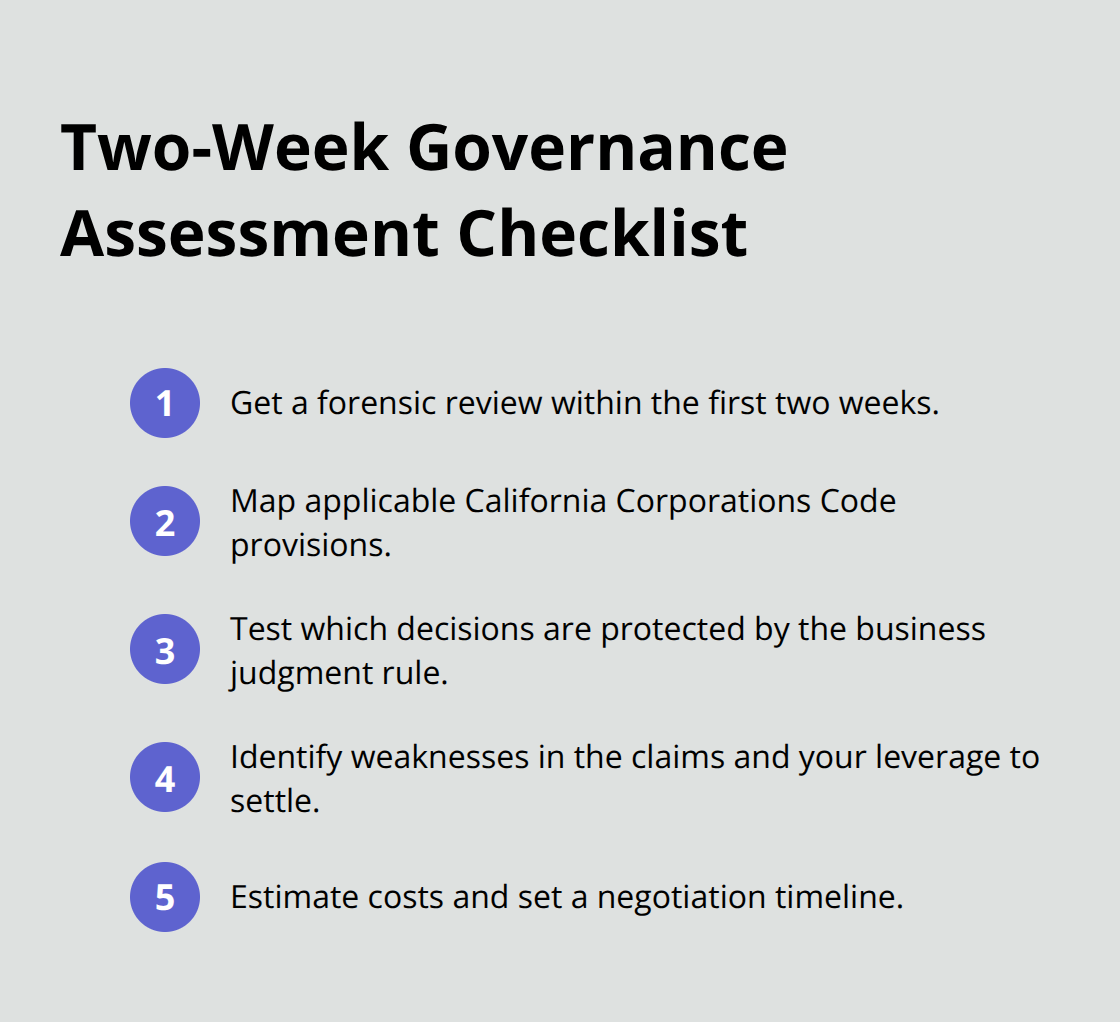
The moment a governance conflict surfaces, most Orange County business leaders face a critical decision: assess the actual exposure before committing resources to a lengthy courtroom battle. Early assessment means obtaining a forensic review of your governance documents, board minutes, and the specific claims being raised within the first two weeks of a dispute emerging. This window matters because evidence degrades, memories fade, and opposing counsel begins building narratives that become harder to counter later. A qualified corporate governance attorney should evaluate whether your company has genuine legal exposure or whether the claims rest on weak contractual language that a court would likely interpret in your favor.
The cost of this initial assessment typically ranges from $10,000 to $25,000 and can save hundreds of thousands in unnecessary litigation. Your attorney should map which California Corporations Code provisions apply to your dispute, identify which board decisions are defensible under the business judgment rule, and determine whether settlement leverage exists before litigation escalates.
Understand the True Cost of Prolonged Conflict
Negotiation and settlement strategies work best when both parties understand the true financial and reputational cost of litigation. Courts in California increasingly push parties toward mediation or arbitration before trial, and many governance dispute contracts already require these steps before litigation proceeds. Governance litigation costs $50,000 to $150,000 monthly in complex cases, and trials extend 18 to 36 months, meaning total exposure often exceeds $1 million before a verdict arrives.
If settlement discussions begin early, you control the narrative and timeline rather than reacting to discovery demands and depositions. Demand letters should specify damages calculations, reference the exact contractual language being disputed, and propose resolution mechanisms tied to your company’s actual financial capacity.
Prepare for Litigation With Strategic Documentation
If litigation becomes unavoidable, your preparation must include document preservation protocols immediately. Organize all board communications and meeting minutes into searchable databases and identify expert witnesses who can testify about industry governance standards. Courtroom representation in governance cases succeeds when your attorney understands both the legal doctrine and the business context-meaning your counsel must be fluent in merger agreements, mission-protection clauses, and the specific board authority disputes that triggered the conflict.
The evidence that matters most includes contemporaneous board minutes showing proper deliberation, email trails demonstrating good-faith decision-making, and expert testimony about whether your board followed governance practices standard in Orange County businesses of comparable size and complexity. Courts in California interpret governance agreements strictly, and your documentation must establish that your board acted with deliberation and transparency throughout the disputed decisions.
Build Your Courtroom Strategy Around Business Realities
Governance disputes demand counsel who speaks both legal doctrine and business language. Your attorney must understand how merger agreements function, what mission-protection clauses actually protect, and which board authority disputes created the conflict in the first place. This dual fluency separates effective representation from theoretical legal arguments that judges dismiss as disconnected from commercial reality.
The strongest cases combine clear contractual language with evidence of breach and quantifiable damages. When your governance documents define independent director authority with precision, specify which decisions require supermajority votes, and establish clear exit mechanisms, courts enforce those terms decisively. Ambiguous language, by contrast, invites judicial interpretation that often favors the party with broader claimed authority-a risk that compounds when disputes reach trial.
Why Specialized Governance Counsel Wins Orange County Disputes
California’s Strict Interpretation of Board Authority
California Corporations Code Section 141 grants boards broad discretion to manage corporate affairs, but that discretion operates within rigid fiduciary constraints that shift based on transaction type, shareholder class, and whether directors face conflicts of interest. Most Orange County business leaders underestimate how narrowly California courts interpret governance statutes compared to Delaware, where case law has evolved over decades to provide predictability. California judges apply strict construction principles, meaning ambiguous board authority language gets resolved against the party claiming broader power-exactly the opposite of what most business owners assume.
Courts in Orange County have consistently upheld shareholder derivative claims under California Corporations Code Section 309 when directors failed to act with the care an ordinarily prudent person in a similar position would exercise. The standard applies regardless of whether the board followed informal governance practices common in smaller companies. The Delaware Court of Chancery’s June 15, 2026 decision on director independence heightened presumptions favoring board judgment, but California courts have not adopted that same deference, leaving Orange County businesses exposed to derivative suits that Delaware companies would dismiss on demand futility grounds.
This distinction matters enormously because it means your governance documentation must prove affirmative compliance with fiduciary duties through contemporaneous board minutes, conflict-of-interest disclosures, and documented deliberation-not merely the absence of obvious wrongdoing.
Local Court Procedures Shape Litigation Outcomes
Local court systems in Orange County operate with specific procedural requirements that separate effective litigation strategy from generic corporate law approaches. Superior Court judges in Orange County have developed predictable patterns in handling discovery disputes, expert witness qualification challenges, and summary judgment motions in governance cases. Counsel unfamiliar with these local tendencies waste months and hundreds of thousands in discovery battles that experienced practitioners resolve through targeted motion practice.
Judges in Orange County expect governance litigation to proceed through mandatory mediation before trial. The parties who prepare settlement positions early-with precise damages calculations tied to specific contractual breaches-control negotiation outcomes far more effectively than those who treat mediation as a formality before courtroom warfare.
Why Local Expertise Translates to Lower Costs
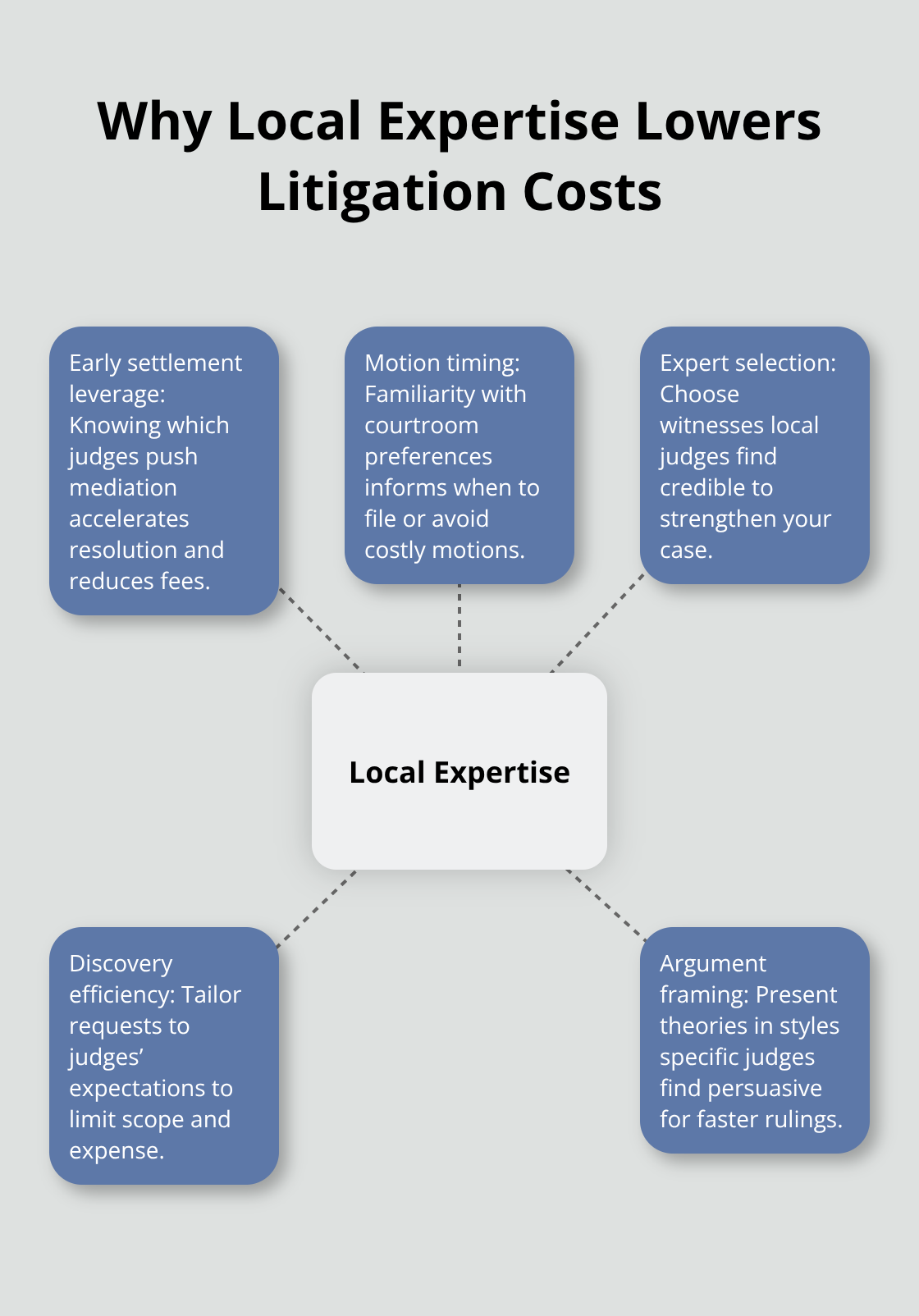
Complex business disputes in Orange County courts succeed when counsel understands both the substantive law and the procedural preferences of specific judges. Your attorney must have tried cases in front of the judges assigned to your case and understand which arguments those judges find persuasive versus dismissive. This dual competency (legal doctrine plus local court knowledge) separates representation that produces faster resolution from representation that extends litigation timelines unnecessarily.
An Orange County boutique litigation practice that focuses on complex commercial disputes brings this localized expertise directly to your governance case. Counsel familiar with Orange County Superior Court procedures knows which judges push parties toward early settlement and which judges permit extended discovery. This knowledge translates into strategic decisions about motion timing, expert witness selection, and settlement positioning that reduce overall litigation costs substantially.
Final Thoughts
Boardroom disputes in Orange County demand counsel who understands California’s strict interpretation of fiduciary duties, knows the local court system intimately, and translates complex governance documents into actionable litigation strategy. Your governance documents must define board authority with precision, because vague language about director independence, voting thresholds, or mission-protection clauses creates litigation risk that compounds over time. Courts in California interpret these ambiguities against the party claiming broader power, meaning weak documentation becomes a liability the moment a dispute surfaces.
Specialized legal representation separates outcomes that preserve your company’s operations from outcomes that paralyze decision-making for years. Your attorney must understand both the substantive law and the procedural preferences of Orange County judges, because this dual competency determines whether your case settles within months or extends into costly discovery battles. Counsel familiar with local court procedures knows which judges push early settlement and which arguments specific judges find persuasive, and this knowledge translates into strategic decisions that reduce overall litigation costs substantially.
If your business faces a governance conflict, obtain a forensic review of your exposure within the first two weeks (this initial assessment typically costs $10,000 to $25,000 and can save hundreds of thousands in unnecessary litigation). Raul Garcia Law Firm represents Orange County businesses in corporate governance litigation California cases and complex commercial disputes, delivering strategic advocacy grounded in practical business insight and aggressive representation to protect your financial interests. Contact the firm today to assess your governance exposure and develop a resolution strategy tailored to your company’s actual circumstances.