

When a business fails to honor a contract, you need to know exactly what compensation you can recover. We at Raul Garcia Law Firm help Orange County business owners understand their breach of contract remedies and fight for the damages they’re owed.
This guide walks you through three paths to recovery: what damages courts recognize, how to negotiate settlements effectively, and when litigation becomes necessary.
What Damages Can You Actually Recover in Orange County
Expectation and Consequential Damages
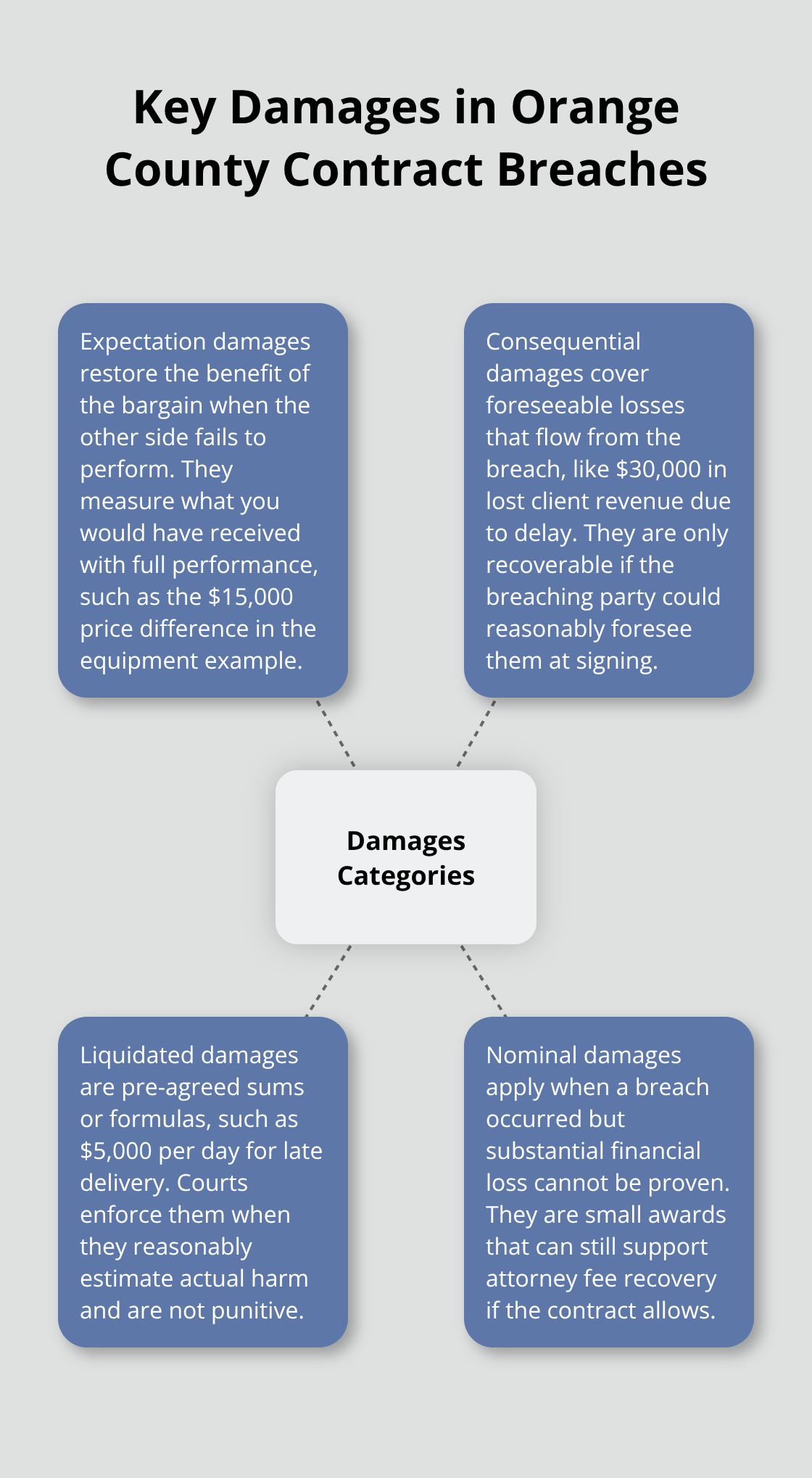
When a contract breaks down, not all losses qualify for recovery. Orange County courts recognize three distinct categories of damages, and understanding which applies to your situation directly affects what you can collect. Compensatory damages represent the most common recovery path, designed to restore you to the position you would have occupied if the breach never happened. These split into two types: expectation damages, which measure the value you would have gained from full performance, and consequential damages, which cover losses flowing from the breach itself.
If a vendor contracted to deliver equipment for $50,000 and fails, but you must purchase a replacement for $65,000, your expectation damages equal $15,000. Consequential damages go further-if that equipment delay caused you to lose $30,000 in client revenue, you can pursue recovery for those lost profits, but only if the breaching party could reasonably foresee such losses when signing the contract. Courts scrutinize foreseeability heavily because it prevents unlimited liability for unintended consequences.
Liquidated Damages Clauses and Their Enforcement
Liquidated damages clauses offer a different path entirely, and they deserve careful attention. These provisions set a fixed amount or formula for breach damages upfront, commonly appearing in real estate and construction contracts. If your contract states that failure to deliver by a specific date triggers $5,000 per day in damages, courts will generally enforce that figure-but only if it represents a reasonable estimate of actual harm, not a penalty designed to punish.
Orange County judges regularly strike down liquidated damages clauses they view as excessive relative to the contract’s value or the realistic harm from delay. Nominal damages apply when a breach clearly occurred but you cannot prove substantial financial loss, and while the amount recovered is minimal, it can open pathways to attorney fee recovery if your contract includes such a provision.
Building Your Damages Case with Documentation
The strongest damage claims combine solid documentation-contracts, emails showing performance, invoices, delivery records, and communications about losses-with a clear causal link between the breach and your harm. Courts require reasonable approximation rather than exact precision, meaning you need a credible basis for your calculations, not mathematical certainty. This foundation becomes critical as you move toward negotiation or litigation, where the quality of your evidence determines whether you recover full damages or face significant reductions.
Settling Orange County Contract Disputes Before Trial
Organize Your Damages Documentation
Settlement negotiations require far more than a demand letter and patience for a response. Most contract disputes resolve outside the courtroom, but only when you present a compelling case backed by organized evidence and realistic damage calculations. Start by creating a detailed damages summary that itemizes every loss traceable to the breach: direct costs, lost revenue, additional expenses incurred, and any consequential losses you can substantiate.
Compile copies of the original contract, performance documentation showing what you delivered or were supposed to receive, invoices and receipts proving your losses, and communications demonstrating the other party understood their obligations. Courts require reasonable approximation rather than mathematical precision, so your documentation should paint a clear picture of how the breach harmed your business operations, not theoretical projections about what might have happened.
Consider Mediation Before Litigation Costs Mount
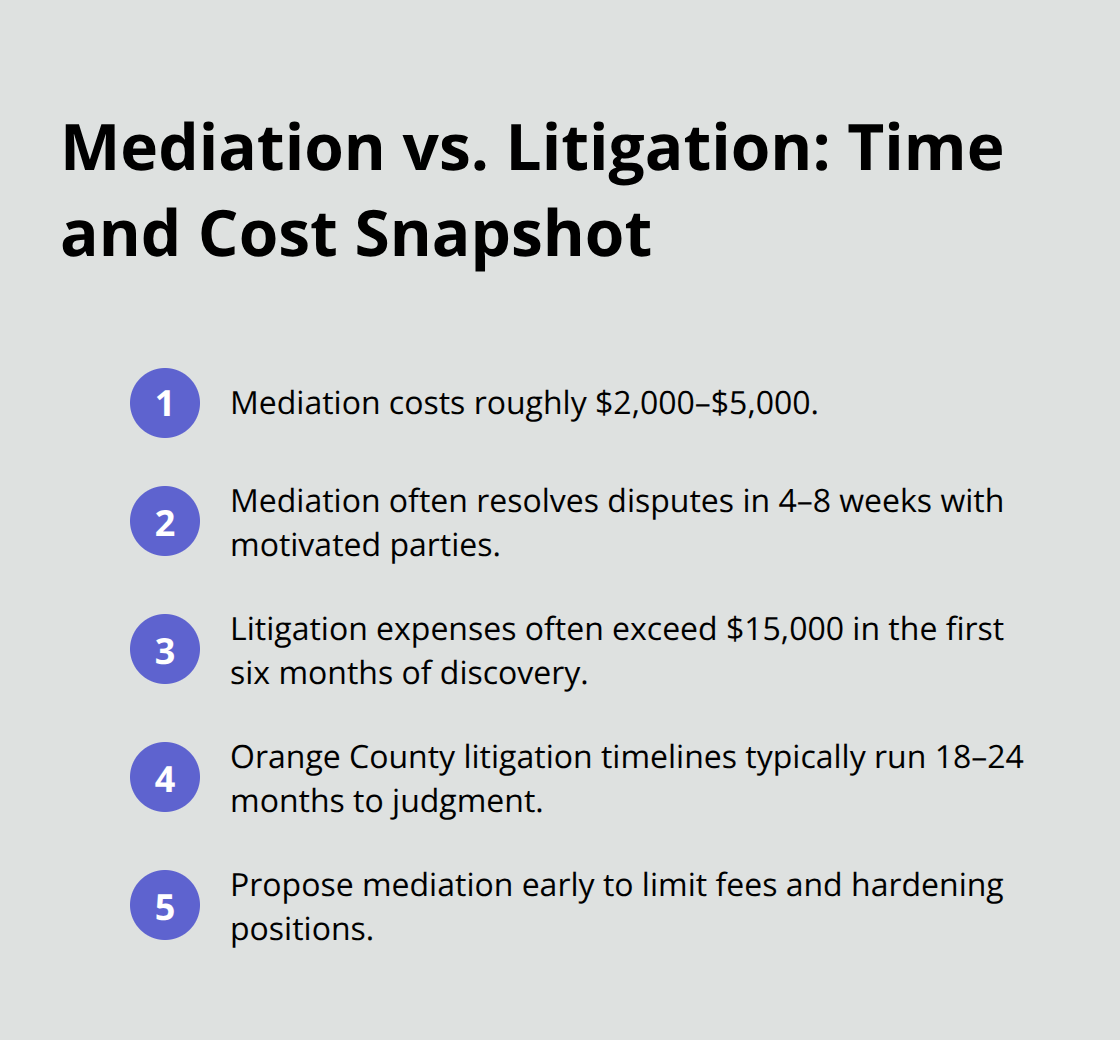
Many Orange County business owners move directly to litigation when mediation could resolve the matter faster and cheaper. Mediation costs roughly $2,000 to $5,000 and resolves disputes in 4 to 8 weeks when parties are genuinely motivated to settle, while litigation expenses often exceed $15,000 within the first six months of discovery alone. Propose mediation early, before positions harden and legal fees accumulate.
During mediation, present your damages documentation systematically, starting with undisputed facts like contract terms and performance dates, then building toward your loss calculations. This structured approach helps mediators understand your position and identify common ground with the other party.
Craft a Strategic Settlement Demand
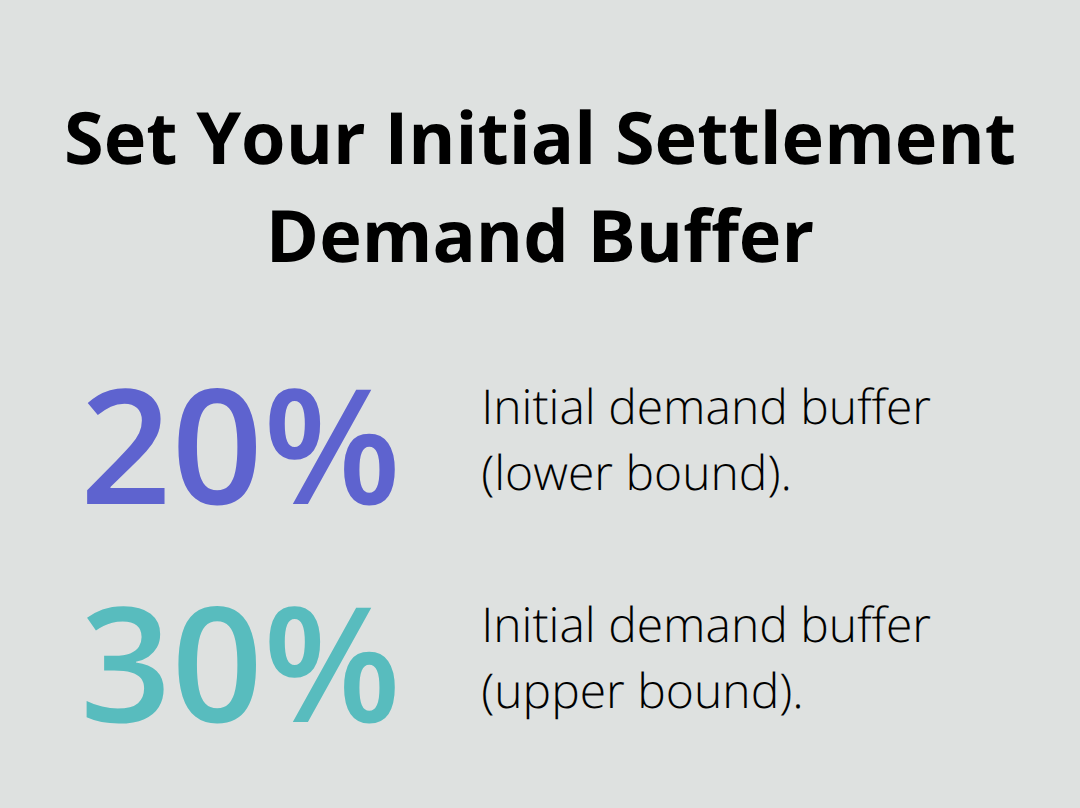
Try setting your initial settlement demand 20-30% above your realistic recovery target, leaving room for negotiation without appearing unreasonable. If the breaching party counters at an insulting level, walk away temporarily rather than accepting pressure to compromise significantly.
Orange County mediators often facilitate multiple rounds over weeks or months, and patience frequently yields better outcomes than rushing settlement.
When you reach a settlement agreement, have an attorney review the terms before signing to confirm the language releases all related claims and includes specific performance obligations if payment is involved. This final step protects you from future disputes over whether the settlement resolved all issues or left certain claims open.
Prepare for Court-Ordered Remedies
If settlement discussions stall and the breaching party refuses reasonable offers, you must shift your strategy toward the remedies a judge can impose. Understanding how Orange County courts calculate damages, award injunctive relief, and allocate attorney fees positions you to make informed decisions about whether continued negotiation makes sense or litigation becomes your best path forward.
Court-Ordered Remedies in Orange County Contract Cases
When your case reaches court, judges follow a specific framework that differs sharply from settlement negotiations. Orange County courts award compensatory damages designed to restore you to the position you would have occupied if the breach never happened, and California Civil Code Section 3300 limits recoverable damages to those arising naturally from the breach or within the parties’ reasonable contemplation at contract formation. Judges require you to prove three elements: that a valid contract existed, that the other party breached it, and that you suffered measurable harm directly caused by that breach.
How Judges Calculate Damages in Orange County
The calculation itself doesn’t demand mathematical precision-courts accept reasonable approximation with a credible basis-but you must present organized evidence showing the breach’s business impact. If a manufacturer contracted to deliver components by March 1st and failed, causing you to miss a $200,000 customer order, you can recover those lost profits only if the manufacturer knew at signing that delays would harm your revenue. Foreseeability acts as the gatekeeper. Courts also recognize that exact damage amounts are impossible to prove in many situations, so they accept your reasonable estimate if you’ve documented the underlying facts thoroughly. This means your documentation strategy from the settlement phase becomes even more critical in litigation because judges scrutinize causation relentlessly-you must show the direct line between the breach and each dollar of loss you claim.
Specific Performance and Injunctive Relief
Beyond compensatory damages, Orange County judges can order specific performance when money alone won’t fix the problem. Specific performance requires that the contract involve unique or irreplaceable assets, that monetary damages prove inadequate, and that the breaching party’s obligations remain clear and definite. Courts rarely grant specific performance for ongoing service contracts or employment agreements because forcing someone to work violates public policy, but they order it regularly for real estate sales, equipment delivery, or intellectual property transfers where the item cannot be easily replaced.
Injunctive relief works differently-judges issue temporary restraining orders or preliminary injunctions to stop harmful conduct while litigation proceeds, such as preventing a former employee from violating a noncompete agreement or blocking a supplier from selling confidential customer lists to competitors.
Attorney Fees and Court Costs
Attorney fees present another path to recovery if your contract includes a fee-shifting provision; California law allows you to recover reasonable fees as damages when the contract explicitly authorizes it, and you can prove the amount through invoices and time records. Courts also award court costs including filing fees, service of process, and expert witness expenses, though these rarely exceed $5,000 unless extensive discovery occurs.
Weighing Settlement Against Litigation
The strategic choice between settling and litigating hinges on whether court-ordered remedies offer substantially more than the other party’s settlement offer, because litigation timelines in Orange County typically extend 18 to 24 months from filing to judgment, during which your capital remains tied up and business focus diverts to depositions and document production.
Final Thoughts on Orange County Breach of Contract Remedies
The decision between settling and litigating rests on concrete numbers, not emotion or frustration with the other party. Calculate what a judge would likely award based on your documented losses and contract terms, then compare that figure to any settlement offer on the table. If litigation could recover substantially more and the breaching party has assets to satisfy a judgment, pursuing court remedies makes financial sense despite the 18 to 24 month timeline.
Settlement offers that approach your realistic recovery target preserve capital and management attention for your business operations rather than depositions and discovery. Protecting your business interests starts now, before disputes arise-review your existing contracts for clear remedies clauses, liquidated damages provisions, and attorney fee language that strengthens your position if breach occurs. When disputes emerge, act quickly to document losses, preserve evidence, and assess whether mediation or litigation serves your interests better.
We at Raul Garcia Law Firm help Orange County business owners navigate breach of contract remedies and recover the damages they’re owed. Contact us for a free consultation to evaluate your claim and develop a recovery strategy tailored to your situation.