

Rent control disputes in Orange County, California have become increasingly complex, with landlords and tenants facing unclear rules and costly mistakes. The stakes are high-one misstep in eviction procedures or rent increase notices can result in significant legal liability.
We at Raul Garcia Law Firm help property owners and renters understand their rights and obligations under California’s rent control laws. This guide breaks down the practical realities of rent control litigation in California and shows you how to protect your interests.
How California’s Rent Control System Actually Works in Orange County
California’s rent control framework operates on two levels, and understanding this dual structure is essential for anyone involved in Orange County property disputes. At the state level, Assembly Bill 1482-the Tenant Protection Act of 2019-sets a statewide baseline that caps annual rent increases at the lower of 5% plus the Consumer Price Index or 10%, whichever is lower. This cap applies within a rolling 12-month period, and landlords can raise rent no more than twice annually. However, this is not a one-size-fits-all rule. Orange County cities impose their own local ordinances that frequently exceed these protections, meaning a property in one jurisdiction may face stricter limits than an identical property across city lines. Some Orange County municipalities maintain rent stabilization ordinances that restrict increases to inflation adjustments alone, while others follow the state baseline. The practical consequence is straightforward: before you issue any rent increase notice, you must verify both the state cap and your specific city’s local rules, because failure to do so exposes you to litigation and damages.
Notice Requirements Trip Up Property Owners Most Often
The mechanics of a valid rent increase notice trip up property owners more often than the math itself. Under California Civil Code Section 827, increases of 10% or less require 30 days’ written notice, while increases exceeding 10% demand 90 days’ notice. The critical detail most miss: that 10% threshold is calculated against the tenant’s rent from 12 months prior, not the current rent. You must deliver the notice personally, by mail, or by posting and mailing if the tenant is unavailable; electronic notices are permitted only if the tenant previously agreed in writing. A defective notice-one that lacks proper delivery, fails to provide adequate days’ notice, or miscalculates the 10% threshold-can be contested under Civil Code sections 827 and 1946, exposing you to damages and attorney fees. Tenants in Orange County frequently challenge increases by claiming improper notice, and these challenges often succeed because the notice itself becomes evidence of your mistake. The actionable step is simple: maintain comprehensive records of every rent increase, including the prior-year rent figure, the calculation method, the notice date, and proof of delivery. If an increase approaches the 10% threshold, provide 90 days’ notice anyway to eliminate disputes over the threshold calculation.
Recent Policy Shifts Have Reshaped Dispute Risk
California’s rent control landscape shifted significantly after 2024, when Assembly Bill 1482 amendments tightened just-cause eviction protections and owner move-in requirements. As of April 1, 2024, owners who seek to evict a tenant for owner move-in must now move into the unit within 90 days after the tenant vacates and remain there for at least 12 months-a requirement that eliminates speculative move-in evictions. The eviction notice must disclose the moving person’s name and relationship, show that no other vacant similar unit exists on the property, and demonstrate good-faith intent. If the owner fails to move in or move out within 12 months, tenants can demand re-entry at the same terms.
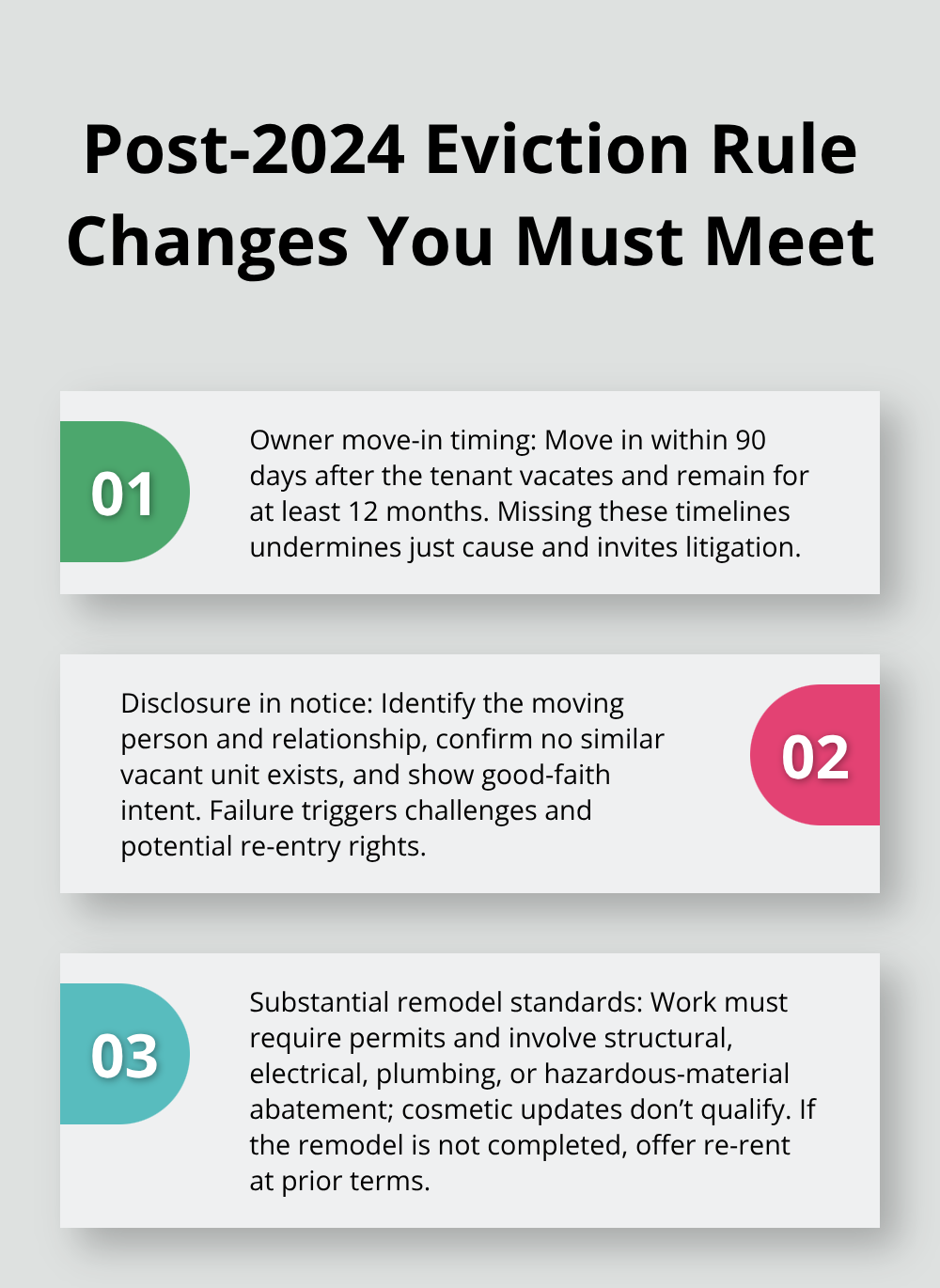
Substantial remodel evictions face equally strict scrutiny: the work must require permits and involve structural, electrical, plumbing, or hazardous-material abatement (cosmetic renovations do not qualify). You must provide detailed work descriptions and permits in the eviction notice, and if the remodel is not completed, tenants must be offered to re-rent at prior terms. These amendments reflect California’s policy shift toward protecting tenant stability, and Orange County courts now scrutinize owner move-in and remodel claims heavily for bad faith. Litigation risk has increased because landlords who misrepresent their intentions face dismissal and liability for the tenant’s legal costs.
Bad Faith Evictions Now Carry Real Consequences
Courts will hold you accountable if your stated reason for eviction does not match your actual conduct. Speculative evictions no longer work in California, and judges examine the facts closely to identify landlords who cite owner move-in or remodels as pretexts for removing tenants. If you claim owner move-in but fail to occupy the unit within 90 days, the tenant can sue for damages and recover attorney fees. If you claim a substantial remodel but perform only cosmetic work, courts will find bad faith and dismiss the eviction. Orange County judges have shown little tolerance for these schemes, and the financial exposure extends beyond the eviction itself-you may owe the tenant’s legal costs and damages for wrongful eviction. The practical reality is that your stated reason for eviction must reflect your genuine intent and actual conduct. Any disconnect between what you claim and what you do will be discovered in discovery and used against you in court.
Understanding these mechanics positions you to avoid costly mistakes, but the intersection of state law, local ordinances, and recent amendments creates complexity that demands careful attention. The next section examines the specific disputes that arise most frequently in Orange County and shows how landlords and tenants navigate these conflicts in practice.
Where Rent Control Disputes Blow Up in Practice
Unlawful Eviction Claims and Retaliation Expose Landlords to Dismissal
Unlawful eviction claims dominate Orange County litigation, and most arise from landlords who skip procedural steps or misread the law. A tenant can challenge any eviction based on improper notice, inadequate notice periods, or absence of just cause under AB 1482. If you serve a three-day notice to pay rent or quit without first documenting the exact amount owed, tenants will contest the calculation and win. Courts in Orange County have dismissed hundreds of evictions because landlords failed to account for partial rent payments, late fees applied incorrectly, or rent increases that exceeded the legal cap. The consequence is not just dismissal-you lose the filing fee, attorney costs, and months of lost rent while the tenant remains in the unit.
Retaliation claims compound this risk significantly. California Civil Code prohibits landlords from evicting tenants in response to complaints about habitability, requests for repairs, or exercise of tenant rights. If a tenant requests mold remediation in writing and you serve an eviction notice within six months, the tenant can claim retaliation, and the burden shifts to you to prove the eviction was not retaliatory. Orange County courts presume retaliation when the timing is close, so you must document that the eviction reason existed independently and was not triggered by the tenant’s complaint.
Keep detailed records showing when maintenance issues were reported, when you discovered lease violations, and when you made the eviction decision-separate from tenant communications about repairs. One landlord in Orange County served a three-day notice two weeks after a tenant requested habitability inspections; the court dismissed the eviction and awarded the tenant damages. The actionable step is straightforward: never serve an eviction notice within six months of a tenant’s repair request, and if you must, document the independent reason thoroughly before serving notice.
Rent Increase Disputes Stem From Calculation Errors and Notice Failures
Rent increase disputes arise from calculation errors and notice failures that are entirely preventable. The most common mistake is comparing the proposed rent to the tenant’s current rent instead of the rent from 12 months prior. If a tenant paid $1,500 twelve months ago and now pays $1,650 (after a prior increase), and you propose $1,815, you have increased the rent by 10% from the prior year ($1,650 to $1,815), but landlords often miscalculate and think they are only increasing from the current amount. This error triggers a notice defect claim, and tenants win these disputes routinely.
The second mistake is failing to account for local ordinances stricter than AB 1482. Garden Grove, Santa Ana, and other Orange County cities cap increases at inflation alone, eliminating the 5% plus inflation option available statewide. If you apply the state formula in a city with stricter controls, your notice is defective and the increase is void. The third mistake is delivering notice improperly. Mailing alone does not satisfy the statute if the tenant is present at the property; you must mail and post the notice or deliver it personally.
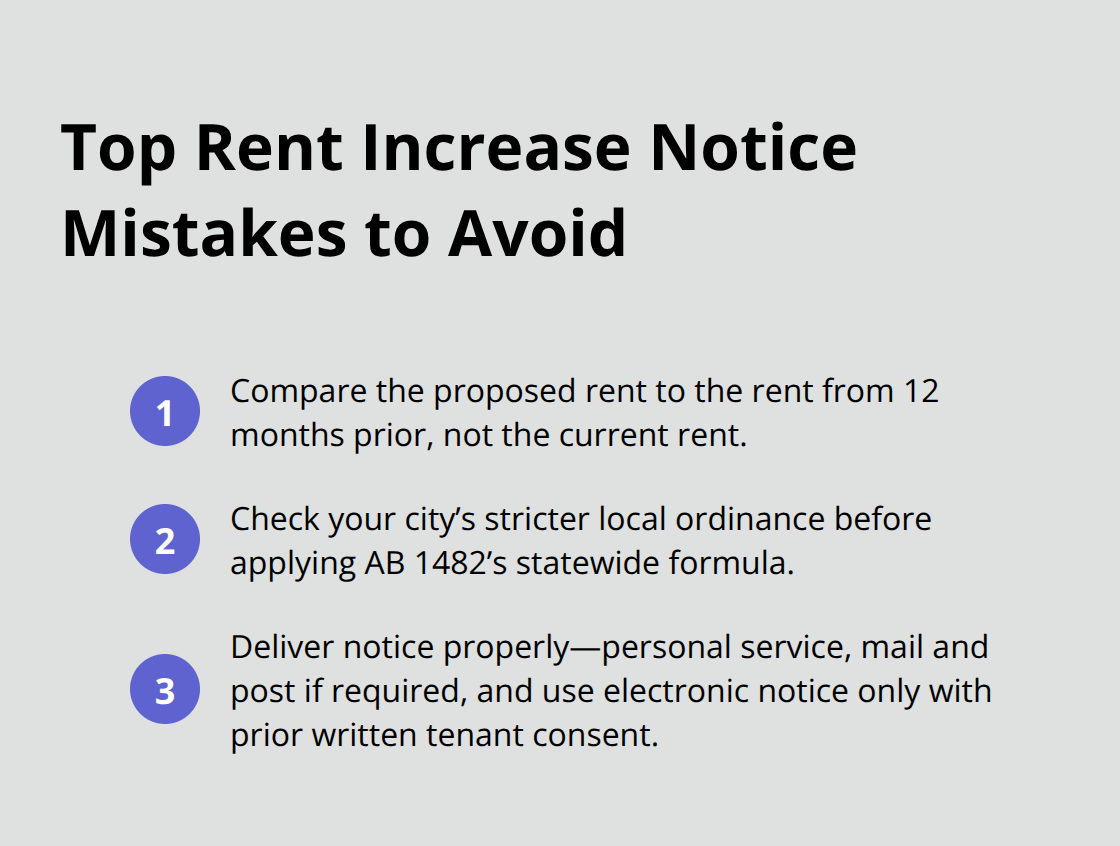
Electronic notices work only if you have written prior agreement from the tenant.
Courts find notice defects easily because the notice itself is the evidence-if it does not meet statutory requirements, the eviction fails. Maintain comprehensive records of every rent increase, including the prior-year rent figure, the calculation method, the notice date, and proof of delivery. If an increase approaches the 10% threshold, provide 90 days’ notice anyway to eliminate disputes over the threshold calculation.
Owner Move-In and Remodel Evictions Carry High Litigation Risk
Owner move-in and just-cause conflicts now consume half the eviction disputes in Orange County. The 90-day move-in requirement and 12-month occupancy mandate eliminate the flexibility landlords once had. If you claim owner move-in but the owner does not occupy within 90 days, the tenant can sue for damages and recover attorney fees. Courts view these failures as bad faith, and the tenant’s remedy includes restitution and statutory damages.
Substantial remodel claims face equal scrutiny. The work must require a permit and involve structural, electrical, or plumbing changes; cosmetic work does not qualify. You must provide the permit or planned permit application in the eviction notice, and if you do not complete the work, the tenant can demand re-entry at the prior rent. Orange County judges have rejected remodel claims where landlords applied fresh paint, replaced carpets, or updated appliances without permits.
The practical reality is that owner move-in and remodel evictions are high-risk litigation strategies in Orange County unless the facts are ironclad and documented before you serve notice. These disputes reveal how closely courts scrutinize landlord conduct, and the next section examines the strategic approaches that protect your interests when litigation becomes unavoidable.
Winning Rent Control Cases Requires Building an Airtight Record Before Court
Documentation Wins Cases Before You Enter the Courtroom
The difference between winning and losing a rent control case in Orange County comes down to documentation you create before litigation starts, not arguments you make in court. Landlords who maintain meticulous records of rent calculations, notice deliveries, and tenant communications win dismissals and summary judgments; those who rely on memory or reconstruct facts after disputes arise lose. This pattern repeats consistently-cases are won or lost on the strength of the evidence you have already gathered.
Start by creating a rent calculation worksheet for every tenant that shows the prior-year rent, the proposed increase amount, the percentage increase, the statutory cap applicable in your city, and the calculation method. Document this worksheet before you serve notice, not after a dispute emerges. Take screenshots or photos of your rent ledger showing payment history, and retain copies of every notice you serve with proof of delivery (personal service receipts, certified mail receipts, or photographs of posted and mailed notices). If you discover a lease violation or maintenance issue, document it with dated photos, video, or written inspection reports signed by you or a third party. This contemporaneous documentation defeats tenant claims that you fabricated reasons for eviction or acted in retaliation.
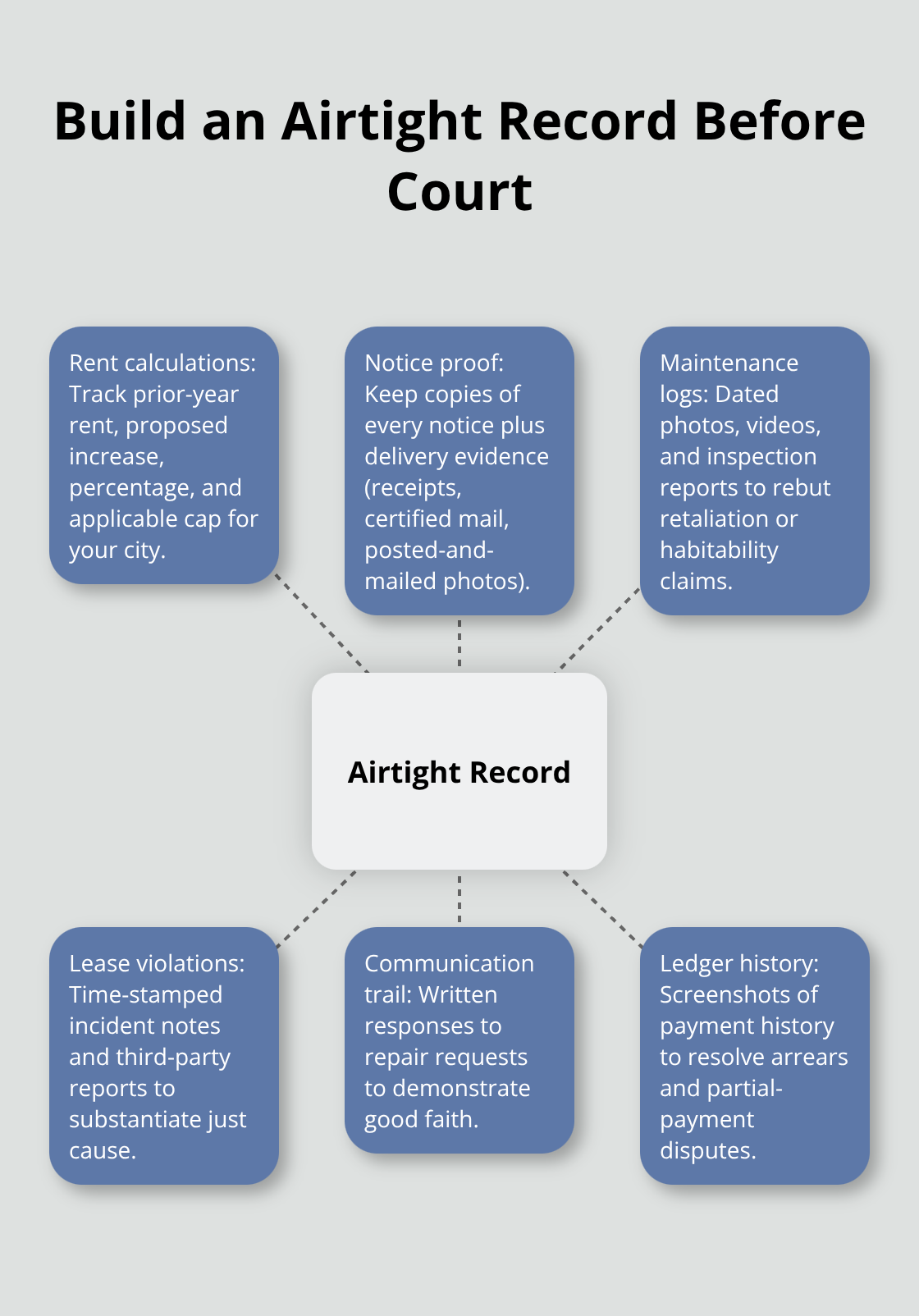
Courts in Orange County trust records created at the time of events far more than testimony created months later during litigation. One landlord in Orange County lost an eviction because he could not produce the written notice he claimed to have served; the court assumed he never served it and dismissed the case. Another landlord won summary judgment because he produced a detailed spreadsheet showing rent calculations for 15 years, making it impossible for the tenant to claim the increase violated the cap.
Implement a System That Captures Every Transaction
Implement a document management system that captures every communication with tenants, every notice, every calculation, and every maintenance record in a single location. Use a simple spreadsheet or property management software that time-stamps entries and prevents later alterations. If you manage multiple properties, this system becomes non-negotiable because courts will compare your records across units to identify patterns of misconduct or inconsistency. The system protects you by creating an objective record that survives scrutiny in discovery and trial.
Counterclaims Transform Eviction Cases Into Complex Litigation
Tenants in Orange County increasingly file counterclaims and cross-complaints that transform eviction cases into complex litigation where your own conduct becomes the focus. A tenant facing eviction can claim habitability violations, retaliation, discrimination, or wrongful eviction and demand damages and attorney fees, shifting the entire case against you even if the underlying eviction reason is valid. Courts allow these counterclaims routinely, and they succeed when landlords have failed to maintain the property, retaliated after repair requests, or discriminated based on protected characteristics.
The practical defense is simple: maintain the unit to code standards, respond promptly to repair requests, and keep written records of your responses. If a tenant requests mold remediation, respond in writing within a reasonable timeframe and document what you did or why you disagreed with the claim. If you deny a request, explain your reasoning in writing rather than ignoring the tenant. This creates a record showing good faith, not retaliation. One landlord in Orange County served a three-day notice two weeks after a tenant requested habitability inspections; the court dismissed the eviction and awarded the tenant damages. The timing alone triggered a retaliation presumption that the landlord could not overcome.
Assess Your Evidentiary Strength Before Settlement Discussions
Negotiation in Orange County rent control cases often produces better outcomes than courtroom litigation because judges apply the law strictly and leave no room for compromise. If you are correct on the law but the facts are ambiguous, you face significant trial risk because the court will resolve factual disputes against you if your documentation is weak. Many landlords settle cases by agreeing to reduced rent increases or waived back rent, sacrificing thousands of dollars that proper documentation might have protected.
Before you enter settlement discussions, assess your evidentiary strength honestly. If you have clear written notice, proper calculation, and no evidence of retaliation or bad faith, your negotiating position is strong and settlement should yield favorable terms. If your documentation is incomplete or your conduct is questionable, settlement often costs less than litigation and attorney fees. The critical point is that negotiation should occur from a position of documented strength, not from weakness masked by optimism.
Final Thoughts
Rent control litigation in California demands precision, documentation, and strategic foresight before disputes arise. A single procedural error in your rent increase notice exposes you to damages and attorney fees, while a poorly documented eviction claim invites counterclaims that transform a straightforward case into months of costly litigation. Success depends on what you do before disputes reach court, not on arguments you make afterward.
Maintain detailed records of every rent calculation, showing the prior-year rent figure and the statutory cap applicable in your specific city. Deliver notices properly and retain proof of delivery, document maintenance issues and tenant communications contemporaneously with photos or dated entries in a property management system, and verify that any owner move-in or substantial remodel claim rests on facts you can prove before you serve notice. When disputes do arise, assess your evidentiary strength honestly before deciding whether to settle or litigate, because incomplete records or questionable conduct often make settlement the more cost-effective choice.
The intersection of state law, local ordinances, and recent amendments creates situations where professional guidance becomes essential for navigating rent control litigation in California effectively. Contact Raul Garcia Law Firm to discuss your rent control dispute or receive guidance before you serve notices or pursue evictions in Orange County.