

Commercial real estate litigation in Orange County doesn’t follow a predictable playbook. Mid-market businesses face disputes that threaten profitability, operational continuity, and long-term growth.
We at Raul Garcia Law Firm have seen how the right strategy-applied early-separates businesses that recover from those that spiral into costly court battles. This guide walks you through the tactics that protect your interests.
What Disputes Cost Mid-Market Businesses in Orange County
Lease Disputes Drain Resources Fast
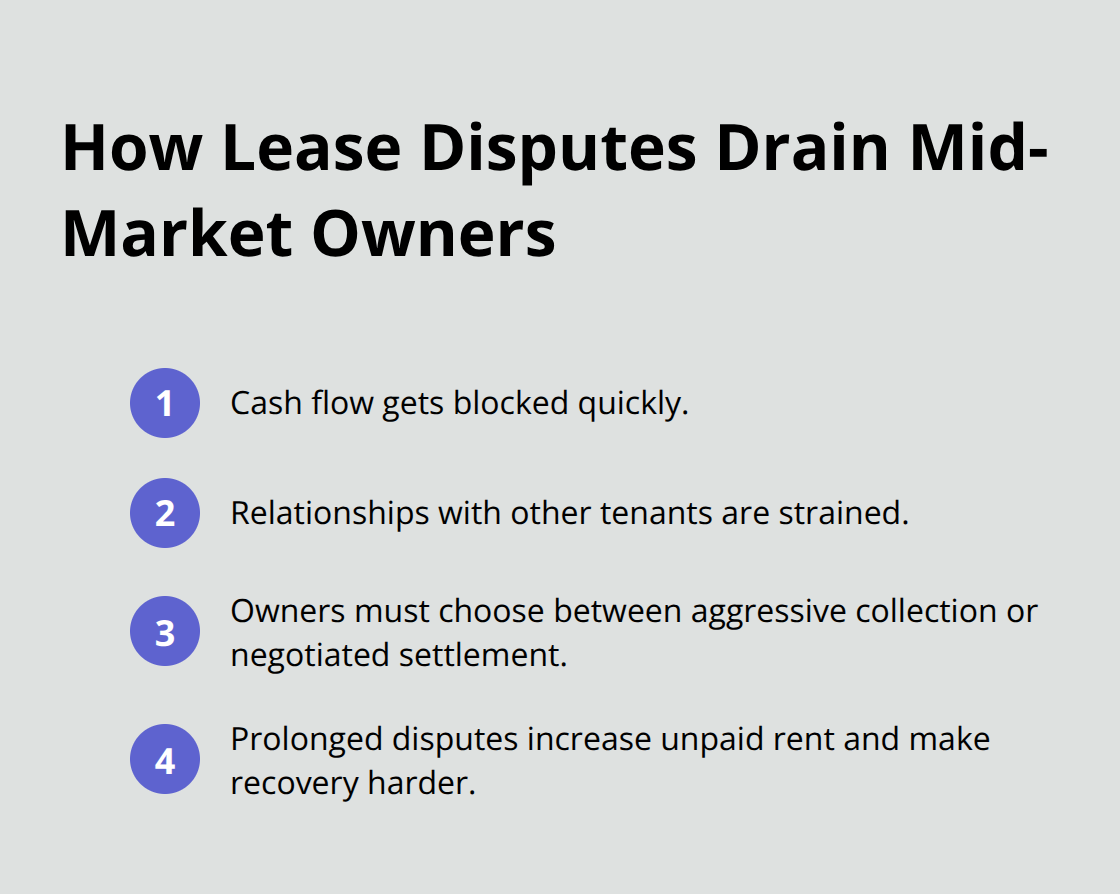
Lease disputes dominate mid-market commercial real estate conflicts in Orange County, and they consume capital quickly. A tenant stops paying rent, disputes maintenance obligations, or claims the space is unusable-suddenly you manage back-and-forth demands while operations continue. These conflicts block cash flow, strain relationships with other tenants, and force owners to choose between aggressive collection tactics and negotiated settlements. The longer disputes persist, the more rent accumulates and the harder recovery becomes.
Boundary and Title Issues Block Transactions
Boundary and title disputes between neighboring properties create different pressure. A survey reveals an encroachment, a neighbor claims easement rights, or property records conflict. These disputes block refinancing, delay sales, and invite title insurance companies to withhold coverage until resolution. A single boundary dispute can freeze a property’s value and prevent owners from accessing capital tied up in real estate.
Development Breaches Unravel Financial Plans
Contract breaches in development and purchase agreements hit harder than lease conflicts. A seller fails to disclose environmental issues, a buyer refuses closing, or a developer misses construction deadlines-each breach unravels financial projections and locks up capital. These disputes often involve multiple parties (lenders, contractors, agencies), which multiplies complexity and extends resolution timelines.
Orange County’s Market Amplifies Risk
Orange County’s real estate market amplifies these risks. The county’s strong commercial fundamentals attract investment, but that same activity creates density and complexity. Mixed-use developments, transit-oriented projects, and industrial expansions mean more touching boundaries, more shared infrastructure, more regulatory entanglement. Projects like the SANDAG Mid-Coast Corridor Transit Project illustrate the scale: a $2 billion, 11-mile trolley extension requires precise property acquisitions across multiple parcels. Any misstep-a missed easement, a misdescribed boundary, or a lease term that conflicts with public agency requirements-cascades into months of renegotiation.
Orange County’s permitting environment adds friction. CEQA review, local conditional use permits, and design approvals create conditions of approval that tie property rights to regulatory compliance. A tenant violates a condition, a developer’s use shifts, or a property owner fails to maintain required mitigation measures-suddenly you face agency enforcement or third-party litigation.
The Financial Toll Accelerates Quickly
Unresolved disputes freeze capital that could fund operations or growth. A mid-market owner with five properties cannot refinance one until a boundary dispute settles. A developer cannot close on land until a purchase agreement breach is resolved. Court litigation costs escalate fast: expert appraisals, surveying, environmental assessment, depositions, and trial preparation consume $100,000 to $500,000 or more depending on complexity.
Settlement negotiations often fail because positions harden early and no structured process exists to bridge them. The longer disputes sit, the worse the financial damage. Tenants withhold rent. Buyers walk away. Lenders demand additional collateral. Clients who waited months before seeking counsel often discover that early documentation, negotiation, and strategy would have shortened timelines and lowered costs dramatically.
Orange County’s 2026 commercial real estate outlook shows rising transaction volume and capital availability, according to J.P. Morgan’s Commercial Real Estate 2026 Outlook. That activity means more deals, tighter timelines, and less room for dispute drift. Businesses that move fast on documentation and early assessment protect themselves. Those that ignore warning signs pay in months of legal fees and operational paralysis-which is why the next section covers the strategic approaches that separate successful dispute resolution from costly stalemates.
How to Stop Disputes Before They Become Lawsuits
The moment you sense a problem-a tenant stops communicating, a survey reveals an encroachment, a seller’s disclosure looks incomplete-your instinct is often to wait and see. That instinct costs money. Mid-market owners lose negotiating leverage and accumulate legal fees simply because they delayed assessment and documentation by weeks or months. The window to control a dispute closes fast, and once it does, your options narrow to expensive litigation or unfavorable settlement. The practical path forward starts with three concrete steps: document your position immediately, pursue structured negotiation before emotions and legal positions harden, and escalate to litigation only when negotiation genuinely fails.
Document Your Position Before You Contact the Other Party
Documentation must happen first. If a tenant stops paying rent, gather lease copies, payment records, notices sent, and communications about the space condition or maintenance issues. If a boundary encroachment exists, obtain the survey, property records, title insurance commitment, and any prior communications with the neighbor about the boundary line. If a purchase agreement falters, collect all written communications, inspection reports, and evidence of the other party’s breach or your own performance.
This documentation serves three purposes: it clarifies your actual legal position without emotion, it prevents the other party from later claiming they never received notice or that facts were different, and it gives your attorney the facts needed to assess settlement value and litigation risk accurately. Most mid-market owners underestimate how much their own records prove their case. An email chain showing the tenant acknowledged a maintenance obligation contradicts later claims of uninhabitability. Payment records and late notices demonstrate the landlord’s diligence. Inspection reports and seller communications establish what was disclosed and when.
Litigation costs $100,000 to $500,000 or more for complex disputes, yet many cases turn on documents that already exist in your files. Spend one week gathering facts. This step saves months of legal discovery and thousands in attorney fees.
Move to Structured Negotiation Quickly
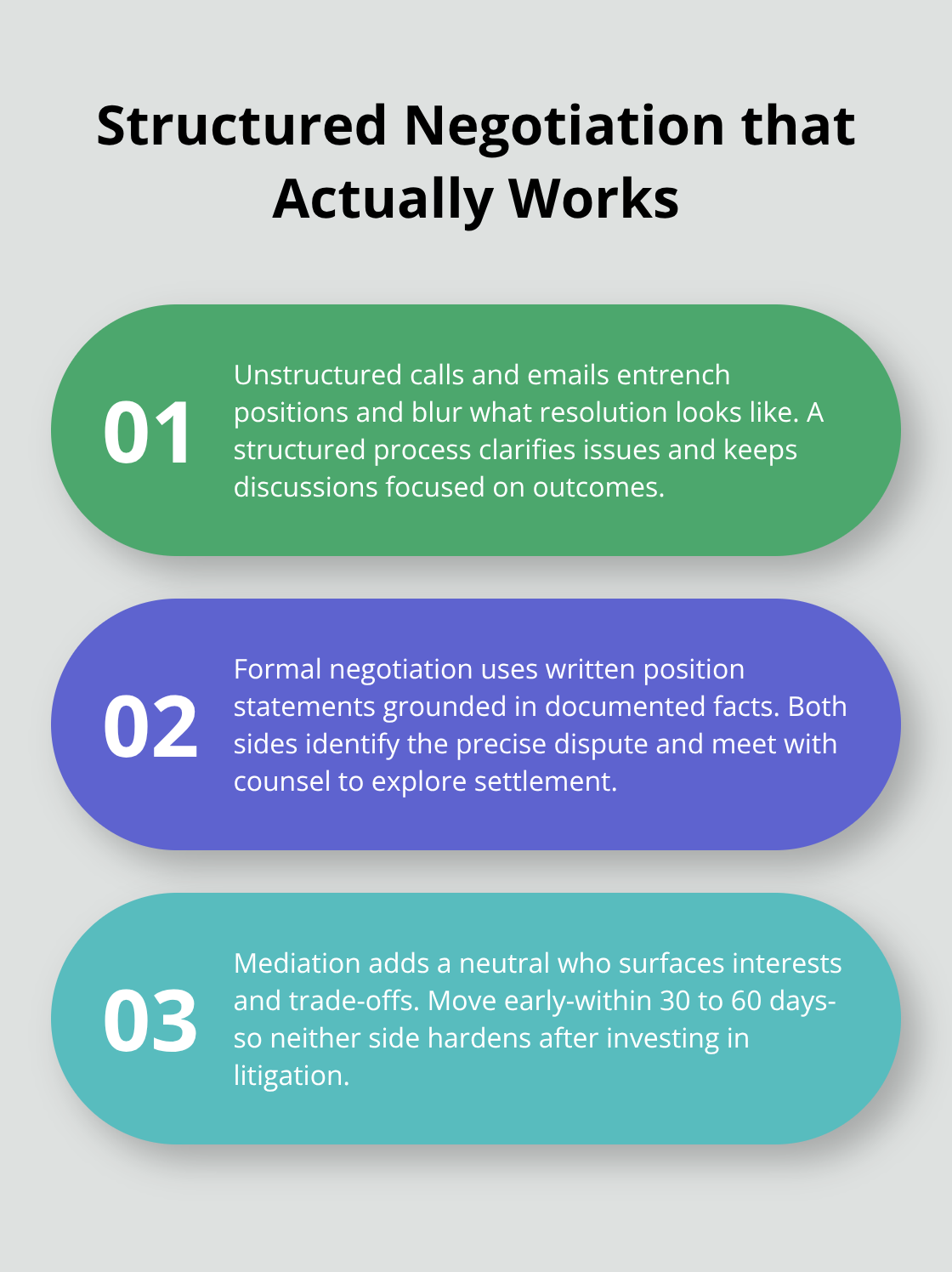
Negotiation requires structure once documentation is complete. Unstructured back-and-forth-phone calls, emails, informal meetings-entrenches positions because neither party has clarity on what resolution looks like or what the other party truly needs. Instead, move to formal negotiation or mediation. In formal negotiation, each side prepares a written position statement grounded in documented facts, identifies the actual dispute (is it rent owed, maintenance responsibility, or lease termination?), and meets with the other party and counsel to explore settlement. Mediation adds a neutral third party who helps both sides understand each other’s interests and find common ground.
California law strongly favors pre-litigation resolution, and most mid-market disputes settle before trial. A lease dispute that might cost $200,000 in litigation often settles for $50,000 to $100,000 through negotiation if both parties understand their litigation risk early. A boundary dispute that would require years of surveying, expert testimony, and appellate risk can settle for a boundary agreement and modest payment if both neighbors see the cost of proving title in court. The key is moving to negotiation quickly-within 30 to 60 days of identifying the problem-before the other party invests in their own counsel and hardens their position.
Delay turns negotiable disputes into entrenched conflicts.
Escalate to Litigation Only When Negotiation Stalls
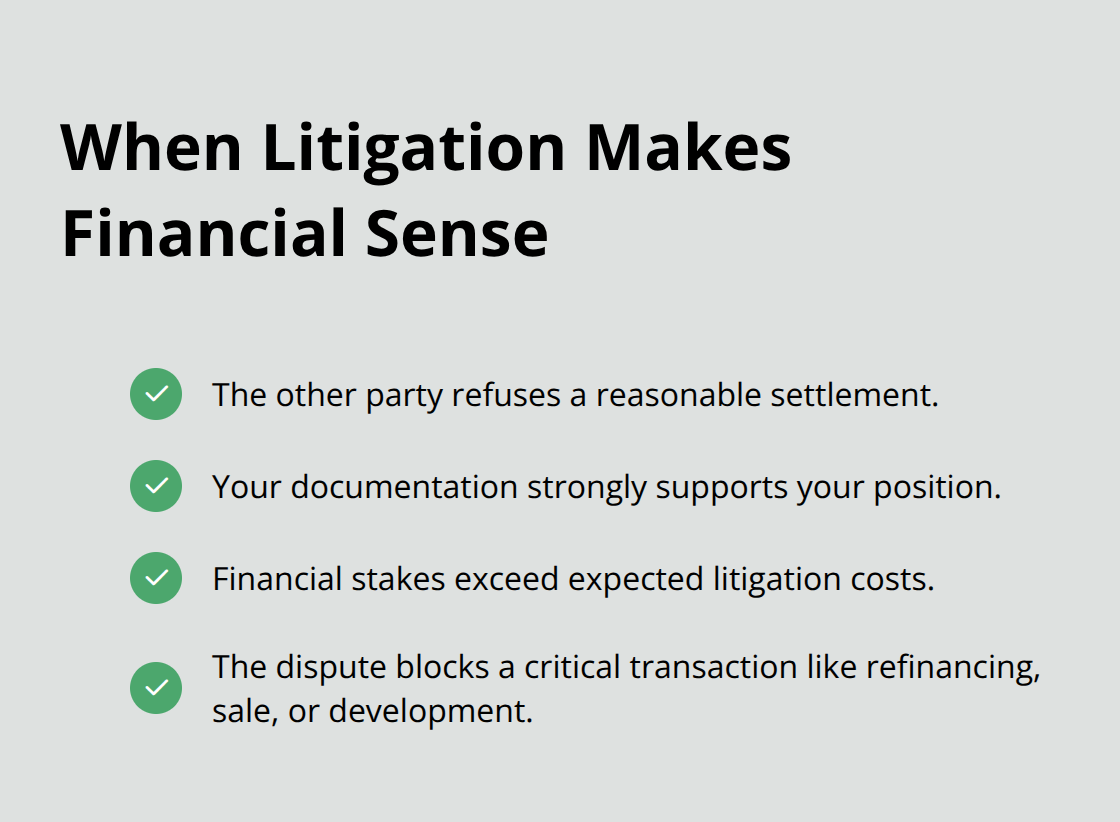
Escalation to litigation becomes necessary only when negotiation genuinely stalls and the financial stakes justify court costs. Not all disputes warrant litigation. A $30,000 lease dispute may not justify $150,000 in legal fees. A boundary encroachment that does not block your use or refinancing may settle for a boundary agreement rather than a title lawsuit. Litigation makes sense when the other party refuses reasonable settlement, when your documentation strongly supports your position, when the financial stakes exceed litigation costs, or when the dispute blocks critical transactions (refinancing, sale, development).
Once you decide to litigate, expect six to 18 months for trial and another six months for judgment and possible appeal. Depositions, discovery requests, expert reports, and motion practice will consume $50,000 to $200,000 before trial even begins. Your attorney must provide a clear forecast of costs and timeline based on case complexity, the other party’s willingness to settle, and local court backlogs. Orange County Superior Court processes commercial cases efficiently, but litigation timelines still require patience and budget discipline.
The businesses that succeed in litigation are those that commit resources upfront, maintain clear communication with counsel about costs, and remain open to settlement as new facts emerge through discovery. Those that treat litigation as a way to punish the other party or prove a point typically spend far more than the dispute’s actual value and end up worse off than had they settled earlier. Once you understand when litigation makes financial sense, the next critical step is selecting counsel who can navigate Orange County’s specific commercial real estate environment and build your case from day one.
Critical Issues in Orange County Commercial Real Estate Cases
Title and Boundary Disputes Demand Speed Over Aggression
Title and boundary disputes between neighboring properties consume time and money because they force you into expert testimony, surveying, and often appellate litigation over questions that should never reach court. A survey reveals an encroachment onto your property, or your title insurance company flags a boundary issue before closing. Your instinct is to demand the neighbor fix it immediately. That demand hardens their position, they hire their own surveyor (who reaches a different conclusion), and suddenly you are locked in a dispute where resolution costs $150,000 to $300,000 in legal fees and expert fees just to establish who owns what.
The real problem is that boundary disputes rarely settle on their own because neither party can easily concede without appearing weak to their lender or their own counsel. Instead, they escalate through depositions, expert reports, and trial. Mid-market owners waste six months and $200,000 fighting over a ten-foot encroachment that could have settled for a boundary agreement and modest compensation if both parties had moved to structured negotiation within 30 days of discovering the problem.
The moment your title company flags an issue or your survey reveals an encroachment, hire an attorney to send a formal letter proposing mediation or negotiation. Speed matters more than aggression at this stage because the other party is still forming their position and may be open to a practical solution before they invest in their own counsel.
Landlord-Tenant Conflicts Follow a Predictable Pattern
Landlord-tenant disputes over lease obligations and defaults follow a predictable pattern that mid-market owners consistently mishandle. A tenant stops paying rent, and the owner waits 60 days hoping the tenant will catch up. During that 60 days, the tenant falls further behind, uses the money for other expenses, and eventually claims the space is unfit for occupancy or that maintenance failures justify non-payment. Once the owner pursues eviction or collection, the tenant has a defense, the dispute shifts to lease interpretation rather than simple non-payment, and litigation costs spiral.
The practical approach requires speed and documentation. Send a formal notice of default within 10 days of missed rent, document the specific lease provision violated, and offer a cure period (typically 5 to 10 days) with clear consequences if the tenant does not comply. If the tenant disputes the default, move immediately to mediation rather than eviction. Mediation costs $2,000 to $5,000 and takes two to four weeks. Eviction litigation costs $15,000 to $40,000 and takes three to six months, and you still may not recover unpaid rent if the tenant lacks funds.
Contract Breaches in Development Demand Immediate Action
Contract breaches in development and purchase agreements demand even faster action because they involve multiple parties and often block critical transactions. If a seller fails to disclose environmental contamination or a buyer refuses closing without justification, your attorney must send a preservation letter within days documenting the breach and your damages, then move to negotiation or mediation within 30 days.
Delay allows the other party to take actions that worsen your position, hide evidence, or claim you waived your rights through inaction. The businesses that minimize litigation costs and recover faster are those that treat every dispute as a negotiation problem first, not a courtroom battle. Your attorney should provide a clear timeline for each phase (notice, negotiation, mediation, litigation) and help you understand when settlement makes financial sense versus when the stakes justify court costs.
Final Thoughts
The disputes that damage mid-market businesses in Orange County rarely resolve themselves, and commercial real estate litigation demands counsel who understands both legal mechanics and business realities that drive settlement. We at Raul Garcia Law Firm represent businesses, owners, and professionals in complex commercial and real estate disputes across contract, partnership, landlord-tenant, title, and related matters. Our approach combines practical business insight with aggressive negotiation or courtroom representation to protect your financial interests and minimize operational disruption.
Selecting the right litigation partner means finding counsel who moves fast on documentation and early assessment rather than waiting for problems to escalate. Your attorney should provide clear timelines and cost forecasts before you commit to litigation, help you understand when settlement makes financial sense, and maintain focus on your bottom line rather than winning at all costs. The best litigation outcomes come from counsel who treats every dispute as a negotiation problem first and understands that most mid-market cases settle before trial.
Building a strong case foundation starts on day one: gather your documents immediately, move to structured negotiation within 30 to 60 days of identifying the problem, and escalate to litigation only when negotiation stalls and the financial stakes justify court costs. Your attorney should guide you through each phase with clarity about what happens next, what it costs, and what realistic outcomes look like. Contact Raul Garcia Law Firm to discuss your situation and understand your options.