

Business disputes in Orange County can derail operations, drain resources, and threaten your company’s future. Contract breaches, partnership conflicts, and property disagreements happen regularly, and without proper California business law guidance, many owners make costly mistakes.
We at Raul Garcia Law Firm help Orange County businesses navigate these disputes strategically. This guide covers the disputes you’ll likely face, the legal framework that governs them, and the practical approaches that actually work.
What Business Disputes Actually Cost Orange County Companies
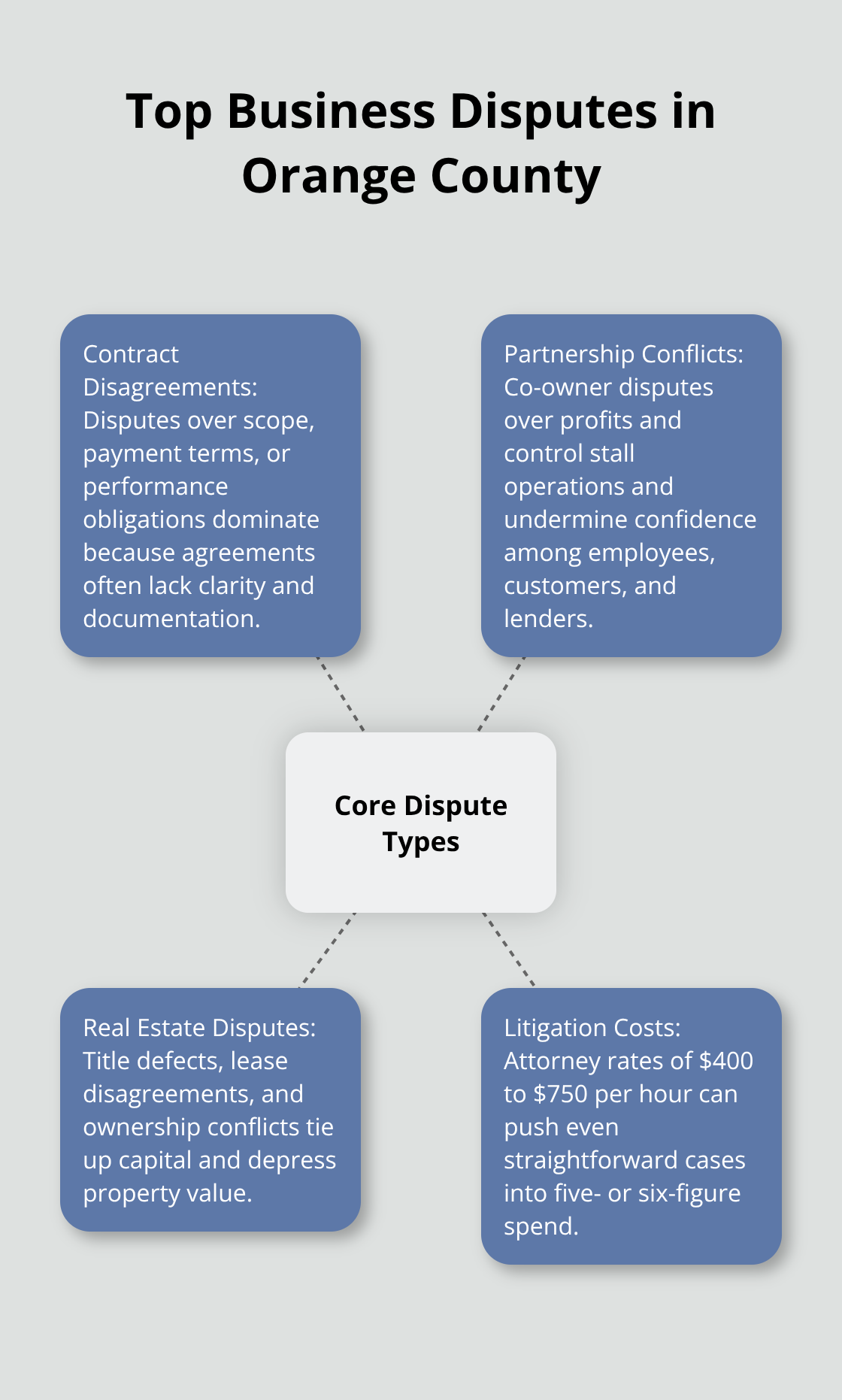
Contract breaches, partnership conflicts, and property disputes represent the three most destructive threats to Orange County businesses. These aren’t theoretical problems-they’re operational emergencies that force owners to choose between expensive litigation, lost time, and damaged relationships. California business litigation in Orange County typically costs between $400 and $750 per hour, meaning a straightforward breach-of-contract case can run $15,000 to $50,000 before trial, while complex disputes with multiple parties easily exceed $250,000. The stakes multiply when you factor in lost productivity, management distraction, and revenue interruption.
Contract Disagreements Trigger Most Orange County Disputes
Contract disagreements dominate Orange County disputes because vendors, suppliers, and service providers frequently misunderstand scope, payment terms, or performance obligations. Disputes over unclear delivery dates, incomplete work, warranty claims, and payment delays trigger the majority of breach claims. A vendor supplies defective materials but claims the contract language shields them from liability. A client refuses final payment because deliverables don’t match specifications. A contractor demands payment for work the business owner considers substandard. These situations escalate because neither party documented the actual agreement clearly enough.
Partnership Conflicts Destroy Companies From Within
Partnership and shareholder conflicts destroy companies from the inside. When co-owners disagree over profit distribution, operational decisions, or fund allocation, the business grinds to a halt while litigation consumes capital and attention. Minority shareholders face exclusion from decisions, funds disappear without explanation, or one partner secretly competes against the company. These internal wars cost more than money-they create uncertainty with employees, customers, and lenders who question the company’s stability.
Real Estate Disputes Lock Up Capital and Property Value
Real estate and property disputes in Orange County frequently involve title defects, lease disagreements, or misrepresentation claims. Tenants claim landlords failed to disclose property conditions. Buyers discover title problems after closing. Partners dispute property ownership percentages or sale proceeds. These disputes tie up capital, prevent refinancing, and create legal clouds that damage property value.
Proper Documentation Prevents Expensive Disputes
Most Orange County business disputes originate in poor contract drafting or missing agreements entirely. A handshake deal between long-time partners avoids conflict until money gets involved. A service agreement uses a generic template that doesn’t address your specific industry requirements. A lease fails to specify maintenance responsibilities, leading to disputes years later. Proactive contract work prevents these problems by establishing clear terms, specific remedies, and dispute-avoidance provisions before conflict arises.
When you invest in proper contract drafting during the formation stage, you eliminate ambiguity that later becomes litigation. Industry-specific language matters enormously-a technology services agreement requires different protections than a construction contract or commercial lease. Clear payment schedules, performance milestones, and dispute-resolution procedures reduce misunderstandings and give you leverage if conflict emerges. Document retention systems become equally critical. Keeping organized records of contracts, amendments, emails, accounting records, loan documents, meeting minutes, and payment history transforms litigation from a guessing game into evidence-based strategy. Companies that maintain these records settle disputes faster and win at trial more consistently than those scrambling to reconstruct transactions from memory.
Settlement Negotiations Resolve Disputes Faster Than Litigation
Settlement negotiations should start immediately when a dispute emerges, not after months of litigation expenses. Negotiation is the most cost-effective resolution path because it avoids discovery costs, expert fees, and court proceedings. A demand letter that clearly states your position, references supporting documentation, and proposes resolution often triggers settlement discussions before formal litigation begins.
Orange County businesses frequently resolve disputes through negotiation by focusing on mutual business interests rather than legal positions. A vendor dispute resolves when both parties agree on acceptable product standards and revised payment terms. A partnership conflict settles when one partner purchases the other at a fair valuation. A lease dispute ends when landlord and tenant agree on repair responsibilities and rent adjustments. These outcomes happen faster and cost less than litigation because they preserve business relationships and avoid court delays.
Mediation offers a middle ground when direct negotiation stalls. A neutral third party facilitates discussion between parties, helping each side understand the other’s interests and constraints. Mediation costs significantly less than litigation and often produces creative solutions that courts cannot order. Arbitration becomes appropriate when your contract includes an arbitration clause, which requires disputes to be resolved through binding arbitration rather than court litigation. Arbitration is typically faster than litigation but may limit your appeal rights depending on contract terms. Understanding which resolution path fits your situation-and acting quickly to pursue it-separates businesses that recover from disputes and those that hemorrhage resources for years.
California Business Law Framework for Orange County Businesses
California statutes governing commercial transactions establish the foundation for how Orange County disputes resolve, but most business owners never read them and instead rely on outdated contract templates or assumptions about what the law requires. The California Uniform Commercial Code (UCC) sections 2-101 through 2-725 control sales of goods, defining when title transfers, what warranties apply, and when payment obligations arise. The California Uniform Partnership Act and Corporations Code sections 15000-15410 establish fiduciary duties for partners and LLCs, meaning co-owners cannot secretly compete against the business or misappropriate funds without exposure to damages and removal. California Civil Code sections 1667-1670 address contract formation and require that agreements be sufficiently clear to be enforceable, which is why vague handshake deals collapse when disputes emerge. Real property disputes fall under California Civil Code sections 1100-1120 for partition actions and sections 3400-3410 for quiet title proceedings, which allow owners to clear title defects or force the sale of jointly owned property.
Statutes That Govern Your Specific Dispute
Understanding which statute governs your specific dispute matters because it determines what remedies you can pursue, what damages you can recover, and what timeline the court must follow. California business litigation typically costs $400 to $750 per hour according to industry surveys, and statute-specific claims require different litigation strategies than general contract disputes. A breach-of-contract claim under the UCC follows different rules than a fiduciary duty claim under the Corporations Code, and real property disputes invoke entirely separate procedural requirements.
Why Alternative Dispute Resolution Saves Time and Money
Alternative dispute resolution avoids the expense and delay of California litigation, which routinely takes 18 to 36 months from filing to trial verdict. Negotiation should be your first approach because it costs nothing beyond attorney consultation time and often produces settlement within weeks once both parties understand their litigation exposure. Mediation through providers like JAMS or the American Arbitration Association adds a neutral facilitator who helps parties reach compromise, typically costing $1,500 to $5,000 total and resolving disputes in two to four sessions.
Arbitration, required by many commercial contracts, is faster than litigation but results in binding decisions with limited appeal rights, so arbitration favors parties with strong evidence and clear legal positions. This approach works well when your contract includes an arbitration clause that both parties agreed to upfront.
Orange County Court Venues and Filing Requirements
Orange County businesses filing in state court typically use the Civil Complex Center in Santa Ana for multi-party disputes or cases exceeding $250,000 in damages, while simpler matters go to the Central Justice Center, also in Santa Ana. Federal cases involving diversity jurisdiction or federal law questions file in the Central District of California, Southern Division. Real property disputes specifically route to the Lamoreaux Justice Center. Limited-jurisdiction cases under $35,000 file at regional centers in Fullerton, Newport Beach, or Westminster depending on location.
Meeting Deadlines and Managing Discovery Costs
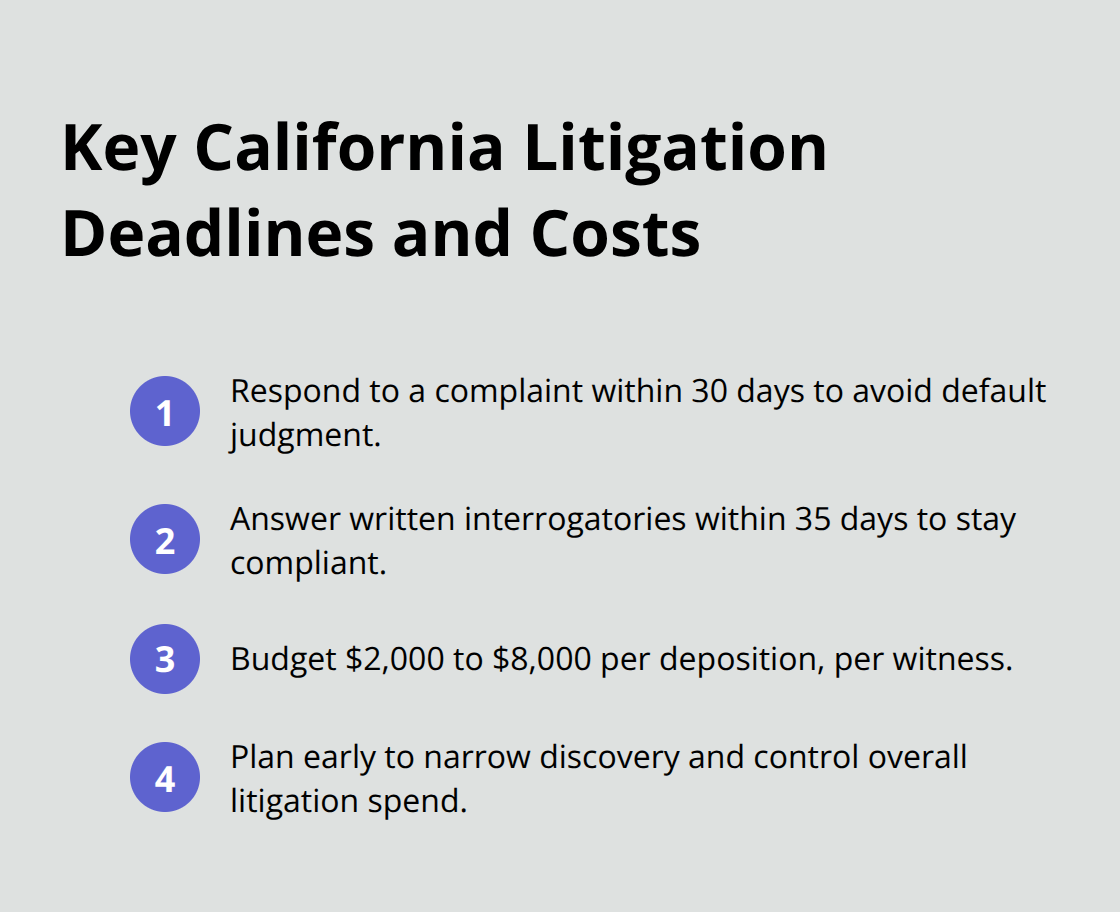
Meeting court filing deadlines is non-negotiable because failure to respond to a complaint within 30 days triggers default judgment, meaning the other side wins without trial. Discovery in California requires exchanging documents, responding to written interrogatories within 35 days, and sitting for depositions that cost $2,000 to $8,000 per witness depending on complexity. Strategic court selection and early preparation for discovery costs separates businesses that control litigation expenses from those buried in surprise legal bills. The venue you select and the discovery strategy you adopt at the outset will shape your entire litigation timeline and budget, making these early decisions critical to protecting your financial interests and operational continuity.
How to Assess Your Dispute Before Spending on Litigation
The first decision you make after a dispute emerges determines whether you spend $15,000 or $250,000 resolving it. Most Orange County business owners skip proper case assessment and jump straight into litigation mode, which wastes money on claims that won’t survive discovery or on cases that settle in the first month anyway. A rigorous early assessment identifies which disputes have legal merit, which ones collapse under scrutiny, and which ones settle quickly if you apply pressure correctly.
Gather Documentation and Identify Your Legal Claims
Start by collecting every document related to the dispute: contracts, emails, invoices, meeting notes, payment records, and any written communications between parties. This documentation either supports your position or exposes weaknesses that will cost you later. Next, identify the specific legal claims available to you. A vendor non-payment situation might involve breach of contract, account stated, or unjust enrichment, and each claim has different proof requirements and damage calculations. A partnership conflict might rest on fiduciary duty violations, fraud, or breach of the operating agreement, and the strength of each claim varies dramatically depending on your facts. An experienced business attorney should conduct this assessment within two weeks of the dispute emerging because delay allows evidence to disappear, memories to fade, and your negotiating position to weaken.
Evaluate Your Own Exposure Honestly
Risk analysis requires honest evaluation of your own exposure, not just the other side’s weaknesses. If you breached the contract first or failed to perform, settlement becomes your realistic goal rather than trial victory. If the other party has stronger documentation or witnesses, arbitration or mediation protects you from a jury that might penalize you for litigation aggression. California litigation statistics show that cases settling before discovery costs average $8,000 to $25,000 in attorney fees, while cases proceeding to trial average $150,000 to $300,000 or more. This cost difference alone justifies aggressive settlement pursuit in cases where your legal position is solid but not overwhelming.
Use Negotiation as Your Primary Tool
Once you understand your legal claims and realistic exposure, negotiation becomes your primary tool. A well-crafted demand letter cites specific contract language, documents the other party’s breach, and proposes concrete settlement terms-often resolving disputes within 30 days. Avoid emotional language or threats; instead, focus on the other party’s litigation costs if they refuse settlement. Most businesses settle when they understand that defending a lawsuit costs $400 to $750 per hour and that trial preparation requires six to twelve months of management distraction.
Pursue Mediation or Arbitration When Direct Negotiation Stalls
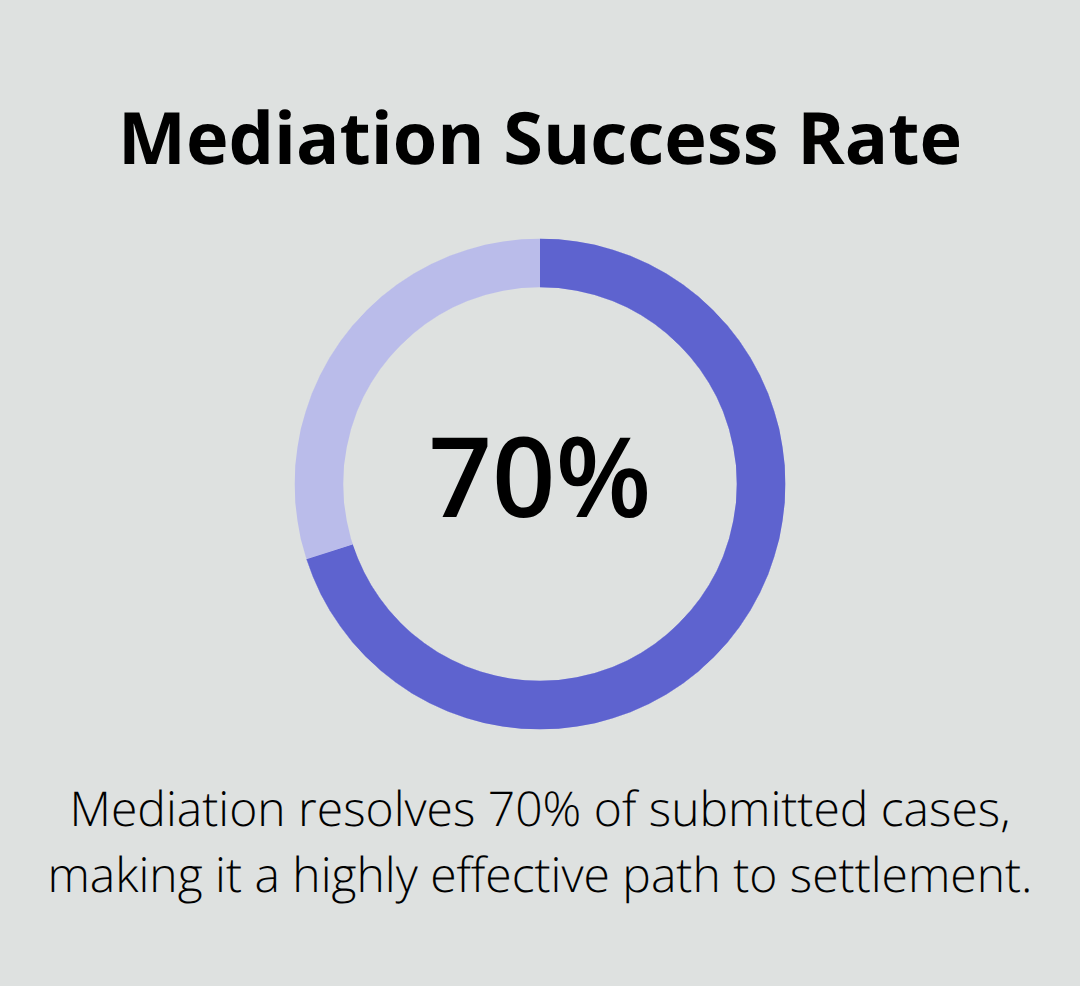
If direct negotiation stalls, mediation through JAMS or the American Arbitration Association typically costs $2,000 to $5,000 total and resolves 70 percent of submitted cases. Mediation works because a neutral third party helps both sides move past positional bargaining into interest-based problem solving. When your contract includes an arbitration clause, arbitration becomes your fastest resolution path, typically concluding within six to nine months compared to 18 to 36 months for litigation.
Prepare for Trial Only When Settlement Genuinely Fails
Trial preparation only makes sense if settlement negotiations genuinely fail and your legal position is strong. This means your contracts are clear, your documentation is complete, your witnesses are credible, and your damages are easily calculated. Trial strategy focuses on witness preparation, evidence organization, and jury selection that favors your industry and dispute type. An Orange County business facing trial should expect 200 to 400 attorney hours for case preparation, expert witness coordination, and courtroom representation, translating to $80,000 to $300,000 depending on case complexity.
Final Thoughts
Orange County businesses protect their interests by acting decisively when disputes emerge. The cost difference between early settlement and trial is staggering-disputes resolved through negotiation or mediation cost $8,000 to $25,000 while trials exceed $150,000 to $300,000. This reality means your first decision after a dispute surfaces determines whether you recover quickly or spend years in litigation.
Seek legal counsel the moment a serious dispute emerges, not after you’ve already made costly mistakes. Many Orange County business owners wait weeks or months hoping disputes resolve themselves, then contact an attorney only after the other party files suit or sends a demand letter. This delay weakens your negotiating position, allows evidence to disappear, and forces you into reactive rather than strategic decision-making. California business law guidance requires understanding which statutes govern your specific situation, what remedies are available, and whether settlement or trial serves your business interests better.
We at Raul Garcia Law Firm represent Orange County businesses in complex commercial and real estate disputes, combining practical business insight with aggressive negotiation and courtroom representation to protect your financial interests and minimize operational disruption. Contact us for a free initial consultation to discuss your situation and explore your options. The sooner you act, the faster you resolve your dispute and return to running your business.