

Unfair competition litigation in Orange County can devastate your business if you don’t understand the rules or act quickly. California’s unfair competition laws are stricter than most states, and the stakes are high.
We at Raul Garcia Law Firm have handled dozens of these cases and seen firsthand how the right strategy makes the difference between winning and losing. This guide walks you through what unfair competition actually means, how to fight back, and what real Orange County cases teach us about winning.
How California’s Unfair Competition Law Works
The Three Pathways to Liability Under Section 17200
California Business and Professions Code Section 17200 casts an unusually wide net compared to unfair competition statutes in other states. The law prohibits three distinct categories of conduct: unlawful business acts, unfair business practices, and fraudulent business practices. What makes this statute dangerous for businesses is that it borrows violations from other laws as independent predicates for liability. A wage-and-hour violation under the Labor Code, a trade secret theft under common law, or even a non-compete breach can trigger a Section 17200 claim without requiring proof of traditional fraud or deception.
The Unlawful Prong: The Most Aggressive Tool
The unlawful prong transforms violations of statutes ranging from Penal Code Section 502 (computer fraud) to Labor Code wage laws into unfair competition claims with their own four-year statute of limitations. This means a business can face liability years after an initial violation occurred, especially if a plaintiff argues the violation continued or was discovered late. Plaintiffs favor this pathway because it sidesteps the need to prove deception or intent-they simply point to the underlying statute and claim unfair competition.
The Unfair and Fraudulent Prongs: Different Standards for Different Plaintiffs
The unfair prong demands a different analysis depending on who is suing. When consumers bring claims, courts balance the utility of the conduct against harm to consumers-a relatively low threshold. When competitors sue, courts require showing incipient antitrust harm or significant competitive injury, which is a higher bar but still achievable in cases involving market manipulation or predatory pricing.
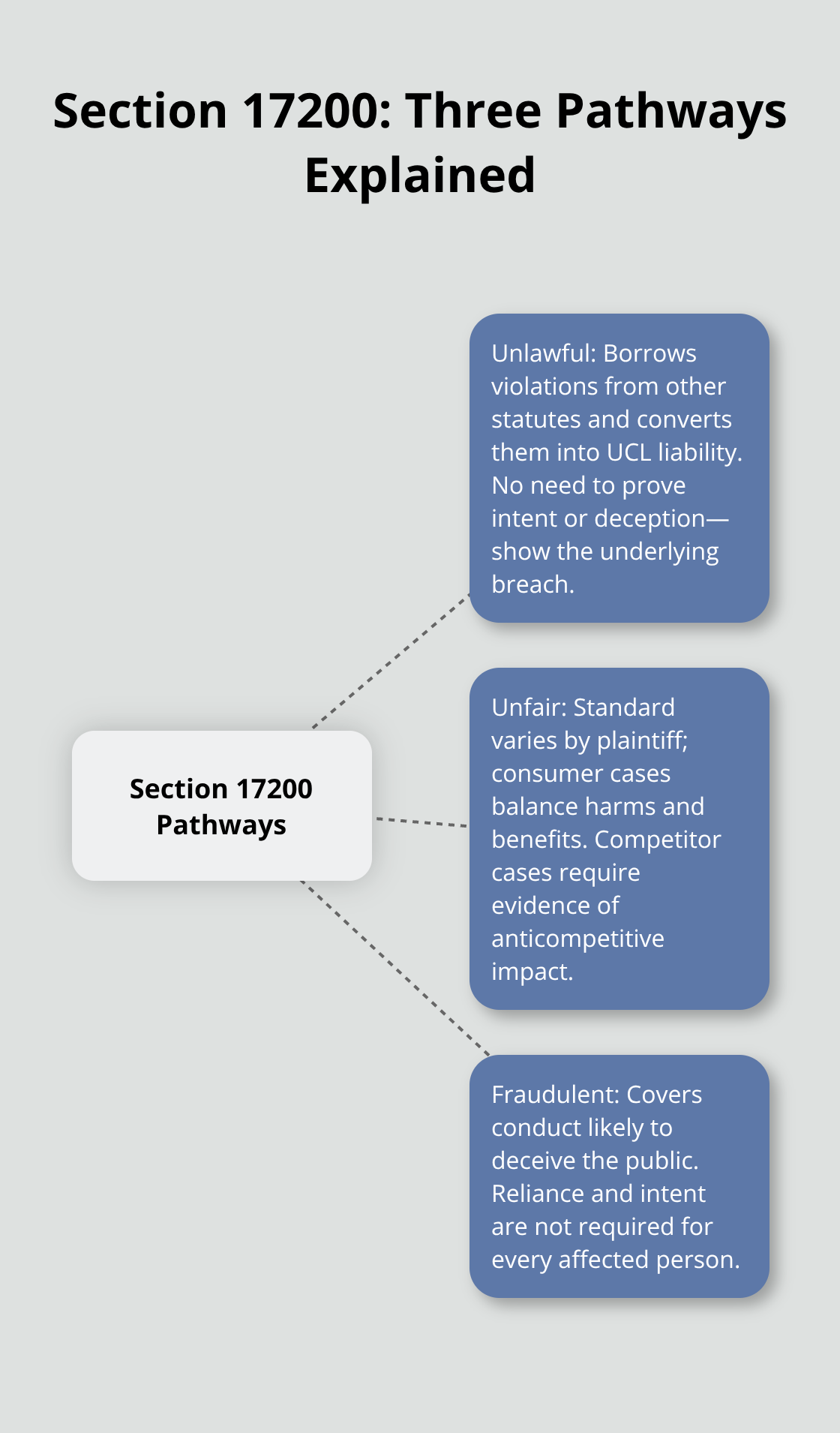
The fraudulent prong covers any conduct likely to deceive the public, and critically, plaintiffs do not need to prove intent or that every affected person relied on the deception. Deceptive advertising, bait-and-switch schemes, hidden fees, and false labeling all fall here.
Remedies That Move Fast
Courts can grant injunctive relief-including temporary restraining orders issued the same day and preliminary injunctions within 30 to 60 days-to halt ongoing conduct immediately. Restitution is limited to actual losses the plaintiff suffered, not the defendant’s profits beyond those losses. This combination of broad predicates, multiple liability pathways, and fast-moving injunctive remedies makes Section 17200 the statute plaintiffs reach for first in California business disputes.
What Orange County Litigation Reveals About Real Claims
In Orange County litigation, the most common unfair competition claims involve trade secret misappropriation, deceptive marketing, intellectual property infringement paired with unfair practices, and wage-and-hour violations. These cases show that Section 17200 operates as a catch-all tool-plaintiffs layer it with other claims to maximize recovery and extend the time window for liability. Understanding which pathway a plaintiff will pursue in your case shapes everything from discovery strategy to settlement negotiations, which is why the next section focuses on how to investigate and gather evidence before litigation begins.
Building Your Case Before Trial
The moment you suspect unfair competition, your instinct will be to call a lawyer and demand immediate action. Resist that impulse. The businesses that win unfair competition cases in Orange County invest weeks in investigation before filing anything. Cases win or lose during the first 30 days of investigation, not in the courtroom. Start by identifying exactly what conduct violates Section 17200 and which pathway applies: unlawful, unfair, or fraudulent. Pull every contract, email, advertisement, and financial record related to the disputed conduct. If a competitor stole trade secrets, preserve communications showing access and intent.
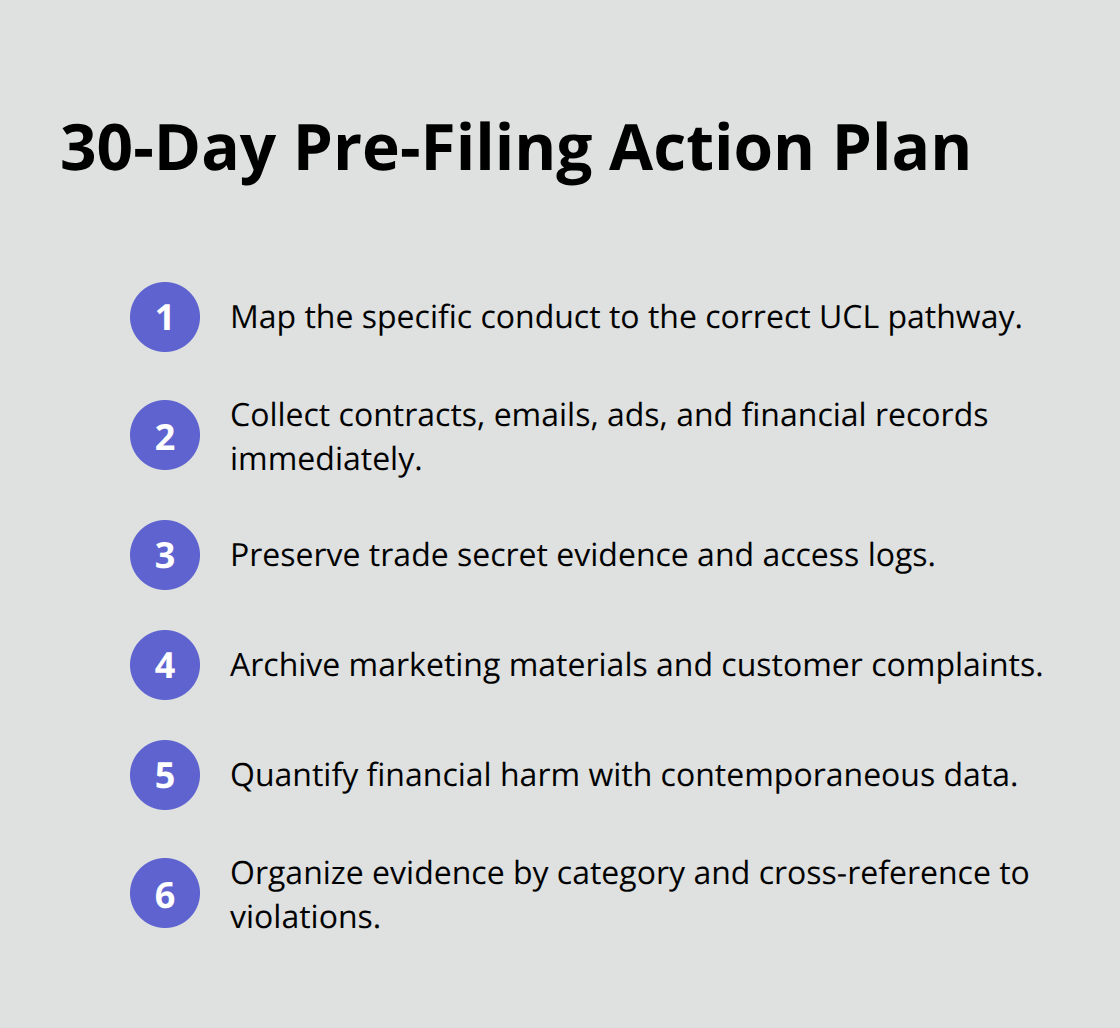
If deceptive marketing is the issue, collect all advertising materials, customer complaints, and sales data showing financial harm. Orange County courts expect plaintiffs to arrive with organized evidence, not scattered fragments.
Document Everything With Precision
The timeline matters enormously. Section 17200 has a four-year statute of limitations, but continuous violations can extend accrual dates, so you must show exactly when misconduct began and continued. Photograph, screenshot, and archive everything in its original format because opposing counsel will attack the authenticity of hastily gathered evidence. Many cases settle before trial because one side’s evidence becomes so overwhelming during discovery that the other side recognizes defeat is inevitable. Organize your materials by category-contracts, communications, financial records, advertising materials-and cross-reference them to specific Section 17200 violations. This preparation transforms your case from a collection of complaints into a coherent narrative that judges and opposing counsel cannot ignore.
Negotiate From Strength, Not Hope
Settlement in unfair competition cases hinges on one factor: the strength of your evidence and the defendant’s exposure to injunctive relief. Defendants fear injunctions because courts grant preliminary injunctions within 30 to 60 days in Orange County, halting profitable conduct while litigation drags on for years. Present the specific unlawful or deceptive acts, the financial harm quantified precisely, and the injunctive relief you will seek if settlement fails. Defendants often settle because stopping the misconduct immediately costs less than defending a multi-year case and facing an injunction that destroys their business model. Propose concrete terms: the defendant stops specific conduct by a date certain, pays restitution for documented losses, and agrees to injunctive language that prevents future violations. A neutral third party at mediation helps both sides see the real cost of litigation. If mediation stalls, arbitration clauses in your original contract may offer faster resolution than court. The defendant’s insurance coverage for unfair competition claims also shapes settlement leverage-cases involving trade secret misappropriation or deceptive advertising often trigger advertising injury coverage under commercial general liability policies, meaning the insurer has incentive to settle and control defense costs.
Present Evidence That Persuades Judges
If settlement fails, the courtroom fight in Orange County unfolds differently than many business litigators expect. There is no jury for Section 17200 claims-judges decide these cases. Your evidence must persuade a judge trained to scrutinize legal elements, not a jury swayed by emotional storytelling. Focus your trial strategy on proving the specific predicate violation and the resulting injury. If the unlawful prong applies, show the Labor Code wage violation or Penal Code breach with documentary evidence and expert testimony if needed. If the unfair prong is your theory, prove the competitive harm or consumer injury with financial data and market analysis. If fraud is your claim, establish that the defendant’s conduct was likely to deceive the public-and the defendant’s own marketing materials usually prove this better than your arguments. Orange County judges expect clean, organized presentation: exhibits numbered and cross-referenced, witnesses prepared to answer specific questions, and a clear road map connecting conduct to damage. Articulate precisely which statute was violated or which deceptive practice occurred, then show the direct financial consequence.
Deploy Expert Witnesses Strategically
Expert witnesses matter significantly in these cases. Economists quantify damages, industry specialists explain competitive harm, and forensic analysts trace stolen trade secrets-all strengthen your position substantially. The judge will decide liability and remedies: injunctive relief to stop ongoing conduct and restitution limited to your actual losses, not the defendant’s profits beyond those losses. Your case strategy now shifts from investigation and negotiation to the next critical phase-understanding how Orange County courts have actually ruled in similar disputes and what outcomes businesses achieved through litigation or settlement.
What Orange County Courts Actually Award in Unfair Competition Cases
Insurance Coverage Transforms Settlement Dynamics
Orange County judges have handed down substantial awards in unfair competition litigation, but the outcomes reveal patterns that most business owners misunderstand. The Ninth Circuit’s decision in Sentex Systems v. Hartford Accident & Indemnity Co. established that advertising injury coverage under commercial general liability policies extends to trade secret misappropriation claims. This means defendants’ insurance often covers both defense costs and damages in unfair competition disputes. In Kurisu v. Michigan Millers Mutual Insurance Co., the California Court of Appeal reinforced this principle, ruling that insurers must defend their insured in unfair competition claims involving wrongful appropriation of proprietary information, even when the misconduct involved competitive activities. The practical takeaway is straightforward: identify the defendant’s insurance coverage early because it directly impacts settlement leverage and the defendant’s willingness to negotiate seriously.
Preliminary Injunctions Create Immediate Financial Pressure
Real Orange County outcomes show that injunctive relief often matters more than monetary damages. Courts grant preliminary injunctions within 30 to 60 days to halt ongoing deceptive conduct, and this timing creates immediate financial pressure on defendants whose business models depend on the unlawful practice. A defendant facing an injunction that stops profitable operations while litigation continues for years will settle aggressively to avoid that outcome.
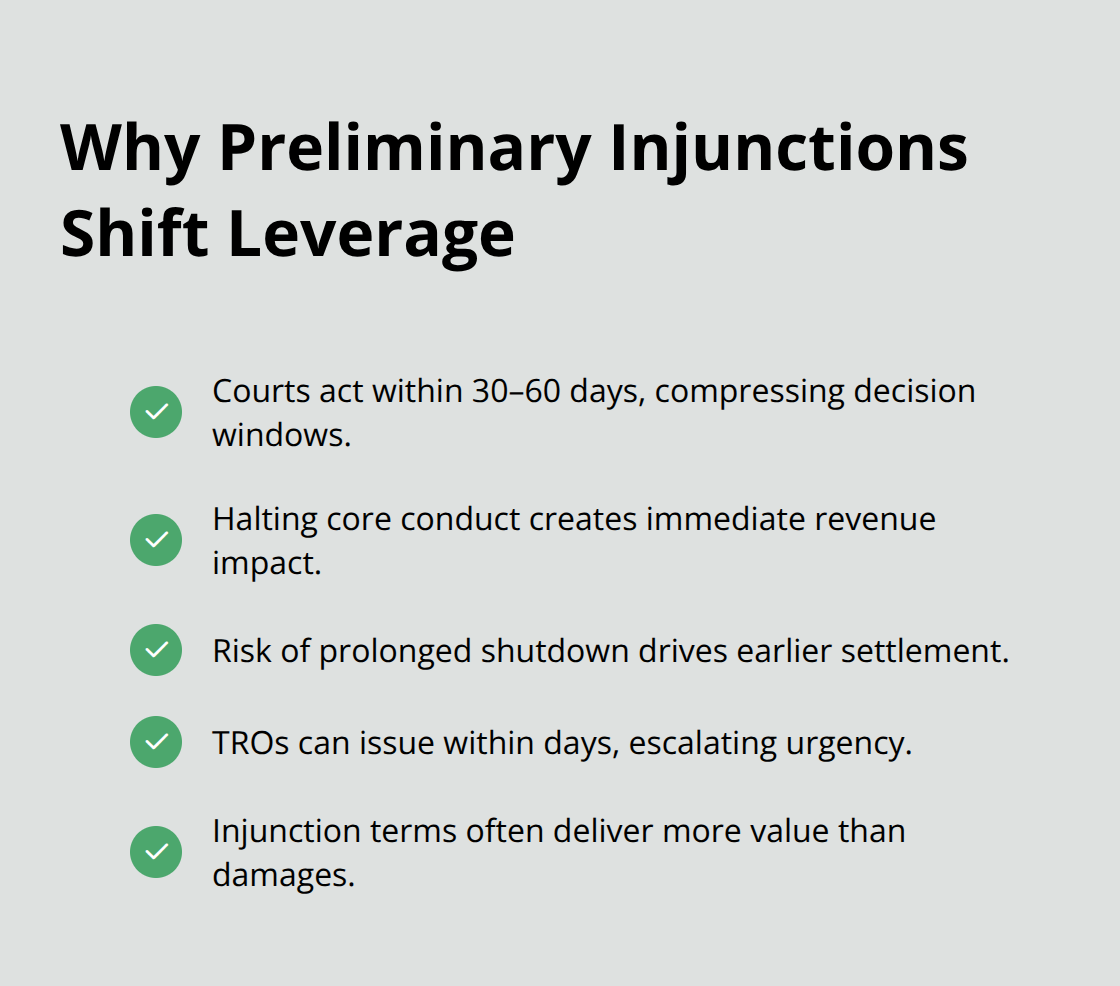
The speed of preliminary injunctions-sometimes issued within days for temporary restraining orders-forces defendants to make settlement decisions quickly rather than wait years for trial.
Restitution Awards and Damages Calculations
Restitution awards are capped at the plaintiff’s actual documented losses, not the defendant’s total profits-a limitation that sometimes surprises business owners expecting larger recoveries. However, when trade secrets are stolen and misused at scale, damages calculations can still reach millions. The Fonovisa v. Cherry Auction decision illustrates how control over a marketplace or platform can create liability for copyright and trademark infringement, signaling that courts will hold operators responsible for unfair competition by their vendors or partners if they exercise sufficient control.
Strategic Focus on Injunctive Terms
For businesses evaluating whether to pursue litigation, the math is clear: preliminary injunctions that stop ongoing harm within weeks often deliver more business value than years of litigation fighting over restitution amounts. Settlement discussions should therefore focus first on injunctive terms-exactly what conduct stops, by what date, and what monitoring mechanisms verify compliance-because defendants will often agree to stop misconduct faster than they will agree to large payment amounts.
Final Thoughts
Unfair competition litigation in Orange County demands speed, precision, and local knowledge. The businesses that protect themselves successfully act within weeks of discovering misconduct, gather evidence methodically before filing anything, and recognize that preliminary injunctions often matter more than monetary awards. Section 17200 gives plaintiffs multiple pathways to liability and courts the power to halt your operations within 30 to 60 days, which means waiting passively guarantees defeat.
Defendants with insurance coverage settle faster because their insurers recognize the cost of defending multi-year litigation plus the risk of injunctive relief that destroys business operations. Plaintiffs who arrive at settlement negotiations with organized evidence and a clear understanding of which Section 17200 pathway applies gain leverage that translates directly into favorable terms. Courts assign judges, not juries, to decide these cases, which means your evidence must be documentary, precise, and connected explicitly to statutory violations rather than emotional appeals.
If you face unfair competition claims or suspect a competitor is engaging in deceptive practices, the first 30 days determine your outcome. Identify the specific unlawful, unfair, or fraudulent conduct, preserve all communications and financial records, and consult an attorney experienced in Orange County litigation before taking action. Contact Raul Garcia Law Firm to evaluate your situation and develop a strategy that protects your business interests before litigation becomes inevitable.