

Trade secrets are often a company’s most valuable assets, yet many businesses lack adequate protection measures. California law provides specific frameworks to safeguard these assets, but only if you implement them correctly.
We at Raul Garcia Law Firm help Orange County businesses build defensive strategies that actually work. This guide walks you through the legal requirements, practical security steps, and response protocols you need.
What Qualifies as a Trade Secret Under California Law
The Two-Part Test for Trade Secret Protection
California’s Uniform Trade Secrets Act defines a trade secret as information that derives independent economic value from not being generally known and is subject to reasonable secrecy measures. This definition matters because it sets the bar for what you can actually protect. Information alone is worthless without both economic value and active protection. Many Orange County businesses mistakenly believe that simply calling something confidential makes it a trade secret-it does not. You must prove two things: that competitors lack access to this information, and that you took deliberate steps to keep it hidden.
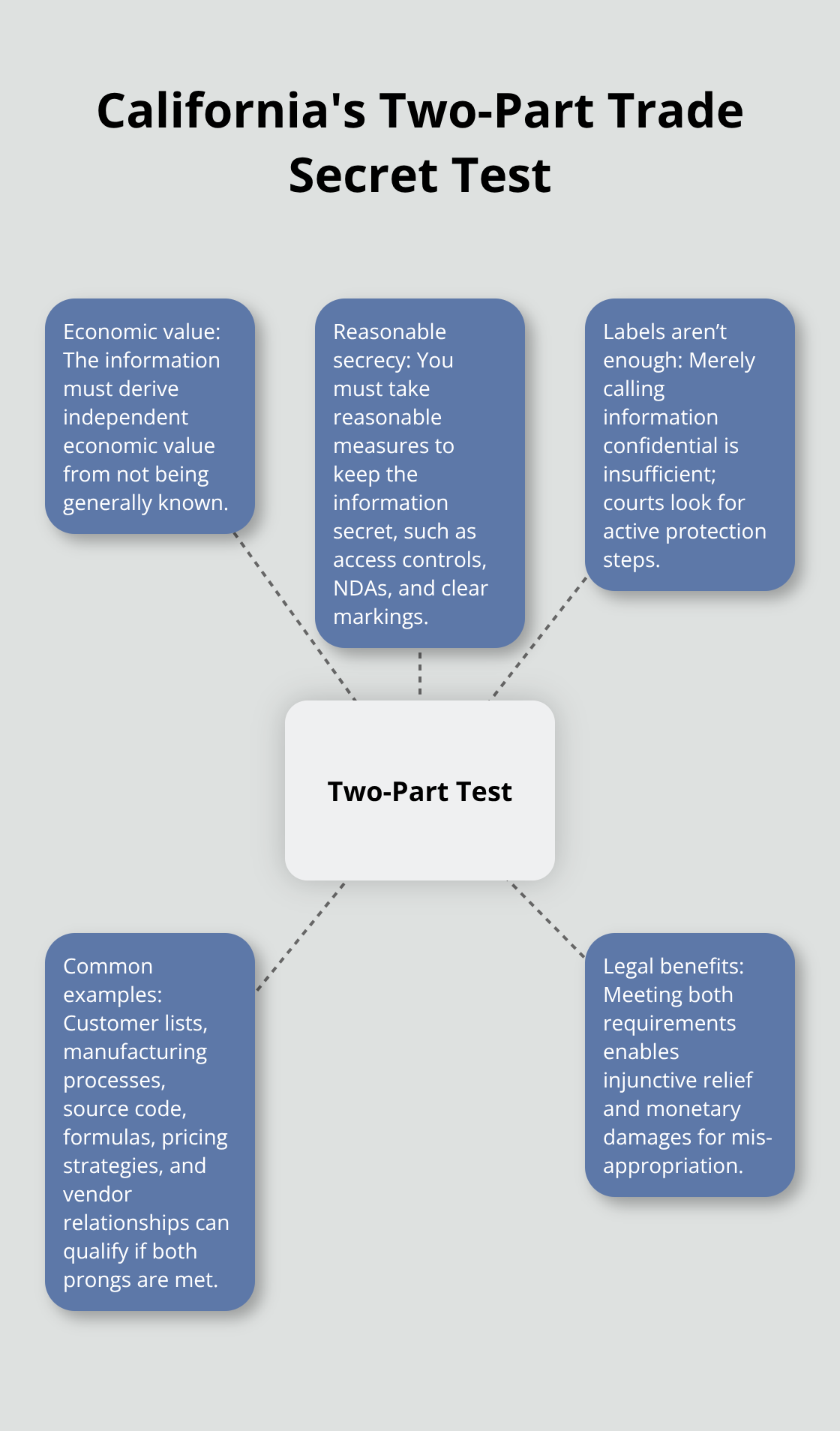
Customer lists, manufacturing processes, software source code, chemical formulas, pricing strategies, and vendor relationships all qualify as trade secrets if they meet these criteria. The distinction is critical because only information meeting both requirements receives the full protection of California law, including injunctive relief and damages for misappropriation.
What Does Not Qualify as a Trade Secret
The line between trade secrets and other confidential information is sharper than many businesses realize. General business information-market trends, publicly available competitor pricing, or information your employees could reasonably discover through independent research-does not qualify. This matters when you build your defensive stack because you will waste resources protecting non-secret information while potentially neglecting genuine trade secrets. Focus your security efforts on information that competitors cannot easily obtain through reverse engineering, public records, or independent derivation. The California statute explicitly states that reverse engineering alone is not an improper means of obtaining information, so if a competitor can legally figure out your process by studying your product, you have no legal recourse.
Conduct an Honest Inventory of Your Assets
Conduct an honest inventory of what truly qualifies as a trade secret. Ask yourself three questions: Does this information provide a real competitive advantage? Would a competitor pay for it? Have I documented and restricted access to it? If you cannot answer yes to all three questions, it probably does not meet California’s definition. This clarity prevents you from overreaching in your confidentiality agreements and allows you to concentrate your protection efforts where they actually matter. Once you identify your genuine trade secret matter, you can move forward with the specific legal and operational safeguards that will actually defend them.
Building Your Defensive Stack: Legal and Operational Safeguards
Craft Specific and Enforceable Confidentiality Agreements
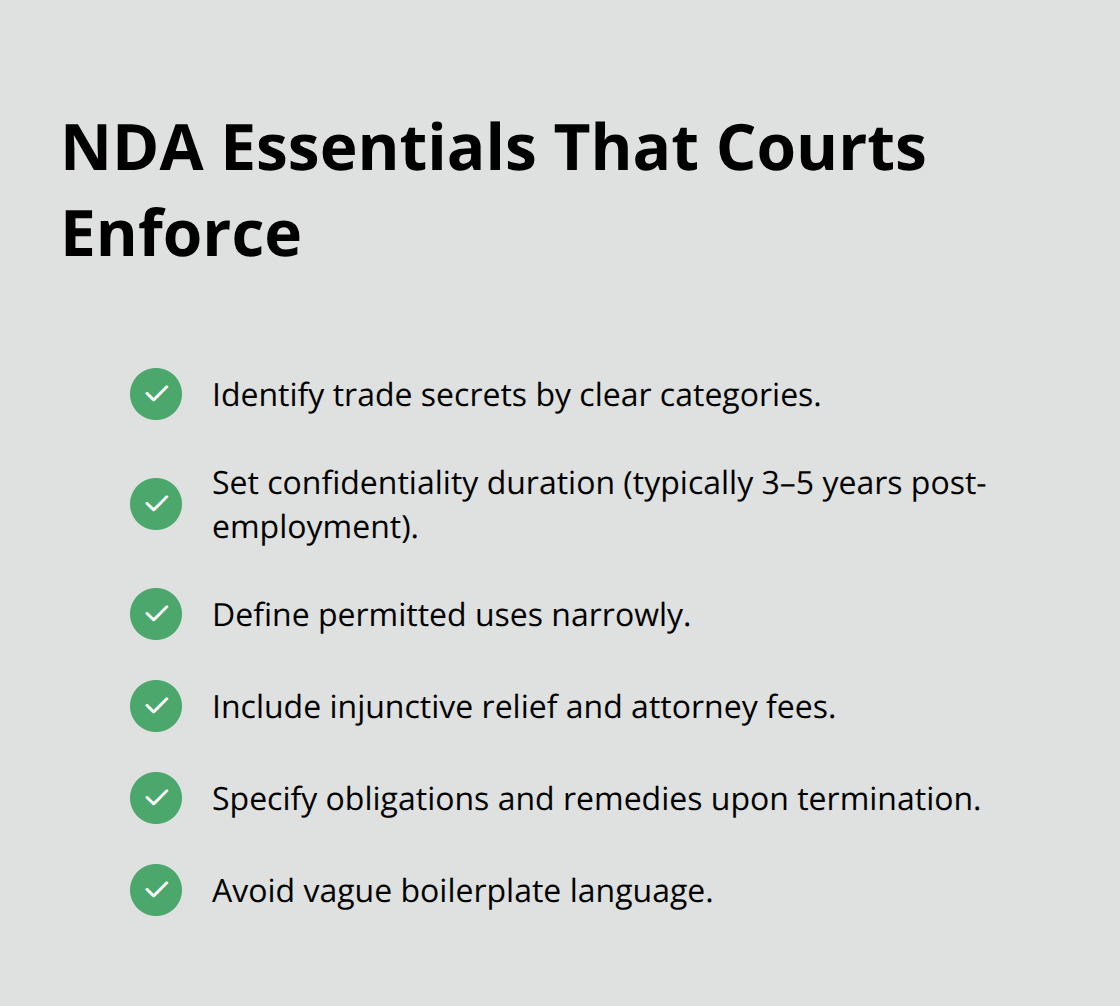
A solid defensive strategy rests on three interconnected pillars that work together, not separately. Your confidentiality agreements must be specific and enforceable. Generic NDAs that describe information vaguely as confidential fail in court because judges need to see exactly what you are protecting. Your NDA should identify trade secrets by category (customer lists, manufacturing processes, pricing data, source code), specify the duration of confidentiality obligations (typically three to five years post-employment or termination), define permitted uses narrowly, and outline concrete remedies including injunctive relief and attorney fees. Courts enforce agreements that spell out what information qualifies as confidential far more readily than vague boilerplate language.
Implement Layered Physical and Digital Security
Your physical and digital security must match the value of what you are protecting. For digital assets, implement role-based access controls where employees see only the information they need for their job, use encryption for sensitive data at rest and in transit, enable multi-factor authentication on systems holding trade secrets, maintain detailed access logs that show who viewed what and when, and restrict USB drives or external device usage in areas where trade secrets are stored. For physical materials, limit facility access to authorized personnel, store confidential documents in locked cabinets or safes, require sign-out procedures for sensitive materials, and destroy confidential information through certified shredding rather than standard waste disposal. The Department of Homeland Security’s Cybersecurity and Infrastructure Security Agency recommends treating access logs as evidence; if a dispute arises, these logs prove what was accessed, by whom, and when.
Document Everything and Enforce Consistently
Documentation and policies create the evidentiary foundation you need if litigation becomes necessary. Mark all confidential materials clearly with a confidentiality notice, maintain an updated inventory of trade secrets that identifies what qualifies, specify in employee handbooks which information is confidential and the consequences of disclosure, and require employees to sign acknowledgments that they understand confidentiality obligations at hire and after any policy updates. California courts examine whether your secrecy measures were reasonable, so inconsistent enforcement undermines your position. If you mark some documents confidential and others identical in content are not marked, judges question whether you genuinely treated the information as secret.
Protect Your Business During Employee Transitions
Exit procedures matter especially because departing employees pose the highest risk. When a key employee leaves, immediately disable access, retrieve laptops and phones, review what files were downloaded in the weeks before departure, and preserve email and messaging records. Establish exit procedures that include device returns, access revocation within 24 hours, and final NDA reaffirmation. The USPTO emphasizes that a well-documented defensive stack accelerates legal response and strengthens your ability to obtain injunctive relief because you have a clear record showing what was secret and how you protected it.
This combination of specific agreements, layered security, and consistent documentation transforms trade secret protection from an afterthought into a working system that courts recognize and enforce. When misappropriation occurs, the strength of your defensive foundation determines whether you can act quickly and effectively-which brings us to the critical steps for identifying breaches and gathering the evidence you need to pursue legal remedies.
Responding to Trade Secret Misappropriation
Act Immediately When You Suspect a Breach
The moment you suspect trade secret theft, your response timeline determines everything. Most Orange County businesses wait too long to act, allowing evidence to disappear and the defendant’s advantage to grow.
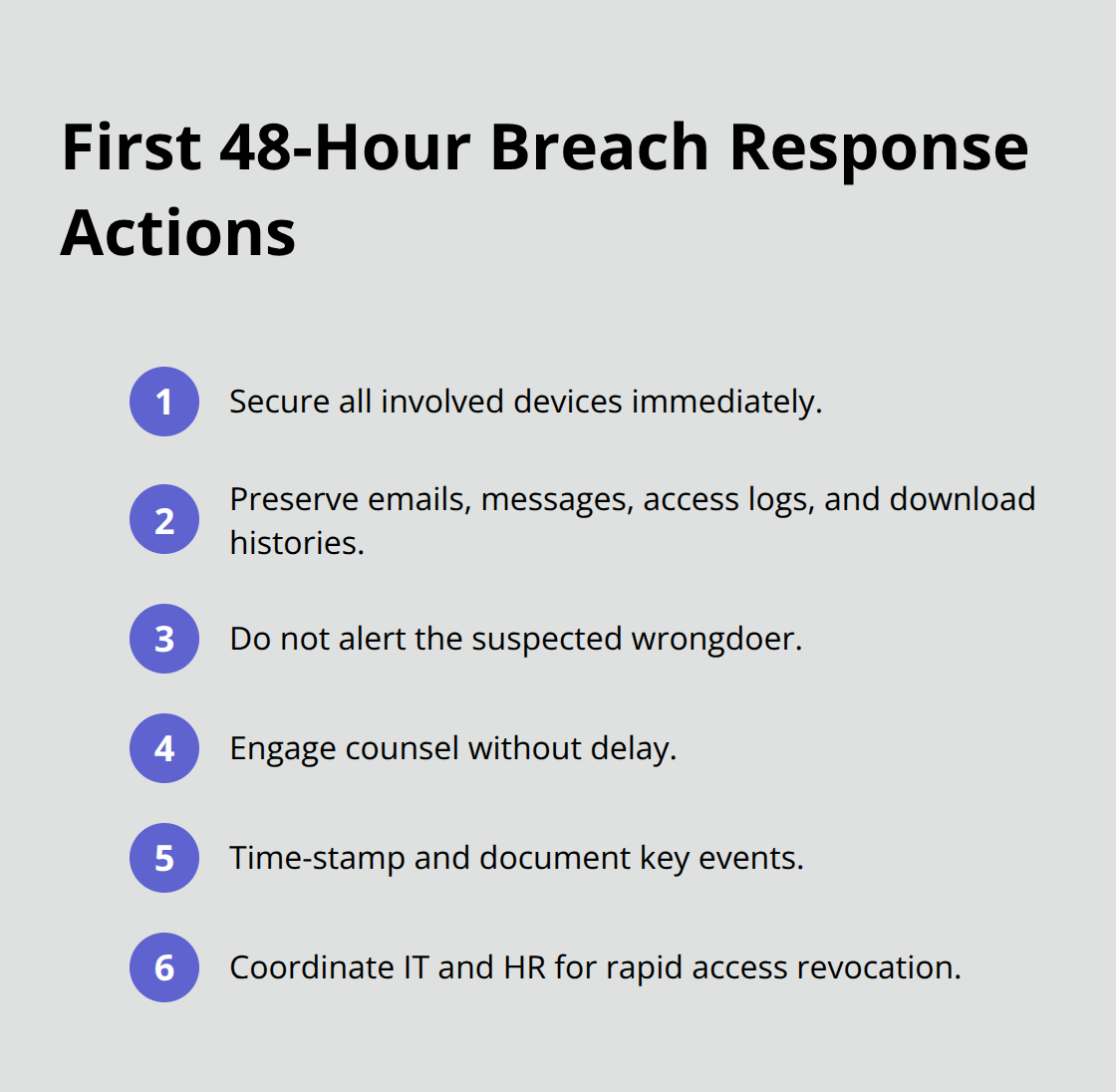
If you discover that files were downloaded before an employee’s departure, or a competitor suddenly launches a product using your process, you have days-not weeks-to preserve evidence and consult counsel. Start by securing all electronic devices involved, including laptops, phones, and servers. Request IT to preserve email and messaging records, access logs, and file download histories from the relevant period. Do not announce your suspicion to the suspected wrongdoer yet; premature accusations give them time to delete evidence or move assets.
Document What You Observe
Document everything you observe: the timing of the departure, which files were accessed, what the competitor is now offering, and how it mirrors your confidential information. California courts recognize that swift, focused preservation of evidence strengthens your ability to obtain injunctive relief-the fastest way to stop ongoing misappropriation. The Defend Trade Secrets Act, which applies to trade secret theft involving interstate or foreign commerce, allows federal courts to grant emergency injunctions with limited notice to the defendant, but only if you can show a clear record of what was secret and what the other party did with it. Without documented evidence preserved immediately, judges deny emergency relief and you lose months fighting the case while the defendant continues using your information.
Understand Your Legal Remedies
California law provides three concrete remedies for proven misappropriation: injunctive relief to stop further use, actual damages to compensate your losses, and in cases of willful and malicious theft, exemplary damages up to twice your other damages. If you cannot prove specific dollar losses-which is common in trade secret cases-California courts award a reasonable royalty for the period the defendant used your information without permission. Attorney fees and expert witness costs go to the prevailing party if the defendant acted in bad faith or resisted an injunction unreasonably, so the cost of litigation can shift to the wrongdoer.
Engage Experienced Counsel Early
Misappropriation cases are expensive; you need experienced counsel from the start to gather admissible evidence, navigate protective orders that keep your secrets confidential during litigation, and position your case for either settlement or trial. Your goal is to stop the bleeding fast-not litigate for years. The strongest cases move quickly because the defensive stack you built earlier (access logs, marked confidential materials, signed NDAs, and consistent security practices) gives counsel the factual foundation needed to demand injunctive relief within weeks, not months, and to negotiate settlements from a position of strength.
Final Thoughts
Trade secret protection measures require consistent execution across legal, operational, and technical domains. The defensive stack you build today determines whether you can respond effectively when misappropriation occurs. Specific confidentiality agreements, layered security controls, clear documentation, and swift breach response protocols work together to create a system that courts recognize and enforce.
Start with an honest inventory of your genuine trade secrets and assess your current protection measures against California’s legal standards. Identify gaps in your confidentiality agreements, security controls, and documentation practices. If you suspect misappropriation is occurring, contact counsel immediately rather than waiting, since the first 48 hours determine whether you can preserve critical evidence and position yourself for emergency relief.
Contact Raul Garcia Law Firm to discuss your trade secret protection strategy with our team. We provide the strategic guidance and aggressive representation that Orange County businesses need to safeguard their most valuable assets and respond decisively when theft occurs.