
Dissolving a business in Orange County requires more than a handshake and good intentions. A poorly drafted dissolution agreement can leave you exposed to unexpected liabilities, disputes over asset division, and costly legal battles.
We at Raul Garcia Law Firm have seen too many business owners skip the details during dissolution agreement drafting, only to face serious consequences later. This guide walks you through the essential clauses, common pitfalls, and best practices that protect your interests.
What Must Go Into a Dissolution Agreement
A dissolution agreement lives or dies by its specificity. Vague language about who owns what, who pays for what, and what happens after the papers are signed creates the conditions for expensive litigation. California courts will not rescue you from ambiguous terms-they expect business owners to spell everything out in writing before dissolving.
Asset Distribution and Property Division
The first critical section addresses property division and asset distribution. This means listing every asset the business owns, assigning each one to either the departing owner or the remaining entity, and establishing the method of transfer or valuation. Real property requires a legal description and title transfer documentation. Equipment, inventory, and fixtures need serial numbers or specific identification. Accounts receivable must be allocated with clarity about who collects payment and how proceeds are split. Intellectual property-patents, trademarks, copyrights, domain names-demands explicit assignment language; courts have rejected dissolution agreements that left IP ownership ambiguous, forcing years of dispute over who actually owns the brand.
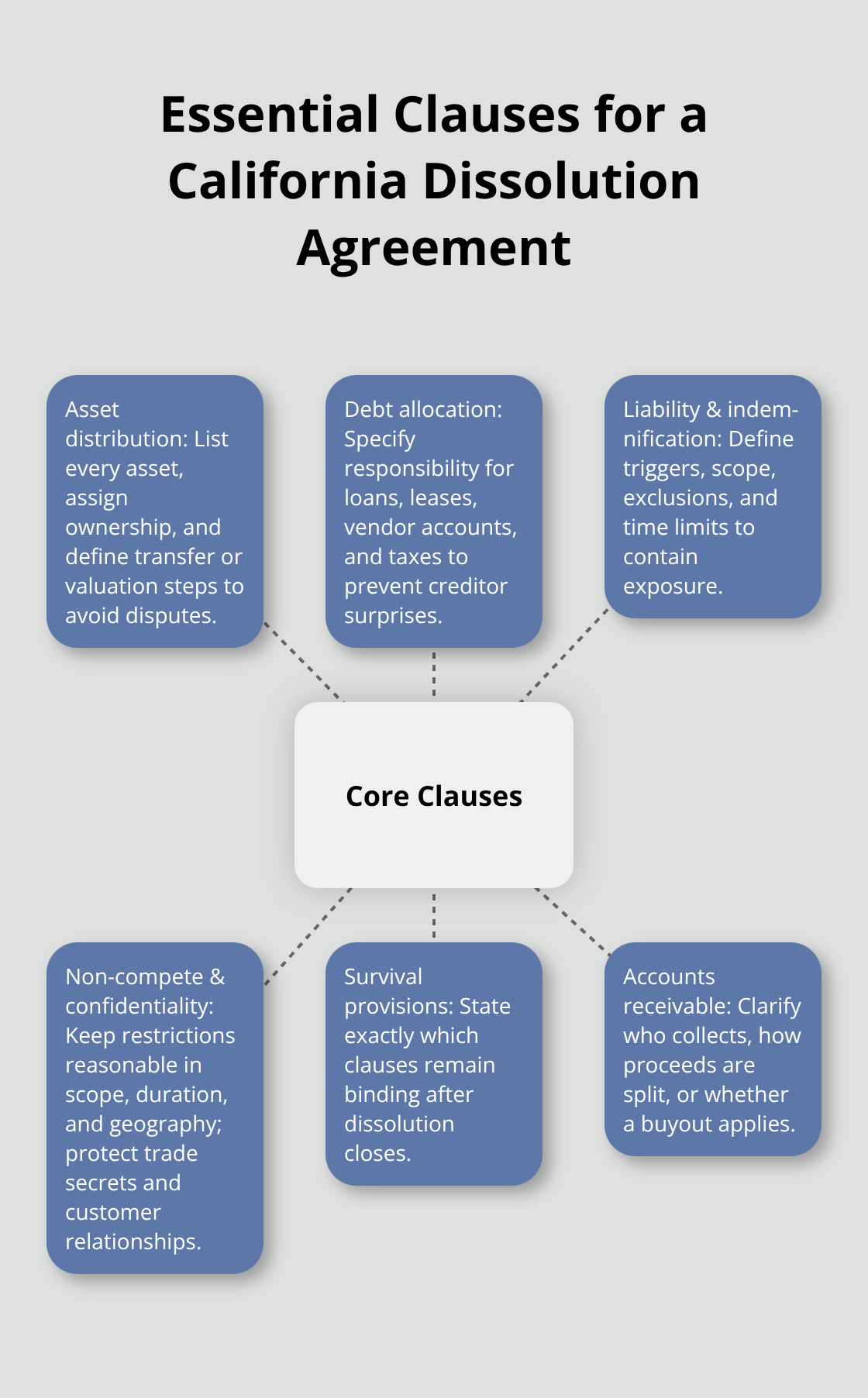
One practical step: hire an appraiser for assets with significant value rather than relying on book value or owner estimates. This creates a defensible record if the other party later claims you undervalued their share. Debt allocation is equally important. The agreement must specify which party assumes which debts, including bank loans, vendor accounts, lease obligations, and tax liabilities. If a debt remains in the business name after dissolution, both former owners can still face pursuit by creditors-so clarity here prevents one party from being blindsided by collection calls months later.
Liability Assignment and Indemnification
Liability assignment and indemnification clauses protect you from claims arising before, during, or after dissolution. An indemnification clause requires one party to reimburse the other for losses caused by breach of the agreement or misrepresentation. Specify which party indemnifies which, what triggers indemnification, and what claims are excluded. For example, if one owner represented that all customer contracts were properly documented but later lawsuits reveal undisclosed disputes, the indemnification clause forces that owner to cover legal costs and settlements. California courts enforce indemnification clauses when they are clearly written, so avoid language like the agreement will cover any issues that might arise. Instead, state exactly which types of claims trigger indemnification, such as breach of representations about financial records or undisclosed litigation. Set a time limit for indemnification claims-typically 12 to 24 months after dissolution-so you are not exposed indefinitely. Survival provisions are equally critical; these specify which terms remain binding after dissolution closes. Confidentiality, non-compete restrictions, and indemnification obligations typically survive; general operational terms do not. Without survival language, a non-compete clause might vanish the moment the business officially dissolves, allowing a former owner to immediately compete against you.
Non-Compete and Confidentiality Protections
Non-compete and confidentiality provisions enforce your competitive advantage after the other party leaves. A non-compete clause prevents a departing owner from starting a competing business, soliciting customers, or hiring employees within a defined territory and timeframe. California courts scrutinize non-competes carefully, so the restriction must be reasonable in scope, duration, and geography. A blanket prohibition on all competition is likely unenforceable, but a two-year restriction on soliciting existing customers within Orange County is defensible. Include specific customer lists or account names so the departing owner knows exactly which relationships are protected. Confidentiality provisions protect trade secrets, customer lists, pricing strategies, vendor relationships, and operational processes. Define what qualifies as confidential information rather than leaving it open-ended. State the duration of confidentiality obligations-often indefinite for true trade secrets, but five to ten years for other sensitive information. Require the departing owner to return or destroy confidential materials and certify they have done so. Without these provisions, a departing owner can walk out with your customer database and pricing model and use them to build a competing business. Courts have awarded substantial damages in cases where confidentiality was breached, but only when the agreement clearly identified what information was protected and what the penalties were for unauthorized disclosure.
The specificity you invest in these three core sections-asset distribution, liability assignment, and competitive protections-determines whether your dissolution agreement holds up under pressure or unravels in court. The next section examines the mistakes that undermine even well-intentioned agreements.
Common Mistakes That Undermine Dissolution Agreements
Most dissolution agreements fail not because of missing clauses but because business owners omit entire categories of assets, leave post-dissolution duties undefined, or treat intellectual property as an afterthought. The difference between a bulletproof agreement and one destined for litigation often comes down to exhaustiveness and precision in three specific areas.
Incomplete Asset and Debt Inventories
Failing to inventory all business assets and debts ranks as the most common and costly error. Business owners typically list real property, equipment, and cash accounts but overlook accounts receivable, work in progress, prepaid expenses, software licenses, domain registrations, and vendor relationships. A marketing firm dissolution illustrates this risk: the departing owner claimed ownership of client retainer contracts that the agreement never assigned, creating months of dispute over ongoing revenue streams. The agreement must include a complete balance sheet with every asset itemized, valued, and explicitly assigned.
Accounts receivable require special attention because they represent cash owed to the business. The agreement must state whether the departing owner receives their share of collected amounts or a lump-sum buyout of their receivables interest. Debt allocation creates equal danger. Secured loans tied to specific assets need clear assignment language so the lender knows who assumes responsibility. Unsecured debts, vendor payables, and tax liabilities must be allocated by name and amount rather than vague references to who pays what.
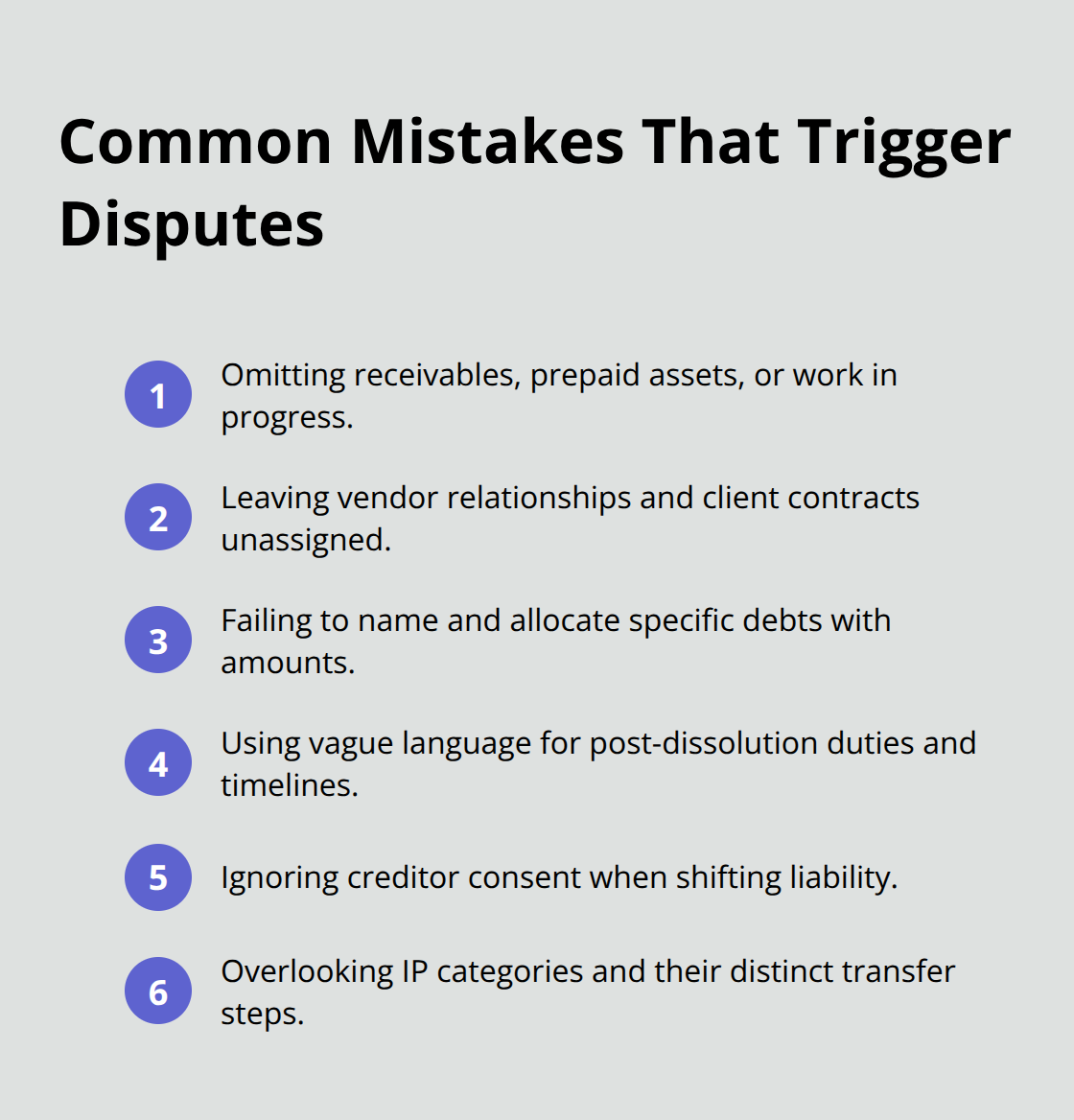
California courts hold both parties liable for business debts incurred before dissolution unless the agreement explicitly states otherwise and the creditor consents. If the agreement fails to assign a vendor payable, both former owners remain jointly liable indefinitely, and the vendor can pursue either party for full payment.
Vague Post-Dissolution Obligations
Post-dissolution obligations deserve far more specificity than most agreements provide. Vague language about winding down operations, transferring customer relationships, or handling pending litigation creates disputes when one party interprets the clause differently than the other. The agreement must state who handles customer notifications, who manages outstanding contracts, who pays for lease termination or early exit fees, and who bears responsibility for pending litigation or regulatory matters.
Establish exact timelines for transferring records, delivering client files, and completing handoffs so one party cannot claim they never received necessary information. Without these specifics, one owner may delay critical transfers indefinitely, leaving the other owner unable to serve customers or access essential business data. The departing owner must certify completion of all handoff obligations in writing, creating accountability and a clear record if disputes arise later.
Intellectual Property Assignment Failures
Intellectual property presents the highest-stakes vulnerability in dissolution agreements. Many agreements treat IP as a single line item rather than breaking down patents, trademarks, copyrights, domain names, and software separately. Each category requires distinct assignment language because ownership transfers differently depending on the asset type.
A trademark assignment needs explicit written language signed by both parties and filed with the USPTO to be valid. A domain name transfer requires account access credentials and registrar authorization. Software code might require source code escrow arrangements or licensing agreements. Without specific IP assignment language, courts treat ownership as ambiguous, leaving both parties unable to fully control their own business operations.
One owner might attempt to use the company name or logo after dissolution, creating trademark disputes that cost tens of thousands to litigate. Another might claim the software code remains jointly owned, preventing either party from enhancing or licensing it independently. The specificity you invest in IP assignment determines whether your dissolution agreement protects your competitive position or leaves it vulnerable to claims from the other party.
These three categories of errors-incomplete asset inventories, undefined post-dissolution duties, and inadequate IP assignment-account for the vast majority of dissolution agreement failures. The next section examines how to avoid these pitfalls through best practices that courts recognize and enforce.
Best Practices for Dissolution Agreement Drafting in Orange County
Work with Experienced Legal Counsel Familiar with California Law
The dissolution agreements that survive scrutiny share one defining characteristic: they were drafted by someone who understood California law and the specific vulnerabilities of business dissolution in Orange County. This is not a task for online templates or do-it-yourself document kits. California Family Code and business dissolution statutes contain traps that catch unprepared business owners. A clause that seems clear to you may fail in court because it does not meet California’s enforceability standards for survival provisions, indemnification language, or post-termination obligations.
Courts in Orange County have rejected dissolution agreements drafted without legal counsel simply because they lacked the statutory language required to make certain protections binding. An experienced attorney familiar with California dissolution law will identify which assets require specific transfer language, which debts need creditor consent to shift liability, and which provisions must survive dissolution to remain enforceable. The cost of preventive legal work during drafting is a fraction of the cost of litigation over an ambiguous agreement.
Document All Agreements in Writing with Specific Terms
Every term in your dissolution agreement must appear in writing with language precise enough to eliminate alternative interpretations. Oral agreements and handshake deals carry no weight in Orange County courts when disputes occur. California courts have repeatedly held that vague language about asset division, liability assignment, or post-dissolution obligations will be interpreted against the drafter, often leaving the party who thought they were protected completely exposed.
Your agreement must specify exact asset valuations rather than ranges, name specific debts with dollar amounts rather than categories, and define what qualifies as confidential information or competitive activity rather than leaving it open. Courts also require that survival provisions explicitly state which clauses continue after dissolution closes. Without survival language, a non-compete clause or confidentiality restriction may vanish the moment the business officially dissolves.
Plan for Dispute Resolution Mechanisms Before Dissolution Occurs
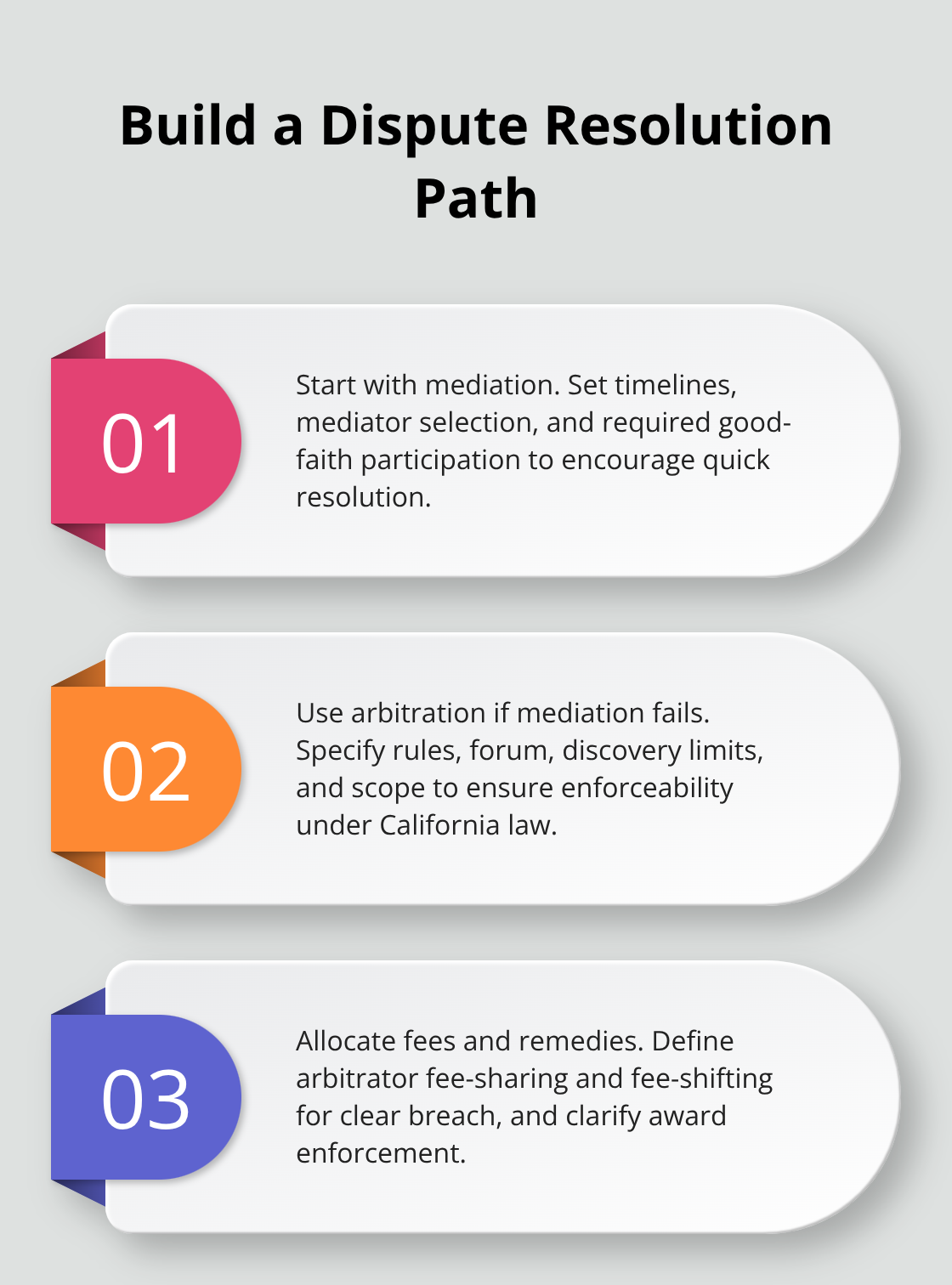
Include a dispute resolution mechanism before dissolution occurs. Mediation or arbitration clauses force the parties to attempt resolution outside court, saving months of litigation and tens of thousands in legal fees. California courts favor arbitration agreements when they are clearly written and mutually agreed upon. Specify whether disputes will go to mediation first, then arbitration if mediation fails, and establish which party pays arbitrator fees if one side clearly breaches the agreement.
A dissolution agreement that lacks dispute resolution language leaves both parties vulnerable to costly court battles over issues that could have been resolved through structured negotiation. The specificity and forethought you invest at the drafting stage determine whether your dissolution closes cleanly or becomes a years-long source of conflict and expense.
Final Thoughts
A dissolution agreement that protects your interests rests on three foundational elements: comprehensive asset and liability assignment, clear post-dissolution obligations, and enforceable competitive protections. The agreements that fail in court share a common thread-they were drafted without the specificity California law demands. Vague language about property division, undefined debt allocation, and ambiguous intellectual property assignment create the exact conditions that lead to expensive litigation.
The mistakes outlined earlier are entirely preventable through careful dissolution agreement drafting. Incomplete asset inventories, unclear post-dissolution duties, and inadequate IP protection account for most dissolution agreement failures. These errors stem not from complexity but from insufficient attention during the drafting stage. A business owner who invests time documenting every asset, naming specific debts with dollar amounts, and explicitly assigning intellectual property eliminates the ambiguity that courts refuse to resolve in your favor.
California courts will not rescue you from poorly drafted language. They expect business owners to spell out terms with precision before dissolution occurs, which means working with legal counsel who understands Orange County’s specific business environment and California’s enforceability standards for survival provisions, indemnification clauses, and non-compete restrictions. If you are considering dissolution or need to review an existing agreement, contact our firm for a strategic assessment of your situation.