
Commercial lease disputes in California happen more often than most property owners realize. Disagreements over terms, maintenance responsibilities, and rent payments can escalate quickly and cost both landlords and tenants thousands in legal fees and lost income.
We at Raul Garcia Law Firm have helped dozens of Orange County property owners and business tenants navigate these conflicts. This guide breaks down the most common disputes and gives you practical strategies to protect yourself before problems start.
What Triggers Most Commercial Lease Disputes in Orange County
Ambiguous Lease Language Creates Conflict
Lease language ambiguity sits at the root of nearly every dispute we see. Orange County had about 106,961 businesses in 2023, many occupying commercial spaces with poorly drafted or hastily negotiated leases. When a lease fails to define who pays for HVAC replacement, what constitutes late rent, or how CAM charges are calculated, conflict becomes inevitable. Tenants often discover after signing that their lease places the cost of structural repairs or roof replacement entirely on them, not the landlord. Landlords, meanwhile, sign leases with vague maintenance clauses and later find themselves liable for costly repairs they expected tenants to handle.
The problem worsens when lease amendments pile up over years without clear documentation of what changed and why. Demand precision before signing: spell out exactly which party pays for HVAC service calls versus replacement, define what building operating costs include, and cap CAM charges. California’s SB 1103, effective January 1, 2025, now requires specific notice periods for rent increases to qualified commercial tenants, adding another layer of complexity.
Rent Payment Disputes and Hidden Costs
Rent payment disputes remain the most common lease conflict, yet they often stem from misunderstandings about what rent actually includes. A tenant sees a $4,000 base rent and signs, only to receive invoices for CAM, property taxes, and insurance that push monthly costs to $5,500 or higher. Late fees compound fast: a single missed payment can trigger acceleration clauses that demand the entire remaining rent balance immediately, forcing business owners into crisis mode.
Landlords face their own payment headaches when tenants withhold rent over maintenance complaints, claiming constructive eviction conditions make the space unusable. Request a full occupancy cost breakdown upfront and obtain a CAM reconciliation process in writing. Clarify exactly what triggers late fees and when acceleration applies.
Documentation Prevents Disputes from Escalating
Document every payment, every notice, and every communication in writing from day one (texts, emails, and signed receipts all matter when disputes reach a lawyer’s desk). This written record becomes your strongest defense when disagreements arise. Renewal terms, repair obligations, and default clauses require careful contract interpretation to avoid costly misunderstandings. The next section covers how landlords can build protective strategies into their leases from the start, ensuring they maintain control over their properties and their financial interests.
Strategies for Landlords to Protect Their Interests
Write Everything Into Your Lease Agreement
Written agreements serve as your only real defense in a lease dispute. The moment a tenant moves in, your lease becomes the contract that courts will examine when disagreements surface. Too many Orange County landlords rely on handshake deals, email exchanges, or oral promises, then discover these carry no weight when rent stops flowing or a tenant claims you breached maintenance obligations. Your lease must address every scenario that could reasonably occur over the lease term.
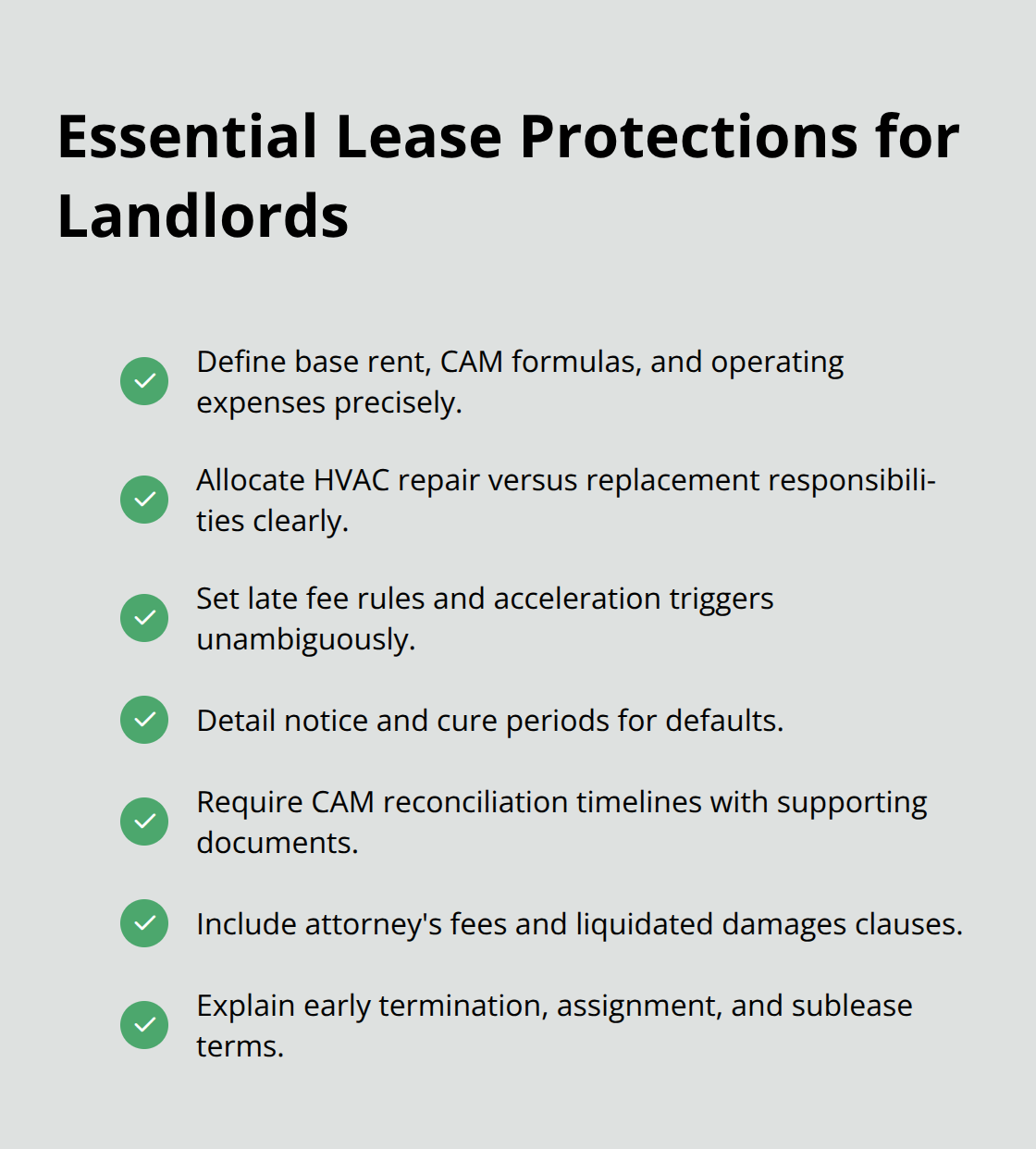
Define base rent, CAM calculations, what costs are included in operating expenses, late fees, acceleration clauses, and default remedies with absolute clarity. Specify exactly who pays for HVAC replacement versus routine service calls, whether the tenant or you handle roof repairs, and what constitutes a material breach versus a minor violation. Include a detailed CAM reconciliation process that requires you to provide tenants with supporting documentation within 30 days of a written request, as California Civil Code Section 1950.9 mandates.
Navigate SB 1103 Compliance Requirements
California’s SB 1103, effective January 1, 2025, adds mandatory protections for qualified commercial tenants (microenterprises, restaurants with fewer than 10 employees, or nonprofits with fewer than 20 employees). Rent increases up to 10 percent require 30 days’ notice, while increases exceeding 10 percent require 90 days’ notice. Include representations and warranties in your lease stating whether the tenant qualifies as a qualified commercial tenant and specify notification obligations if the tenant’s status changes. This written documentation becomes your roadmap for enforcement and protects you from ambiguous claims about what was promised.
Conduct Regular Inspections and Document Findings
Regular inspections catch problems before they become expensive disputes. Schedule property inspections at minimum quarterly, document findings with photos and written reports, and communicate maintenance expectations in writing to tenants before issues escalate. If a tenant reports HVAC problems, respond with a written acknowledgment within two business days and outline your timeline for repair or the tenant’s responsibility if the lease assigns that obligation to them.
Keep all repair records, vendor invoices, and service reports organized and dated. When a tenant withholds rent claiming constructive eviction or uninhabitable conditions, your documented maintenance history and timely responses become critical evidence that you upheld your obligations.
Include Clear Default and Remedies Clauses
Default and remedy clauses specify notice periods before acceleration applies (typically 10 to 15 days for rent nonpayment), what constitutes a cure, and when you can pursue unlawful detainer proceedings. California requires written notice before eviction, and commercial matters demand precision since most eviction guidance focuses on residential tenancies. Your lease should also address remedies beyond eviction: liquidated damages provisions, attorney’s fee clauses that require the breaching party to cover legal costs, and clear language about what happens if a tenant breaks the lease early.
Landlords who invest time in precise lease drafting and consistent documentation rarely find themselves in costly litigation. Those who cut corners and skip enforcement steps often discover too late that their remedies are limited. Tenants, however, face their own set of challenges when signing commercial leases, and understanding how to protect yourself as a business occupant requires equally careful attention to lease terms and your rights under California law.
How Tenants Can Protect Themselves Before Signing
Obtain a Full Cost Breakdown and Negotiate CAM Charges
Tenants hold less leverage than landlords in most Orange County commercial leases, which means your protection depends entirely on what you negotiate and document before you sign. Request a full occupancy cost breakdown from the landlord before you schedule a lease review with an attorney. Demand itemized figures for base rent, CAM charges, property taxes, insurance pass-throughs, and any administrative fees the landlord plans to charge. This single step prevents the shock of discovering your $4,000 base rent actually costs $5,500 monthly once all pass-throughs hit your invoices.
California Civil Code Section 1950.9 now requires landlords to provide detailed CAM documentation and allocate charges proportionately, but you must request this information in writing and verify it matches what the lease promises. Negotiate CAM caps aggressively-many Orange County landlords will cap annual increases at 3 to 5 percent if you push back before signing.
Review Permitted Use and Maintenance Obligations
Examine the permitted use clause with extreme care: if your lease defines your use too narrowly, you cannot pivot your business model or sublease to another tenant without breaching the lease. If it reads too broadly, the landlord may later object to activities you believed were permitted. Clarify HVAC maintenance obligations, roof repair responsibilities, and structural repair duties in writing-do not assume the landlord handles these. Many Orange County commercial leases assign replacement costs entirely to tenants, turning a routine maintenance item into a five-figure surprise.
Request a detailed tenant improvement allowance before signing and define exactly what that allowance covers, who approves construction vendors, and whether costs exceeding the allowance fall on you or the landlord. Verify the property is properly zoned for your specific use and whether a Conditional Use Permit is required; if approval takes months or fails, your lease should include termination rights without penalty.
Document All Communications and Preserve Your Records
Preserve every communication in writing from the moment you first contact the landlord about the space. Texts, emails, and signed receipts documenting discussions about rent, maintenance, renewal terms, or assignment rights become critical evidence if disputes arise later. California’s four-year statute of limitations for written lease claims means disputes can surface years after you sign, and your documentation trail becomes your only proof of what was actually promised.
If the landlord negotiates primarily in Spanish, Chinese, Tagalog, Vietnamese, or Korean, California SB 1103 requires the landlord to provide a full lease translation before you sign and to deliver all notices in that language-if the landlord fails to do this, you can rescind the contract.
Understand Your Rights Under SB 1103 and Avoid Unfavorable Terms
Verify whether you qualify as a qualified commercial tenant under SB 1103 (you do if you are a microenterprise, a restaurant with fewer than 10 employees, or a nonprofit with fewer than 20 employees). If you qualify, rent increases above 10 percent require 90 days’ notice instead of 30, giving you critical breathing room to plan for cost increases or explore relocation. Notify the landlord in writing before signing whether you believe you qualify, and include this attestation in your lease file.
Never sign a lease with relocation clauses that allow the landlord to move you to a different space without your written consent and without the landlord covering moving costs. Do not accept personal guarantees unless absolutely necessary, and if you must guarantee the lease, negotiate a sunset clause that releases you from personal liability after the first three to five years of timely rent payment. An experienced commercial real estate attorney should review your lease before you sign-the cost of a two-hour review typically runs $400 to $600 and pays for itself many times over by catching unfavorable terms, negotiating CAM caps, clarifying maintenance obligations, and securing assignment rights that protect your exit options.
Final Thoughts
Commercial lease disputes in California demand attention before they spiral into expensive litigation. Most disputes stem from preventable oversights: a landlord who fails to document maintenance requests in writing loses leverage when a tenant claims constructive eviction, while a tenant who signs without understanding CAM inclusions discovers months later that occupancy costs far exceed expectations. Both parties protect themselves by treating lease negotiations as serious business decisions, not administrative checkboxes.
When disputes do arise, the stakes escalate rapidly. A single missed rent payment can trigger acceleration clauses that demand the entire lease balance, and a maintenance disagreement can escalate into withholding disputes that threaten business continuity. California’s four-year statute of limitations for written lease claims means disputes can surface years after you sign, making early legal guidance invaluable.
You should seek legal counsel before signing a lease, not after a dispute erupts. An experienced commercial real estate attorney reviews lease language, identifies unfavorable provisions, and negotiates terms that reflect local market norms (this upfront investment typically costs $400 to $600 for a two-hour review and prevents thousands in future disputes). Raul Garcia Law Firm represents businesses, owners, and professionals in complex commercial and real estate disputes across Orange County, and we combine practical business insight with aggressive negotiation to protect your financial interests. Contact us for a free case evaluation at 949-362-0100.