

Nondisclosure agreements in California operate under a unique legal framework that differs significantly from other states. California courts enforce NDAs strictly, but only when they comply with state law and public policy.
We at Raul Garcia Law Firm see businesses make costly mistakes when drafting these agreements without understanding California’s specific requirements. This guide walks you through the essential elements, common pitfalls, and practical steps to protect your confidential information legally.
What Makes California’s NDA Legal Framework Different
Section 16600 Reshapes Confidentiality Protections
California Business and Professions Code Section 16600 fundamentally reshapes how you draft nondisclosure agreements in the state. This statute prohibits non-compete covenants entirely, which means confidentiality clauses cannot function as hidden employment restrictions. Courts have grown increasingly skeptical of NDAs that effectively prevent workers from competing or changing jobs. In Brown v. TGS Management Co., a California court invalidated a confidentiality clause that barred an employee from working in the securities industry, treating the restriction as a de facto non-compete. More recently, 3D Systems, Inc. v. Wynne in 2025 invalidated a confidentiality provision that broadly prohibited use of information beyond trade secrets, signaling that scope matters enormously.
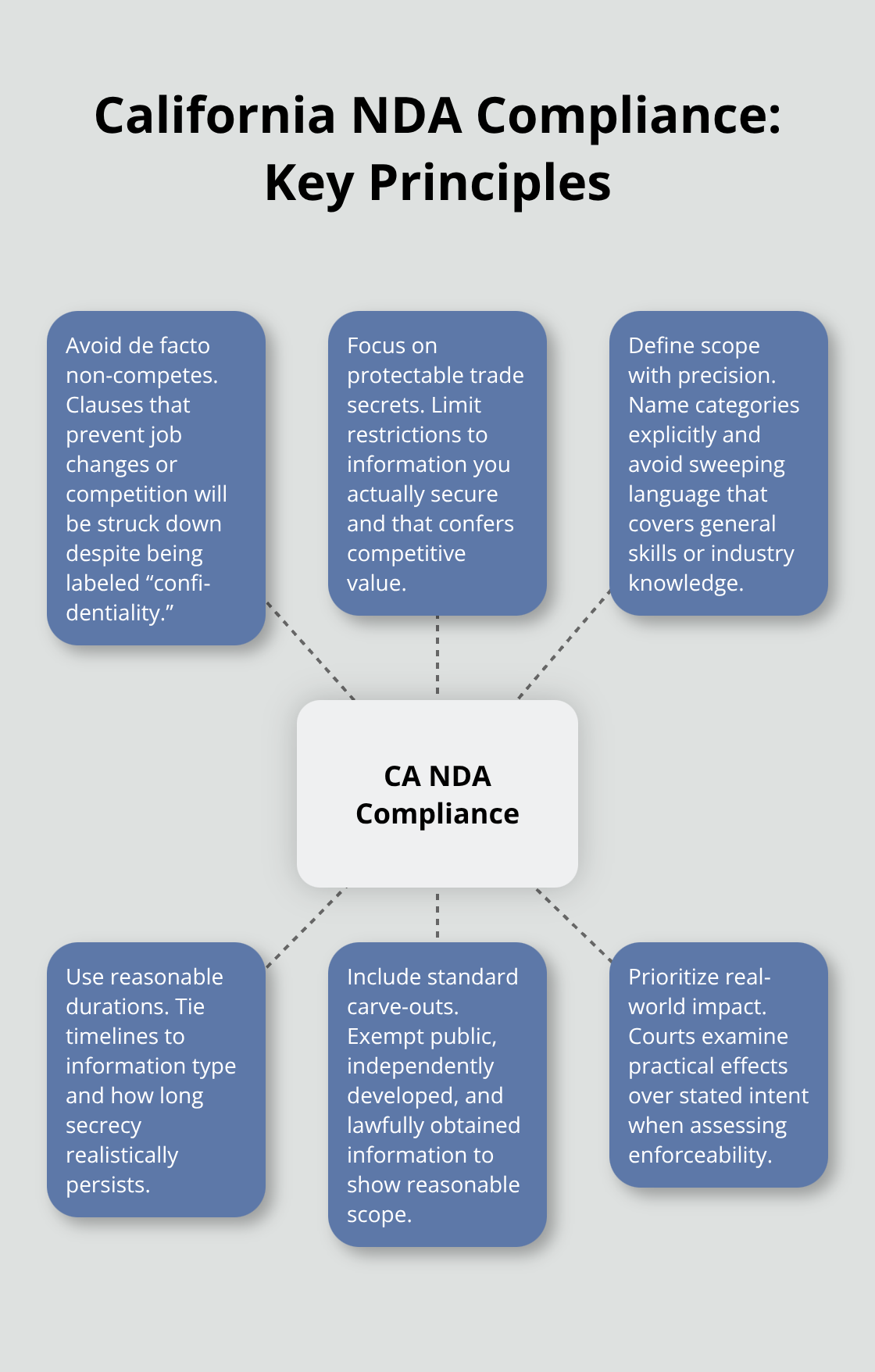
Your NDA must protect specific trade secrets and confidential business information, not restrict where employees work afterward. Courts assess whether a clause actually prevents someone from competing in their field, not just what the language says. If your confidentiality agreement sweeps in general skills, industry knowledge, or customer relationships in ways that functionally bar employment mobility, California courts will strike it down.
Trade Secrets Provide the Strongest Legal Foundation
Trade secret protection operates under California’s Uniform Trade Secrets Act framework and provides the strongest legal foundation for your NDA. Courts protect information like customer lists, vendor relationships, pricing formulas, product roadmaps, and manufacturing processes-but only if you treat them as genuine trade secrets through reasonable security measures. Olson v. World Finance Group Insurance Agency upheld a broad confidentiality provision prohibiting use or disclosure of confidential or trade secret information, demonstrating that properly tailored scope works. Galderma Laboratories v. Tisckos similarly upheld a confidentiality clause preventing disclosure to a new employer when the restriction focused on legitimately protectable information.
The enforceability standard demands specificity: identify exactly what information qualifies as confidential rather than using vague categories. Duration matters too-shorter timeframes like one to five years work for general confidential data, while true trade secrets can receive longer protection tied to how long secrecy realistically persists. Include explicit carve-outs for information that becomes public, was independently developed, or was obtained from lawful sources outside your company. California courts will void provisions that lack these exceptions because they view overly broad restrictions as anticompetitive.
Structuring NDAs for Orange County Enforcement
When Orange County businesses structure NDAs around legitimate trade secret protection with clear definitions and reasonable scope, enforceability improves substantially. The next section examines the specific elements that transform an NDA from a generic template into a legally defensible agreement tailored to your business operations and California’s strict standards.
Building Specificity Into Your NDA Definition
Enforceability in California courts hinges on specificity. Vague language about protecting information gets struck down regularly, while precisely defined confidential information survives judicial scrutiny. You need to identify exactly what qualifies as confidential rather than sweeping in everything your business touches. Customer lists, vendor relationships, pricing structures, product roadmaps, manufacturing processes, and proprietary algorithms all count as legitimate confidential information when you name them explicitly in the agreement. The Brown v. TGS Management decision made clear that courts examine what information is actually restricted and how that restriction affects someone’s ability to work, which means your NDA must spell out the specific categories you’re protecting rather than using catch-all language like “all proprietary information” or “company secrets.”
Duration and Scope Must Match the Information Type
One-size-fits-all time periods undermine enforceability in California. Trade secrets like manufacturing processes or formulas deserve longer protection periods because they retain competitive value as long as secrecy persists, potentially lasting indefinitely if you maintain reasonable security measures. General confidential information like customer lists or pricing typically works better with shorter durations of one to five years, reflecting how quickly market conditions change and information loses competitive advantage. The 3D Systems decision in 2025 emphasized that confidentiality provisions extending far beyond trade secret protection run into enforceability problems. Your NDA should explicitly state different time periods for different categories of information rather than applying one duration across the board.
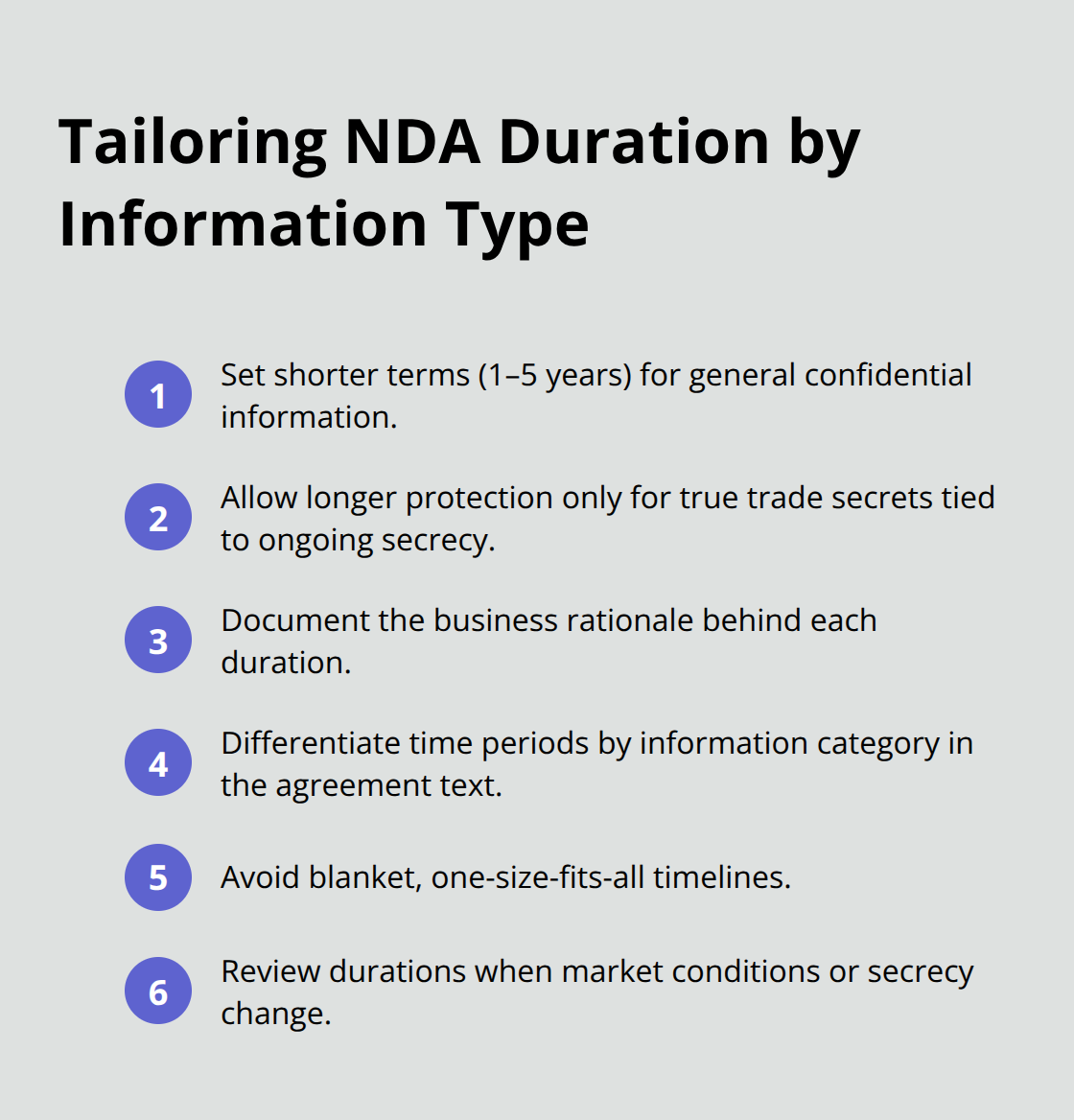
This approach demonstrates to a court that you’ve thought carefully about what genuinely needs protection and for how long, rather than simply attempting to restrict employee mobility indefinitely.
Carve-Outs Strengthen Rather Than Weaken Your Position
California courts require explicit exceptions in NDAs, and including them actually strengthens your agreement’s enforceability rather than weakening it. Information that becomes public through no fault of the receiving party, information independently developed without using confidential materials, and information obtained from third parties through lawful means all need clear carve-out language. Add language permitting necessary disclosures to comply with court orders, subpoenas, or legal requirements, plus disclosures to counsel for advice about confidentiality obligations. The Olson and Galderma decisions both upheld confidentiality provisions that included these standard exceptions because they demonstrated reasonable scope and legitimate business purpose. Without carve-outs, California courts view your NDA as overreaching and void the entire provision rather than narrowing it themselves. Including exceptions shows you’re protecting genuine trade secrets and confidential business information, not attempting to prevent competition or restrict where people work.
Why Courts Scrutinize Scope More Than Language
California courts focus on actual impact rather than what your NDA’s language claims to do. A claimant must explain what information is restricted and how that restriction affects their ability to compete in their field. This practical analysis means your NDA’s real-world effect matters more than its stated intent. Courts will invalidate provisions that function as de facto non-competes even if they’re technically labeled as confidentiality protections. The specificity you build into your definitions directly influences how courts assess this impact, making precise language your strongest defense against judicial invalidation. When you identify exactly what information qualifies as confidential and tie protection periods to legitimate business interests, courts recognize the agreement as reasonable rather than anticompetitive. This foundation sets the stage for addressing the common mistakes that undermine NDA enforceability across Orange County businesses.
Where Orange County Businesses Go Wrong With NDA Scope
California courts invalidate NDAs constantly because businesses draft them without understanding the state’s core enforcement principle: scope determines enforceability, not intent. The Brown v. TGS Management decision makes this explicit-a confidentiality clause that functionally prevents someone from working in their industry gets struck down regardless of whether it’s labeled as protecting trade secrets. Orange County businesses repeat this mistake by creating NDAs that sweep in everything their company touches, from general industry knowledge to customer relationships that aren’t actually confidential. The problem intensifies when you fail to distinguish between legitimate trade secrets deserving protection and ordinary business information that employees naturally learn during employment.
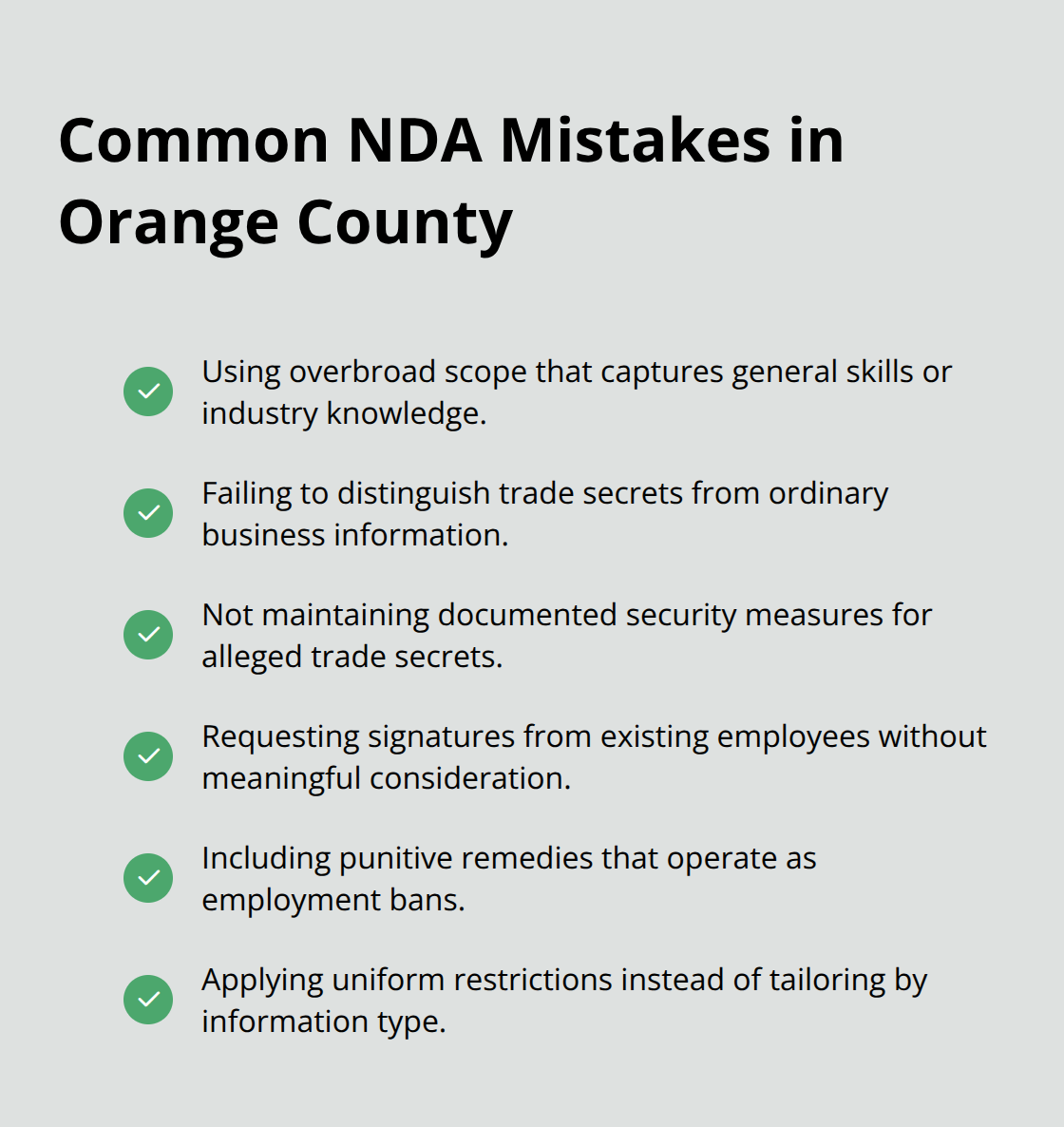
Courts view NDAs protecting general business information as anticompetitive restrictions on employee mobility, which violates California public policy under Section 16600. Your agreement must separate genuine trade secrets like manufacturing processes or proprietary algorithms from information like industry contacts or general sales techniques that any experienced professional would possess. The 3D Systems decision in 2025 invalidated a confidentiality provision extending protection beyond actual trade secrets, signaling courts will examine whether your NDA protects only legitimately protectable information or attempts broader control.
Identifying What Actually Qualifies as a Trade Secret
Start by listing exactly what information qualifies as a trade secret-not potential information, actual information your business treats as confidential through reasonable security measures. If you cannot document that your company maintains specific security protocols protecting certain information, courts will not treat it as a trade secret regardless of your NDA language. This distinction separates enforceable agreements from those that courts strike down as overreaching.
The Consideration Problem in Existing Employment
Inadequate consideration and one-sided terms create a second major vulnerability that California courts exploit. When an existing employee signs an NDA without receiving anything of value beyond continued employment, enforceability weakens substantially because California requires valid consideration for contract modifications. If your employee receives no promotion, raise, bonus, or other benefit beyond keeping their current job, courts question whether the NDA represents a genuine bargain or simply employer overreach.
Orange County businesses often draft NDAs that benefit only the company while imposing significant restrictions on employee post-employment activities, which courts view skeptically under California’s pro-employee interpretation rules. The solution requires either providing meaningful consideration when requesting NDA signatures or incorporating the confidentiality obligations into the initial employment agreement where at-will employment itself provides consideration.
Avoiding Punitive Remedies That Courts Strike Down
Include reasonable remedies for breach rather than punitive language attempting to ban employees from entire industries or impose excessive damages. Courts will strike down provisions that function as de facto employment bans because they conflict with California’s fundamental policy favoring employee mobility and competition. Your NDA should specify injunctive relief for trade secret misappropriation and actual damages for breach, but avoid language suggesting the employee can never work in related fields again.
Final Thoughts
California-compliant nondisclosure agreements require three foundational elements: precise definitions of what qualifies as confidential information, reasonable time periods tied to legitimate business interests, and explicit carve-outs for publicly available information and lawful independent development. Courts in California focus relentlessly on actual impact rather than stated intent, which means an agreement that functions as a de facto non-compete gets invalidated regardless of how you label it. The specificity you build into your definitions directly determines whether a court enforces your agreement or strikes it down as anticompetitive overreach.
For Orange County businesses, the practical path forward starts with auditing existing NDAs against the standards established in Brown v. TGS Management, 3D Systems v. Wynne, and Galderma v. Tisckos. Identify exactly what information your company treats as confidential through documented security measures, then separate genuine trade secrets from ordinary business knowledge. Apply different protection periods based on information type rather than imposing uniform durations across all confidential data, and include reasonable remedies for breach without language that functions as employment bans or industry-wide restrictions.
Nondisclosure agreements California courts will enforce share a common characteristic: they protect legitimate business interests without restricting where employees work or what general skills they can use. We at Raul Garcia Law Firm recommend having experienced counsel review your NDA templates before implementation to ensure your agreements withstand judicial scrutiny. Contact us to discuss your confidentiality governance strategy and let our team help you structure agreements that actually protect your trade secrets while complying with state law.